

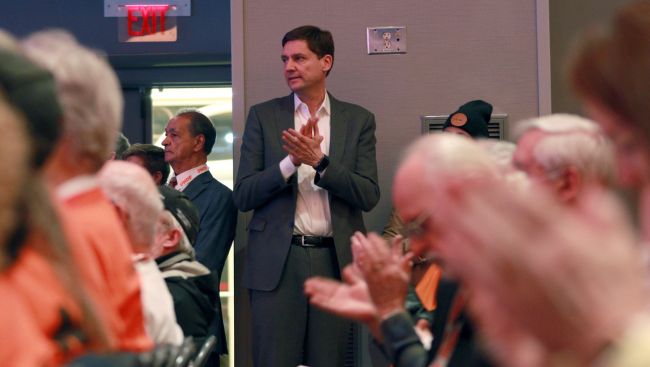
British Columbia Premier David Eby received approval from more than 93 per cent of delegates at the NDP's convention two years ago, and he's hoping for another "healthy majority" at this weekend's convention in Victoria.
But since 2023, the NDP eked out a majority with just one seat to spare in last year's provincial election, and Eby's government has been shedding support from First Nations and its union base.
"Obviously, I want a healthy majority — obviously, I want 100 per cent — but a healthy majority and support for the hard work going ahead," Eby said at an unrelated news conference on Thursday.
The New Democrats took 47 seats in the 2025 election, the BC Conservatives 44 and the Green Party won two seats.
Eby said the convention will give him a chance to meet face-to-face with members from every part of the province.
"It's a chance for me to engage with them about what their ideas are, what their suggestions are, what their critiques are. It's the NDP after all," he said.
The party's convention gets underway Friday amid questions about the state of the NDP's coalition and comes a day after the end of the longest public service strike in the province by members of the British Columbia General Employees Union who voted to accept a contract on Thursday.
That strike lasted eight weeks as the government pleaded poverty while BCGEU president Paul Finch publicly questioned the NDP's commitment toward labour. Contracts have expired for other provincial unions, included teachers and nurses, representing hundreds of thousands of workers in the province.
The BC Ferry and Marine Workers' Union continues to be critical of BC Ferries' decision to contract a shipyard owned by the China's Communist government to build four new large vessels.
Eric McNeely, provincial president, said his union remains "challenged" by BC Ferries' decision.
As for the broader relationship between the NDP government and organized labour, McNeely calls them "a bit troubled right now," adding that it should be more stable.
"If the provincial government doesn't recognize the value of more than half a million unionized workers in B.C., it can be a challenge," McNeely said. "I have heard that labour or unions won't win an election, but they can certainly help you lose an election, and I think that is a risk for government, both nationally and provincially."
UBC political science lecturer Stewart Prest said Eby will likely get a different response from the rank-and-file at this convention compared with two years ago.
"I expect the premier will likely get something of an earful from those who are concerned about the NDP's inability to really break free, to separate themselves from the Conservatives, even as the Conservatives seem to be in an endless process of self-immolation."
Eby will likely also hear some "serious and hard questions" about the direction of the party and province a year after the election, which "proved to a be near-death experience."
Prest said delegates will wonder how long the province can "continue down this path of significant budget deficits" without necessarily being able to show much for that investment.
He said Eby's government has made a "series of big bets" by investing in housing, health and education infrastructure, but the province is now facing "significant financial headwinds," which have reduced its ability to respond to changing economic conditions.
Prest said Eby needs to avoid a leadership result similar to the one that saw John Rustad's leadership of the B.C. Conservatives endorsed by 71 per cent of the 1,268 members who voted.
"Anything in the range of 70 per cent or less will really increase the scrutiny of his leadership," Prest said. "I think (Eby) needs to be well above the, let's say, 75 per cent threshold. As long as he clears that, he can make the case that the broad majority of the party is behind him."
Prest said he expects Eby "will be at pains" to smooth over relations with organized labour, but environmentalists and some First Nations within the NDP coalition could be at risk of being sidelined as the party looks to boost the economy through natural resource projects.
The provincial government passed Bill 14 and Bill 15 this spring to help fast-track natural resource projects.
Robert Phillips of the First Nations Summit said the passage of those bills created a "high sense of frustration" among many First Nations leaders, because they were not consulted.
"But there are, on the other hand, others that have the opportunity for major projects," Phillips said.
He said First Nations need to be fully consulted on a government-to-government level as the province moves forward with its various resource projects.
"I do believe there is a significant opportunity if the relationship is based on communication and continued relationship building," Phillips said.
The convention is also happening against the backdrop of the Cowichan Tribes Aboriginal title case, and Phillips said First Nations are looking for "champions" who push back against the "fearmongering and misinformation" about potential effects on private property rights.
In August, a B.C. Supreme Court judge ruled the Cowichan Tribes have Aboriginal title over about 300 hectares of land on the Fraser River, that Crown and city titles on the land are defective and invalid, and the granting of private titles on by government unjustifiably infringed on the Cowichan title.
The ruling has provoked concerns about the effect on private land ownership, and the provincial government, which plans to appeal the decision, has been directly reaching out to residents and businesses potentially affected by the decision.
Eby has said he won't "sugar-coat" the "great amount of uncertainty" created by the ruling, but also promised government will protect private property owners.
Picture Courtesy: THE CANADIAN PRESS/Chad Hipolito


