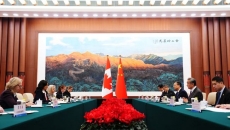
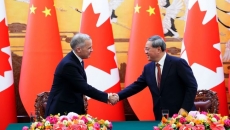
Prime Minister Mark Carney is visiting China this week — part of his government's efforts to repair the bilateral relationship after years of tensions over national security, trade and the detention of two Canadians.
Here is a look at key moments in Canada-China relations since 2016:
Aug. 29, 2016: Then-prime minister Justin Trudeau travels to China for his first official visit to the country, where he meets with President Xi Jinping. Both countries agree to have an annual leaders' discussion.
Dec. 3, 2017: Trudeau makes a second trip to China for a meeting with Xi. They agree to continue exploratory discussions on a comprehensive trade agreement, issue a joint statement on climate change and secure more access to the Chinese market for Canadian beef and pork.
Dec. 1, 2018: Meng Wanzhou, the chief financial officer of Chinese telecom giant Huawei, is arrested by RCMP after arriving in Vancouver on a flight from Hong Kong. The Canada Border Services Agency informs her upon arrival that it was notified of an arrest warrant for extradition to the United States on a charge of fraud over $5,000, related to accusations that Meng and the Huawei subsidiary Skycom violated U.S. sanctions against Iran.
Dec. 8, 2018: China summons Canada's ambassador to protest Meng's arrest. China's assistant foreign minister issues a statement calling on Canada to release Meng, warning of "grave consequences."
Dec. 10, 2018: Two Canadians — Michael Kovrig, on leave from Global Affairs Canada, and entrepreneur Michael Spavor — are arrested in China. Canadian officials view these arrests as unjustified retaliation for Meng's arrest.
Dec. 11, 2018: Meng is released on a $10 million bond and placed under house arrest in Vancouver.
Jan. 17, 2019: Chinese Ambassador to Canada Lu Shaye says Canada’s arrest of Meng was an act of “backstabbing” by a friend. Lu warns of “repercussions” if Canada bars Huawei from its new 5G network for security reasons.
March 4, 2019: China accuses Kovrig and Spavor, who remain in Chinese detention, of acting together to steal state secrets. They are formally charged with spying more than a year later. Both Kovrig and Spavor plead not guilty and deny the allegations.
March 5, 2019: Two major Canadian canola producers, Richardson and Viterra, report that China is refusing shipments. China says it found pests in the seed, but Canadian observers see the move as further retaliation for Meng's arrest.
May 23, 2019: China’s ambassador to Canada says the bilateral relationship is at “rock bottom” compared to any time since diplomatic ties were first established decades ago.
Oct. 13, 2020: Canada and China mark 50 years of diplomatic relations.
Feb. 22, 2021: The House of Commons formally recognizes China's persecution of the Muslim Uyghur minority as a genocide. The Liberal cabinet abstains from the vote.
Sept. 24, 2021: Meng reaches a deferred prosecution agreement with the American government and the U.S. drops its extradition request. She boards a plane to China that afternoon. Hours later, Trudeau announces Kovrig and Spavor have cleared Chinese airspace on their way home to Canada after spending more than 1,000 days in pretrial detention facilities.
May 18, 2022: China lifts a three-year ban on Canadian canola imports from two major producers.
May 20, 2022: Canada bans Huawei from working on Canada's 5G cellular networks, citing national security concerns.
Nov. 17, 2022: Xi confronts Trudeau during the G20 summit and berates him after details of a meeting between the two — during which Trudeau spoke with Xi about foreign interference — are leaked to the press.
Nov. 27, 2022: Canada releases its first Indo-Pacific strategy, which says "China is an increasingly disruptive global power" which has "interests and values that increasingly depart from ours." It calls for tighter ties with other nations that better respect international rules.
Sept. 7, 2023: Following months of news stories alleging multiple countries, including China, attempted to interfere in Canadian elections, Canada launches a public inquiry into foreign interference in the electoral process and democratic institutions. The commission's work begins with a focus on interference from China, Russia and other state actors in the 2019 and 2021 elections.
Jan. 11, 2024: Then-foreign affairs minister Mélanie Joly has a lengthy call with her Chinese counterpart Wang Yi, the first ministerial call since April 2022. China lays out its demands for better relations, including “correct cognition” on Canada's role in causing the diplomatic strain, “mutual respect” — which would include Canada not recognizing an independent Taiwan — and a focus on “win-win co-operation” instead of restricting trade and research collaboration.
Aug. 26, 2024: Trudeau announces a 100 per cent tariff on Chinese electric vehicles, saying China unfairly subsidizes its EV industry and overproduces vehicles to flood the market. The U.S. imposed a similar tariff earlier that year. The prime minister also announces a 25 per cent tariff on Chinese steel and aluminum products.
Sept. 3, 2024: China launches an anti-dumping investigation of Canadian canola imports in response to Trudeau's EV tariffs.
Jan. 28, 2025: The final report from the public inquiry into foreign interference is released. The report says there is no indication foreign inference altered overall election results, but identified a small number of ridings where interference may have had some effect.
The inquiry heard from members of diaspora communities who said foreign governments, including China, make life difficult for their families if they question the regimes.
March 19, 2025: China’s embassy in Ottawa confirms Beijing executed Canadian citizens earlier in the year. Joly later confirms China executed four Canadian dual citizens facing charges related to drug crimes.
March 20, 2025: China's 100 per cent tariff on Canadian canola oil, canola meal and peas takes effect. China also hits Canadian pork and seafood products with a 25 per cent tariff, mirroring Canadian EV, steel and aluminum levies.
April 17, 2025: Carney describes China as "the biggest security threat" facing Canada during the federal leaders' debate, due to foreign interference and Chinese activity in the Arctic.
Aug. 14, 2025: China imposes a nearly 76 per cent tariff on Canadian canola seed, nearly a year after launching its anti-dumping investigation.
Sept. 22, 2025: Carney tells the Council on Foreign Relations that Ottawa should be "clearer about where we engage" with China and collaborate "deeply" with Beijing on energy, climate change and basic manufacturing while maintaining "guardrails" around national security matters.
Oct. 31: Carney and Xi meet on the sidelines of the Asia Pacific Economic Cooperation summit in South Korea. It's the first official meeting between the two heads of government since 2017. Carney calls the meeting a "turning point" in Canada-China relations and talks about the importance of forging new partnerships as the U.S. upends global trade.
Jan. 14, 2026: Carney arrives in China for the first official visit by a Canadian prime minister in more than eight years.
Jan. 16, 2026: Carney and Xi meet in Beijing. The prime minister says the two countries are focusing on areas where they can make historic gains, including agriculture, energy and finance.
Jan. 16, 2026: The Liberal government reaches a deal with Beijing to slash tariffs on a set number of Chinese electric vehicles in exchange for China dropping duties on agriculture products. Carney says Ottawa expects Beijing to drop canola seed duties to 15 per cent from 84 per cent by March 1. In return, up to 49,000 Chinese electric vehicles will be allowed into the Canadian market each year at a 6.1 per cent tariff instead of the current 100 per cent tariff.
Picture Courtesy: THE CANADIAN PRESS/Adrian Wyld