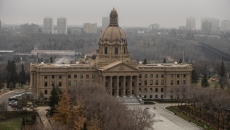
François Legault announced on Wednesday he will step down as Quebec premier when the Coalition Avenir Québec — the party he co-founded in 2011 — chooses his replacement. The departure of Legault, who had also co-founded Air Transat and was its CEO between 1986 and 1997, brings to an end a political career spanning 28 years with two political parties.
Here's a timeline of key moments:
Sept. 23, 1998 — Then-premier Lucien Bouchard names Legault minister of industry, trade, science and technology in the Parti Québécois government before the new recruit is even elected to a riding.
Nov. 30, 1998 — Legault officially makes leap to provincial politics, winning the riding of Rousseau for the PQ in the general election. Legault is named education minister following the win.
Jan. 30, 2002 — Legault is named health and social services minister after Bernard Landry takes over from Bouchard as PQ leader and premier.
April 14, 2003 — The PQ loses general election to Quebec Liberals under Jean Charest. Legault, who is re-elected in his riding, becomes official Opposition spokesperson for the finance and economy files.
June 8, 2005 — Legault, who had considered running to replace Landry as PQ leader, confirms he won't seek the party leadership citing family considerations.
March, 26, 2007 — Legault is re-elected in general election with the PQ, which falls to third place. Liberals win minority government with the Action démocratique du Québec as official Opposition.
Dec. 8, 2008 — Legault is re-elected in general election with the PQ, which returns to official Opposition status. Liberals win majority with Charest.
June 25, 2009 — Legault resigns as member of the national assembly, saying he found working in opposition to be frustrating.
February 2011 — Legault, along with entrepreneur Charles Sirois, announces creation of Coalition pour l'Avenir du Québec — at the time, a non-profit.
Nov. 14, 2011 — The Coalition Avenir Québec is launched as a political party, with Legault describing the new formation as a nationalist party offering a third way from the federalist-sovereigntist dynamic that has dominated Quebec politics for decades. With Legault as leader but without a seat, the party recruits former PQ members and merges with the Action démocratique du Québec.
Sept. 4, 2012 — The party wins 19 seats in its first general election, good for third-party status. Legault returns to the legislature, winning the riding of L'Assomption, northeast of Montreal. PQ is returned to power with a minority government.
April 7, 2014 — The CAQ wins 22 seats but remains in third place after general election. Liberals win majority government under Philippe Couillard.
Oct. 1, 2018 — The CAQ wins 74 out of 125 seats with Legault becoming the premier of Quebec. Much of his first term is spent dealing with COVID-19 pandemic.
Oct. 3, 2022 — Legault and CAQ romp to a second majority government, winning 90 seats. The second mandate is marked by major challenges including the failure of the Northvolt battery plant south of Montreal and the $500-million cost-overrun scandal at the province's automobile insurance board.
Jan. 14, 2026 — Legault announces in Quebec City he will not lead his party into the October 2026 provincial election, saying Quebecers want a change.
Picture Courtesy: THE CANADIAN PRESS/Jacques Boissinot