There will be a dramatic resurgence of COVID-19 cases in Canada unless people limit contact with others in coming days, the country's chief public health officer warns.
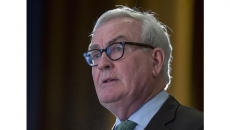
"We don't want it to go up a giant ski hill," Dr. Theresa Tam said Tuesday as she described the potential for a sharp upward curve.
The Public Health Agency of Canada released its latest modelling Tuesday, predicting up to 155,795 cases and up to 9,300 deaths by early October if the current trajectory of the epidemic continues.
The message throughout the presentation was clear: everyone needs to act now to limit their contacts or things will get worse.
"Canada is at a crossroads and individual action to reduce contact rates will decide our path," said a presentation deck released Tuesday.
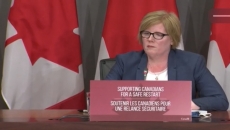
Federal Health Minister Patty Hajdu echoed that advice as she urged people to think carefully before accepting invitations to social gatherings.
"All of us have the future in our hands," she said Tuesday during a media briefing in Ottawa.
She also said, however, that the spread of the novel coronavirus is not the same across the country, or even across single provinces, so determining whether restrictions need tightening demands a "surgical approach."
Meanwhile, Canada has now committed more than $1 billion to buy doses of COVID-19 vaccines after securing a fifth deal with Sanofi and GlaxoSmithKline Tuesday.
Procurement Minister Anita Anand said Tuesday that Canada has a deal in place to buy up to 72 million doses of their experimental vaccine candidate, which is just starting the second of three trial phases this month.
In all, Canada has committed $1 billion to buy at least 154 million doses of vaccines from five different companies, and most of that money will not be refunded even if the vaccines never get approved.
"We need to make a substantial investment in order to ensure that Canada is well positioned to secure access to the successful vaccine or vaccines," she said in an interview with The Canadian Press.
"The way in which we are doing that is to bet on multiple horses at the same time in order to ensure that as one or more of those horses crosses the finish line, we have access to those vaccines."
Canada has signed deals with Moderna, Pfizer, Novavax, Johnson & Johnson and now Sanofi and GlaxoSmithKline, all of which are among some of the most promising vaccines, but none of which have completed all the required clinical trials, or been approved for use in Canada.
On Sept. 3, Sanofi and GlaxoSmithKline said their vaccine candidate was going to begin Phase 1/2 trials which will test it on 440 individuals. The hope is the vaccine will be ready for the third and final phase of trials by the end of the year, and approved for use in the first half of 2021.
Moderna has a vaccine in Phase 3 trials, and Pfizer's is in a combined Phase 2 and 3 trial. Novavax is in a Phase 2 trial, while Johnson & Johnson is in a Phase 1/2 trial.
Most clinical trials have three phases to ensure the safety and effectiveness of the vaccine or drug being developed.
Each level of trials adds more volunteers on whom the drug is tested, looking for adverse health effects and whether the vaccine does cause a person to develop antibodies that can protect against COVID-19.
Anand said Canada has also signed an agreement with Gilead Sciences and McKesson Canada to get 150,000 vials of remdesivir, the only antiviral drug that has proven effective at treating patients with COVID-19. Health Canada approved the drug for use on COVID-19 patients at the end of July.
The doses will begin arriving at Canadian hospitals this month.
Canada has also joined the international vaccine co-operative known as the COVAX Facility, which is bringing together wealthy countries with low- and middle-income countries to collectively invest in doses of vaccines.
It has not yet announced how much money it will contribute, a figure that was to have come last week but has been delayed. Anand says Canada remains committed to COVAX and more details will be coming soon.
Canada has chosen to participate in both parts of the COVAX program. The first is for any country to join to get access to vaccines, and the second is a fund for wealthy countries to help low-income countries participate.
The Canadian Coalition for Global Health Research and the Canadian Society for International Health have both criticized Canada for acting to buy doses of vaccine for itself, hindering efforts to ensure vaccines that are successful are distributed fairly around the world.
GAVI, the Vaccine Alliance, said Monday that 64 wealthy countries had joined the COVAX Facility, including Canada. The United States has not joined.