

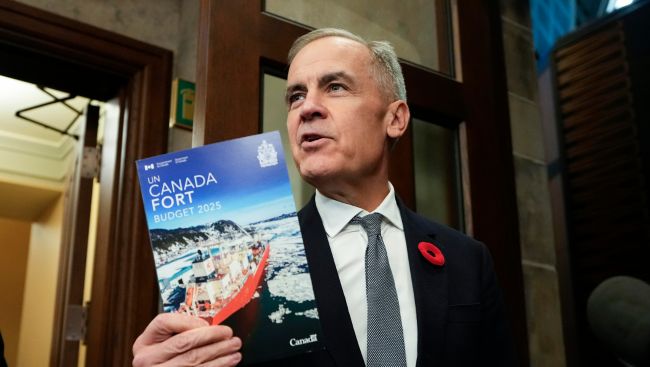
New polling suggests Canadians had a lukewarm response to the federal budget released last week — leading one pollster to argue all parties should think twice before mounting an election campaign over the spending plan.
The Leger survey indicates some 30 per cent of Canadians who responded approve of the budget tabled by Prime Minister Mark Carney's government on Nov. 4. Another 37 per cent had a negative response, while the rest offered no opinion.
Only 15 per cent of households surveyed told Leger the proposed budget will have a positive impact on their personal lives, while 32 per cent predicted a negative effect.
The poll surveyed 1,565 adult Canadians between Nov. 7 and Nov. 9, and can't be assigned a margin of error because it was conducted online.
Andrew Enns, Leger's executive vice-president for central Canada, said that while the Liberals managed to win broad support on some big-ticket items, such as new spending on defence and infrastructure, Carney's first budget missed the mark when it came to Canadians' own pocketbooks.
"Where the budget falls short — and I think this is probably the challenge for the government in the months ahead — is on the affordability equation, which was still a very, very important theme amongst voters," Enns said.
The budget forecasts a deficit of $78.3 billion for this fiscal year, alongside billions of dollars in net new spending aimed at pivoting Canada's economy away from its reliance on the United States.
The budget document says 42 per cent of its spending items are geared toward bolstering Canada's sovereignty in the face of U.S. tariffs and a shifting global trade landscape, while 36 per cent are aimed at affordability.
But Leger's polling suggests measures in the budget to relieve Canadians' immediate economic stress were not top of mind for most households.
Some 55 per cent of survey respondents indicated they wanted to see a personal tax cut in the budget — despite the inclusion of a one-percentage-point reduction in rates paid at the lowest income tax bracket that was introduced in July.
Enns said he believes the tax cut got lost among the other big numbers in the budget, underscoring the communication challenge facing the Liberals.
Despite the large number of respondents saying the budget fell short on the cost of living, roughly 42 per cent said they agreed with the idea of prioritizing long-term growth over short-term affordability, while half that share said they disagreed.
The budget itself is set to go up for a vote in the House of Commons next week, posing a major test of confidence for the minority Liberals.
While the defection last week of Nova Scotia MP Chris d'Entremont from the Conservatives to the Liberals helped the government secure one more vote for the budget, the government will still need support from another party.
If the budget fails to win parliamentary approval, that could trigger an election.
While support for the budget itself was strongest among likely Liberal voters, Enns noted that various budget items secured cross-party support in the survey.
Conservative-leaning voters were most likely to be in favour of measures to tamp down on immigration levels, for example, while NDP supporters overwhelmingly approved of local infrastructure funding for roads and health facilities.
For that reason, other parties should be cautious about rallying the electorate against this budget for a potential election campaign, Enns said.
The same goes for the Liberals, he said, since the affordability gap remains top of mind for voters, while U.S. tariffs may not hold as much sway with them as they did during the spring.
"I think all parties, if they're looking at this rationally, would be a little cautious about how aggressive they want to fight this — or fight on this — in an election campaign."
The polling industry's professional body, the Canadian Research Insights Council, says online surveys cannot be assigned a margin of error because they do not randomly sample the population.
Picture Courtesy: THE CANADIAN PRESS/Justin Tang


