

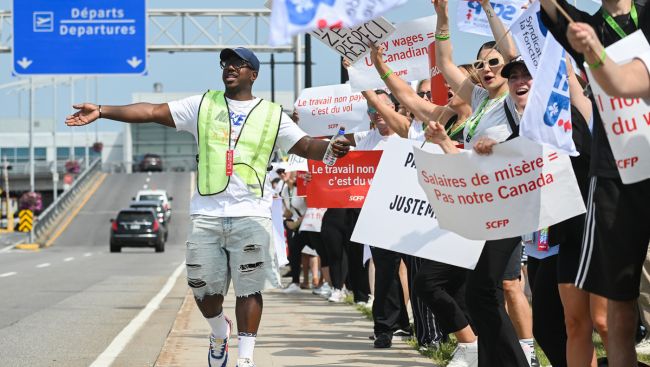
A rare show of defiance by Air Canada flight attendants in the face of a back-to-work order from the government has proven the ineffectiveness of the section of Canada's labour code that allows a minister to order the end to a strike or lockout, the president of the Canadian Labour Congress said.
On Aug. 16, just hours after flight attendants hit the picket line after failing to reach a new contract deal with the airline, Jobs Minister Patty Hajdu invoked section 107 of the Canada Labour Code to order binding arbitration and get the flight attendants back on the job. The section grants the minister the power to act to "maintain or secure industrial peace."
Flight attendants ignored the order and remained on strike until a deal was finally reached early Tuesday, a move Canadian Labour Congress President Bea Bruske lauded as effective.
"It sets a precedent (that) you can defy, and you will find a solution at the bargaining table," Bruske said Tuesday in an interview with The Canadian Press. "It sets a precedent for the reality that (section) 107 is no longer effective, it is effectively dead."
"The best way to deal with it is to remove it entirely because unions, workers, the labour movement has been emboldened by this and we're not going to turn around."
Section 107 has been in the Canada Labour Code for more than 40 years but using it has become more common particularly in the last year.
The Canadian Labour Congress says the Liberals have resorted to section 107 eight times since June 2024, including to prevent a strike by WestJet mechanics, and to end strikes or lockouts at the country's two main railways, ports in Montreal and Vancouver and temporarily a strike and lockout at Canada Post.
Before then, section 107 was only used a handful of times, says the Canadian Labour Congress, including four times between 1995 and 2002. In 2011, the CLC says then-labour minister Lisa Raitt used section 107 after flight attendants rejected two tentative agreements, though the parties ultimately voluntarily agreed to send their dispute to binding arbitration. The CLC says it was used one other time between 2011 and 2024.
Initially the government didn't seem willing to turn to it quickly to end the Air Canada work stoppage. On Aug. 17, a few hours before the deadline set by the union representing flight attendants to reach a new contract deal, Hajdu urged the airline and the union to go back to the negotiating table, and suggested she wasn't ready to intervene in the dispute.
Hajdu told The Canadian Press that day that it was "critical" the two sides return to the table to forge a deal on their own.
The strike officially began just before 1 a.m. ET on Saturday and in turn, Air Canada locked out its agents about 30 minutes later due to the strike action. Hajdu announced just after 12 p.m. on Saturday that she was invoking the labour code section and directing the Canada Industrial Relations Board to order Air Canada and the Canadian Union of Public Employees to resume operations and resolve the dispute through binding arbitration.
The minister said she made the call after meeting with both sides Friday night, finding that talks had broken down and the parties remained too far apart to resolve the conflict quickly enough.
But CUPE defied the order, flight attendants stayed on the picket line and the union launched a legal challenge of the government's move.
On Monday, the Canada Industrial Relations Board board declared the strike unlawful and ordered the union's leadership to tell its striking workers to go back to work. The federal government also announced that it was launching a probe into allegations of unpaid work in the airline sector.
The union and Air Canada met late Monday night and very early Tuesday morning announced a tentative agreement had been reached, ending the work stoppage.
Bruske acknowledged that Air Canada workers' defiance of back-to-work orders could set a precedent for future strikes. She said that, while the government was under "a lot of pressure" from business groups and customers to avoid a disruption, their interference "caused more of a problem than it solved."
"It really gave the employer a way to avoid having to get serious at the bargaining table," Bruske said.
When the union decided to defy the return-to-work order, Bruske said it sent a "strong message" that the only way to resolve the issue is at the bargaining table, "which is where it needed to be found all along."
Bruske noted that the government used the labour code to force the Canadian Union of Postal Workers to vote on an offer from Canada Post, an offer the workers rejected. Canada Post and the union are returning to the bargaining table Wednesday.
"The labour movement is going to be with them no matter what they choose to do," Bruske said.
She said CLC and its affiliate unions, including the Canadian Union of Postal Workers, met on Sunday and labour leaders were unanimous that they supported CUPE in defying back-to-work orders and that they will "do whatever" to support them.
CUPE national president Mark Hancock said that, given the availability of Section 107, it seemed like the company felt that they didn't need to negotiate and were instead preparing to go to binding arbitration. Once it was "pushed to the side," Hancock said the company "got serious" at the bargaining table and a tentative deal was reached.
"Hopefully this has sent a message to government and to everybody that the way to get a deal and a collective agreement is at the bargaining table," Hancock said. "Section 107 is just an impediment that makes it much more difficult to get an agreement on the table."
While he doesn't agree with forcing workers back in a dispute, Hancock said other options, like back-to-work legislation debated in Parliament, are more democratic.
"We're gonna continue talking about 107 and I'm hoping the government never, ever, ever uses it again because it's not a helpful tool," he said.
Hancock encouraged future unions that have to face Section 107 to "respond appropriately." He also said it's still unclear if there will be any consequences for the union or its members as a result of the strike but that CUPE will protect and defend workers and their jobs.
"Hopefully Air Canada has learned a lesson that we're not going to back down when it comes to bargaining and that we'll be there to support our members every step of the way," Hancock said. "I'm sure Air Canada wants to put this behind them and move forward and if they start disciplining or attempting to discipline people, that's not gonna be helpful for them or anybody."
Daniel Safayeni, president and CEO of FETCO, an employers’ association comprised of federally regulated firms within the transportation and communications sectors, said CIRB and the Supreme Court have affirmed the constitutionality of Section 107, recognizing that the right to strike can be limited in exceptional circumstances when justified by threats to national economic stability.
"There is a time and place for the usage of this," Safayeni said, adding that something like a special mediation process could be used before the invocation of Section 107. "At the end of the day, the government is going to need a tool to keep particularly critical industries, critical supply chains moving, if a deal can't be reached."
He said unions are entitled to challenge decisions in court but can't just ignore orders because that "sets a dangerous precedent."
"That is normalizing behaviour that frankly, I think when we look south of the border, we see it and we are shocked and disappointed to see it, and I don't think we want to replicate those same norms here," Safayeni said.
Picture Courtesy: THE CANADIAN PRESS/Adrian Wyld


