

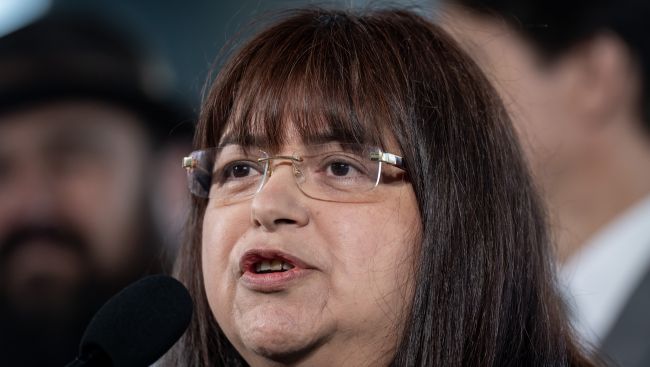
The head of a group representing First Nations along British Columbia's coast says they will not support a new pipeline proposed by Alberta and nothing can be done to change that.
Marilyn Slett, chief councillor of the Heiltsuk Tribal Council and president of the Coastal First Nations-Great Bear Initiative, said Wednesday that First Nations fought for decades to get the federal moratorium that keeps oil tankers out of their waters.
"As the rights and titleholders of B.C. North and Central Coast and Haida Gwaii, we must inform Premier (Danielle) Smith once again that there is no support from coastal First Nations for a pipeline and an oil tankers project in our coastal waters," Slett said moments after Alberta's premier announced her government will be pitching a pipeline to Ottawa.
Smith acknowledged that laws, including the tanker ban, would have to be repealed or have a carve-out created, but said a new pipeline would unlock Canada's "economic potential" with Indigenous partners.
First Nations in B.C., environmental groups and that province's premier lined up in opposition to the plan.
Grand Chief Stewart Phillip, president of the Union of British Columbia Indian Chiefs, said in a statement that any proposal to "ram" a new oil pipeline through "is a direct assault on the inherent and constitutionally protected title and rights of the First Nations who steward these lands and waters."
"This is a blatant attempt to tear up the legislated federal North Coast tanker ban that defends one of the world's most pristine and rich coastal ecosystems from disaster. To even entertain this idea shows a profound disrespect for both First Nations law and the will of the people who live there, as well as a total disregard for the climate emergency," he said.
The GitxaaIa Nation, a member of the Great Bear Initiative, said in its own statement that it remains opposed to any crude oil project on the Northern coast.
"Attempts to use empty promises from engagement or consultation to clear the way for any pipeline is an old and tired ploy, one that Gitxaała is more than familiar with,” said Linda Innes, elected chief councillor of Gitxaała Nation.
“As a nation, Gitxaała has been steadfast and clear that the risk of a pipeline or tanker on our lands, waters, community, and way of life is too great and that no amount of pressure from any government or private company can undermine Gitxaała’s duty to protect our territory for our future generations.”
Smith told a news conference Wednesday that the proposal is expected to be filed in the spring of next year to the new federal Major Projects Office, which aims to speed up projects deemed in the national interest.
Alberta plans to develop the project with the backing of an advisory group that includes three major Canadian crude pipeline operators: Enbridge Inc., Trans Mountain Corp. and South Bow Corp.
Smith said she's confident that if Ottawa fixes the "investment climate" by changing laws, including the tanker ban, proponents will step up and the pipeline will be built with private sector money.
B.C. Premier David Eby, who has criticized Smith for talking about pipelines without a private company interested in building one, said Wednesday that his government supports the tanker ban because it is "foundational to our ability to get some major projects done."
"To put that tanker ban at threat, is not just a threat to our pristine coast that so many British Columbians, including myself, value, but it is a direct economic threat to the kind of economy that we're trying to build in the country here," he said.
"There is no project. There is no bridge to cross unless the Albertan government and the federal Canadian government are committing billions of taxpayer dollars to build this project, and if that is the plan, then they should be transparent about it.
"Don't mistake my politeness for weakness on protecting our economy and our coast."
Alberta Minister of Indigenous Relations Rajan Sawhney told the news conference she has spoken with Indigenous leaders in B.C. and Alberta about the project and the "responses were different from what you may have expected about 10 years ago."
"There was more support than I had anticipated," she said.
Slett said she spoke with Sawhney to reiterate their opposition to a pipeline.
"I told her … that there is no support from my community, from coastal First Nation communities, that our position has not changed and that this is a project that we cannot support and will not support," Slett said.
The Coastal First Nations-Great Bear Initiative includes nine First Nations on the North Pacific Coast.
Slett said any potential proponent of the pipeline, including the Alberta government, should be "on notice" that the First Nations are not prepared to accept crude oil through their waters.
"This is a non-starter for us. We've said that before, and our stance has not changed and will not change for any other reason," she said.
"We will use every tool in our tool box, at our disposal, to make sure that our coast remains tanker free."
B.C. Green Party energy critic Jeremy Valeriote said British Columbians "made their voices very clear" when the Northern Gateway pipeline was cancelled in 2016.
"The Alberta government said themselves, no private entity is willing to front it, because it's not environmentally responsible, it's not fiscally responsible," he said.
"We've got an oil tanker moratorium and there's no reason to change that given the sensitivity of the B.C. coast."
Jessica Clogg, senior counsel with West Coast Environmental Law, which was involved in the fight to stop the Northern Gateway pipeline, said both federal law and laws passed by coastal First Nations ban crude oil tankers.
More than 100 First Nations are signatories on the Save the Fraser Declaration that bans tankers from the Pacific North Coast, throughout the Fraser River watershed and ocean migration routes of salmon, she said.
"I think any federal government would lift the existing oil tanker moratorium at their political peril. We have not seen oil tankers, super tankers, on the coast. The fear and the concern about an Exxon Valdez-style oil spill is still very live, and it would, quite frankly, be both a political and an economic mistake," she said.
The Exxon Valdez ran around in Prince William Sound, Alaska in 1989 and spilled more than 41 million litres of crude, creating one of the largest environmental disasters in U.S. history.
Picture Courtesy: THE CANADIAN PRESS/Ethan Cairns


