
Tuesday, June 23, 2026
ADVT 
National

Alberta Premier Smith's government formalizes Oct. 19 separation question

Darpan News Desk The Canadian Press, 29 May, 2026 10:53 AM
  • Alberta Premier Smith's government formalizes Oct. 19 separation question

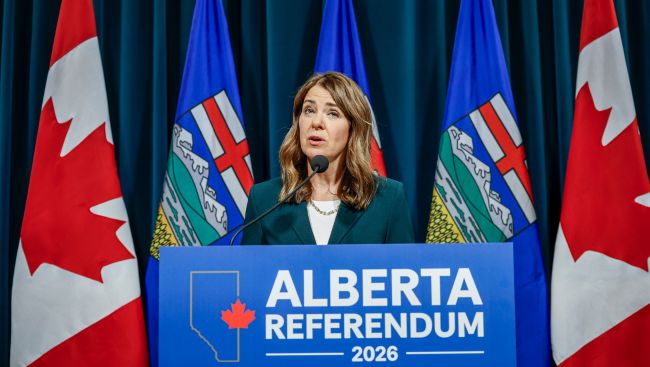
Alberta's upcoming referendum question on separation was made official Thursday, and it mirrors what Premier Danielle Smith announced last week.

Smith and her cabinet issued an order in council confirming the date and format of the Oct. 19 referendum, along with the question.

It will ask voters to pick one of two options.

Option one reads: "Alberta should remain a province of Canada."

Option two reads: "The Government of Alberta should commence the legal process required under the Canadian Constitution to hold a binding provincial referendum on whether or not Alberta should separate from Canada."

The cabinet order also confirms, as Smith has stated, that the fall vote will not be binding.

Mail-in ballots will be allowed.

Smith has said she considers the threshold for a majority to be 50 per cent plus one and that she will respect the result.

It is one of 10 questions that will be put to Albertans that day. The other nine, announced in February, deal with questions on immigration policy and constitutional concerns.

Elections officials confirmed Thursday that the referendum question will be the first in a stack of unique colour-coded ballots for each of the 10 questions.

A spokesperson for the agency said voters will be free to mark an X or leave any given question blank.

"As with any election, an elector may refuse any or all ballots at the voting station," said Michelle Gurney in a statement.

Gurney said that up to 38 million printed ballots will be required for the vote.

"This will require 60,000 to 90,000 election officers to administer and count the referendum," she said.

If the staffing level needed is at the higher end of the range, it would be enough to almost fill Edmonton's Commonwealth Stadium twice over.

The last provincial general election in 2023 cost taxpayers $37 million, but only required about 13,000 election officials.

The ballots this fall must be hand counted within 48 hours, provincial law indicates, and the question on whether to hold a binding separation referendum will be counted first.

Smith's decision to call the question has drawn ire from some of her provincial counterparts, as well as some petitioners on both sides of the debate who characterized her handling of the issue as a betrayal.

She has said she shares past frustrations about the federal government, but aims to test the waters of public opinion. Smith has said she and her United Conservative Party want to remain in Canada, and that she will vote accordingly.

Prime Minister Mark Carney said earlier this week the "question about a question" does not invoke the federal Clarity Act, which allows Parliament to weigh in on separation questions, because Alberta's fall vote is explicitly non-binding.

Picture Courtesy: THE CANADIAN PRESS/Jeff McIntosh

MORE National ARTICLES

Weak loonie signals economy is 'in trouble': currency expert

Weak loonie signals economy is 'in trouble': currency expert
The Bank of Canada's end-of-day exchange rate Monday had the loonie trading at 68.48 cents US, but the Canadian dollar neared 70 cents in the minutes after Prime Minister Justin Trudeau said the planned tariffs would be paused for at least 30 days. The overall trend for the Canadian dollar however has been weak, which has implications for the economy. 

Weak loonie signals economy is 'in trouble': currency expert

Interprovincial trade barriers: what they are, why they exist and how to cut them

Interprovincial trade barriers: what they are, why they exist and how to cut them
The Trump administration's on-again, off-again threat to impose damaging tariffs has boosted an old idea for driving economic growth in Canada: eliminating interprovincial trade barriers. Here's a look at how interprovincial trade barriers work and why years of efforts to tear them down them have largely failed.

Interprovincial trade barriers: what they are, why they exist and how to cut them

Trudeau says U.S. tariffs on Canada will be paused for 30 days

Trudeau says U.S. tariffs on Canada will be paused for 30 days
Prime Minister Justin Trudeau says "proposed tariffs" between Canada and the United States will be paused for at least 30 days while the countries work together on the border.

Trudeau says U.S. tariffs on Canada will be paused for 30 days

Canada's forestry sector faces uncertainty with 25 per cent U.S. tariffs

Canada's forestry sector faces uncertainty with 25 per cent U.S. tariffs
A wide shadow of uncertainty has been cast over Canada's forestry sector by U.S. President Donald Trump's decision to impose a 25-per-cent tariff on its lumber products. Several industry groups have released statements criticizing the tariff as unnecessary and harmful for both sides, a sentiment echoed by British Columbia Premier David Eby who vows full support for the provincial sector.

Canada's forestry sector faces uncertainty with 25 per cent U.S. tariffs

Trump mistaken, U.S. banks can and do operate in Canada says finance professor

Trump mistaken, U.S. banks can and do operate in Canada says finance professor
A finance professor at the University of Toronto says American banks do operate in Canada despite assertions by U.S. President Donald Trump that they are not allowed to do business in the country. The Office of the Superintendent of Financial Institutions lists Amex Bank of Canada, Citibank Canada and J.P. Morgan Bank Canada on Schedule II, all having U.S. parent companies. 

Trump mistaken, U.S. banks can and do operate in Canada says finance professor

B.C. critical minerals being diverted away from United States: David Eby

B.C. critical minerals being diverted away from United States: David Eby
Companies in British Columbia are in the process of redirecting critical minerals and energy products to markets outside the United States, Premier David Eby said, as the reality of U.S. President Donald Trump's tariffs sets in. Eby noted B.C. has opened new trade offices in Taiwan, Vietnam and the Philippines over the last 18 months.

B.C. critical minerals being diverted away from United States: David Eby