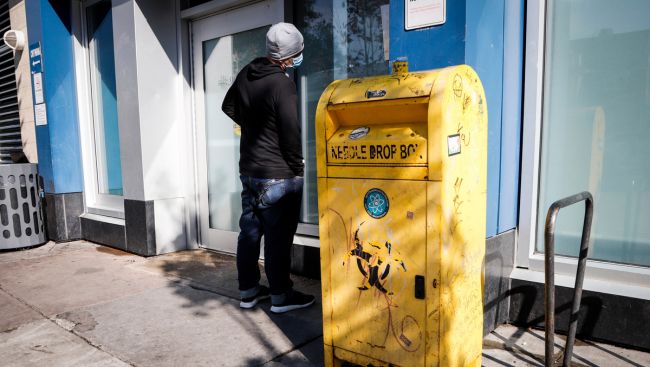
The Alberta government announced Friday it's shutting down the province's first-ever supervised drug consumption site.
Public Safety Minister Mike Ellis said the site, housed in the Sheldon M. Chumir Centre in Calgary — as well as a mobile overdose prevention service in Lethbridge — will be shuttered as the next step in Alberta's move to a recovery-oriented approach to addiction.
Ellis said funding for the two sites would be transitioned into different support services, including 30 to 40 new withdrawal management beds in Calgary and 10 more withdrawal beds and an addiction medicine clinic in Lethbridge.
"People will not be left without support," he told reporters.
Both are slated to close June 30.
The Calgary site opened in 2017 in response to the ongoing opioid and overdose crisis. Six more opened in the following years across the province.
Last year, the government closed a site at the Royal Alexandra Hospital near Edmonton's downtown core, as well as a site in Red Deer. The new closures mean three supervised consumption sites would remain in Alberta: two in Edmonton and a mobile site in Grande Prairie.
Ellis and Addictions Minister Rick Wilson said supervised consumption sites were always meant to be a temporary response to the opioid crisis.
"Drug consumption services were introduced during a very different time," Wilson said.
Alberta now wants to provide people with other paths, he added.
"People need more than survival. They need hope," said Wilson.
"That's not about walking away from some of our most vulnerable people. It's about doing better by them and using our health system more effectively."
Elaine Hyshka, a public health professor at the University of Alberta who has studied supervised consumption sites, said overdose deaths have decreased in the province but are still higher than when the opioid crisis was declared in Canada in 2016.
"I don't think the situation has changed enough to warrant closing (the sites) by any stretch," said Hyshka, who also serves as the Canada Research Chair in health systems innovation.
Hyshka predicts that when the sites close, drug use will shift from inside the private facilities to more open spaces, such as parkades, washrooms and on the streets.
Wilson said the government doesn't currently have plans to close the remaining sites, especially the two in Edmonton, as the capital accounts for about 60 per cent of opioid deaths each month in Alberta.
He rejected the notion that not closing the Edmonton sites suggests they have merit.
"We'll get to them, but we've got some more work to do first," he said.
The site in Calgary has long been a political football.
Former premier Jason Kenney tried to close it in 2022 but didn't follow through. In 2025, the province, under Premier Danielle Smith, got into a spat with former Calgary mayor Jyoti Gondek about its future.
Smith's government said it was up to city council to tell the province whether it wanted the site shut down. Gondek said it wasn't council's jurisdiction and later accused the province of dragging its heels in developing a plan to increase other services if the site was to close.
Late last year, the province announced it would be shuttering the site and replacing it with a treatment program.
Calgary Mayor Jeromy Farkas said Friday's announcement marks a "significant transition" in how addiction, recovery and community safety are addressed in the city.
"Based on the data and evidence available from Red Deer, I have cautious optimism that this transition, if implemented with the right supports, can increase access to treatment and recovery services while maintaining a strong, co-ordinated response to overdoses and community safety concerns," he said in a statement.
The mayor of Lethbridge wasn't immediately available for comment.
The Red Deer site's closure is the focus of an ongoing legal battle, as well as a recent study.
The study by the Canadian Centre of Recovery Excellence, a provincial Crown corporation, suggests the closure didn't lead to increased overdose deaths or emergency department visits.
In a news release announcing the study earlier this month, the Crown corporation called it "landmark" evidence, though its authors said the research was inconclusive as it only covered a six-month time period.
Wilson touted the report on Friday, calling it a tool he can use to make decisions.
"I try to base all my decisions on research and evidence-based (studies)," he said. "To have that study now, that gives us one more tool to look at as to how we move forward."
The study relied on individual health information from Alberta Health Services that can't be shared publicly or with other researchers.
Hyshka said it's unfortunate neither the minister nor the Crown corporation has acknowledged the study's limitations.
"I think it's overstating the conclusions of the study," she said.
"I would never say you should make policy based on a single paper, and this paper in particular stands in significant contrast to 30 years of research on supervised consumption sites."
Hyshka said she's concerned that if Calgary and Lethbridge see stints of particularly dangerous drug supplies, supervised consumption site infrastructure won't be available, and people will die.
Red Deer resident Aaron Brown challenged the government's decision to close the site there, arguing it violates various Charter rights. A Court of King's Bench judge dismissed the case.
It's now before the Alberta Court of Appeal.
Brown's lawyer, Avnish Nanda, said the result could affect the closure of other drug sites, including those in Calgary and Lethbridge.
"We need clarity from the highest court in Alberta over what Alberta is doing and whether it's constitutional or not," he said.
Picture Courtesy: THE CANADIAN PRESS/Jeff McIntosh