
Monday, May 11, 2026
ADVT 
National

Anand in DC as Trump administration makes the case for critical mineral trade zone

Darpan News Desk The Canadian Press, 04 Feb, 2026 10:38 AM
  • Anand in DC as Trump administration makes the case for critical mineral trade zone

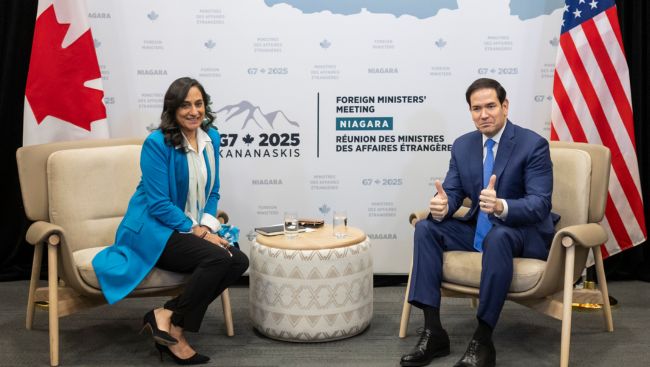
Foreign Affairs Minister Anita Anand was in Washington on Wednesday as the Trump administration made a case for international partners to join a preferential trade zone for critical minerals with forced price floors.

Vice-President JD Vance told a room filled with foreign ministers and officials at the U.S. State Department the goal was "diversifying global supply in the critical minerals market while strengthening the partner countries who help all of us in the shared effort."

"We are all on the same team," Vance said.

Ending China's stranglehold on rare earth minerals became a key U.S. priority last year after U.S. President Donald Trump escalated his trade war between the world's two largest economies by imposing massive tariffs. Beijing responded with retaliatory duties and export restrictions on various critical mineral exports to the U.S., causing anxiety throughout supply chains.

Vance said the United States will establish reference prices for critical materials at each stage of production that reflect "real world fair market value."

"And for members of the preferential zone, these reference prices will operate as a floor maintained through adjustable tariffs to uphold pricing integrity," he said.

Countries that join would get a foundation for private financing, Vance said, and would secure access to "the critical mineral supplies your nation would require in an emergency or some other contingency."

U.S. Secretary of State Marco Rubio told foreign officials "everyone here has a role to play," whether it's mining or refining. He said an international effort would be essential for success.

That push comes, however, as the Trump administration continues to undermine multilateral institutions and rattle traditional allies with tariffs and threats of annexation.

Trump's obsession with acquiring Greenland infuriated European countries and put into question the future of NATO.

The Trump administration already has signed critical mineral agreements with several countries, including Australia and Japan.

The international gathering is taking place after Trump announced Monday the launch of "Project Vault," a strategic reserve for rare earth elements.

While the United States does have reserves for defence purposes, the Trump administration said the new reserve would help shield makers of autos, electronics and other goods from supply chain disruptions.

The reserve is to be funded initially by a $10 billion loan from the U.S. Export-Import Bank and nearly $1.67 billion in private capital.

It's not clear what the Trump administration would want from Canada in any critical mineral agreement.

Canadian officials have made collaboration on rare earths a talking point with their counterparts in Washington as they lay the groundwork for a mandatory review of the Canada-U.S.-Mexico agreement on trade later this year.

Canada and the U.S. Department of Defense already have a co-investment deal to accelerate Canadian mining development and strengthen critical minerals supply chains.

Picture Courtesy: THE CANADIAN PRESS/Nick Iwanyshyn

MORE National ARTICLES

Heiltsuk Nation written constitution passes with 67 per cent of votes

Heiltsuk Nation written constitution passes with 67 per cent of votes
The Heiltsuk Nation has approved the adoption of a written constitution for the First Nation on British Columbia's central coast. The nation says 67 per cent of the 725 people who voted on the referendum were in favour of the constitution.

Heiltsuk Nation written constitution passes with 67 per cent of votes

Poilievre's proposed incentives for First Nations water, resource projects draw fire

Poilievre's proposed incentives for First Nations water, resource projects draw fire
Conservative Leader Pierre Poilievre says he would incentivize First Nations to support natural-resource projects through industry taxes and revisiting how much sway Indigenous Peoples and environmental considerations have over approving projects.  The proposals drew swift criticism from some experts and researchers.

Poilievre's proposed incentives for First Nations water, resource projects draw fire

Indigenous kids in care more likely to experience poor health later in life: report

Indigenous kids in care more likely to experience poor health later in life: report
Indigenous people who were in government care as children experience poorer health and socioeconomic outcomes later in life than those who were never in care, a new Statistics Canada report says. They suffer higher rates of disability, lower self-rated health levels and more homelessness, and are more likely to struggle to meet basic household needs, the report says.

Indigenous kids in care more likely to experience poor health later in life: report

Ex-coroner says B.C.'s drug policy overhaul looks like 'impulsive political decision'

Ex-coroner says B.C.'s drug policy overhaul looks like 'impulsive political decision'
British Columbia's former chief coroner says she's disappointed by the province's overhaul of its program that provides prescription alternatives to toxic street drugs, a shift she says "feels like a really impulsive political decision." Lisa Lapointe said the move to a "witnessed-only" model in which people are supervised while consuming their prescription drugs appeared to ignore scientific evidence.

Ex-coroner says B.C.'s drug policy overhaul looks like 'impulsive political decision'

Internal military report blames botched shooter drill on poor organization

Internal military report blames botched shooter drill on poor organization
During the drill, which took place on Nov. 12 at a service depot at CFB Longue-Pointe in Montreal, military police also confused a racialized employee with a drill participant playing an active shooter and wrestled him to the ground.

Internal military report blames botched shooter drill on poor organization

70% of Canadians support retaliatory tariffs on United States: poll

70% of Canadians support retaliatory tariffs on United States: poll
Seventy per cent of Canadians are in favour of dollar-for-dollar retaliatory tariffs on the United States, a new poll suggests. Nearly half of respondents to the Leger poll — 45 per cent — said they were strongly in favour of such tariffs, while 25 per cent said they were somewhat in favour.

70% of Canadians support retaliatory tariffs on United States: poll