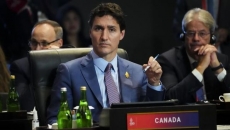
Prime Minister Justin Trudeau embraced a more intimate form of Pacific Rim diplomacy Thursday as he sat down with several world leaders on the margins of a sprawling international summit in California.
Even before all 21 members of the Asia-Pacific Economic Cooperation group could gather for their traditional family photo, Trudeau had already hosted meetings with Japan, Thailand and Australia, with plans to meet Mexico and Vietnam in the afternoon.
The @APEC Economic Leaders’ Meeting is wrapping up. Tune in as I provide an update on the work we’ve done over the past few days to create good jobs and new opportunities for Canadians, advance climate action, strengthen our partnerships, and more: https://t.co/PYKltEuuF5
— Justin Trudeau (@JustinTrudeau) November 17, 2023
Each meeting touched on familiar themes: shared concern about the Israel-Gaza war and the fate of hostages held by Hamas, the effect of the war in Ukraine on global food supplies and the ever-present perils of the impact of climate change.
The other common element was a mutual interest in expanding opportunities for international trade and economic growth throughout the Indo-Pacific.
"Canada has a long and deep friendship with Japan, but I have to say I don't think it has ever been better or closer bilaterally than it has been this past year," Trudeau told Japanese Prime Minister Fumio Kishida through an interpreter.
"Whether it's been an issue of energy security, of investments in the growing clean economy or fighting climate change and protecting nature, Canada and Japan have been working side by side on all these issues and I really look forward to doing even more."
In an ever more turbulent world, Canada must be focused both on its own national self-interests as well as the broader discussion about the world's looming crises, said Kirsten Hillman, Canada's ambassador to the U.S.
"I think you always do both, and I think they're different endeavours," Hillman said. Strong country-to-country relationships are important, particularly when there are bilateral issues to resolve, she added.
"But with many of the challenges that we're facing in the world, it's also important to group together as countries when you have a point to make, when you have something that you want to convey or stand up for or make sure that the world understands that there's a group of countries that share a similar view."
While Trudeau's bilateral meetings were playing out, host President Joe Biden was telling his fellow leaders and corporate CEOs that the U.S. was fully committed to the idea of expanding Pacific Rim trade.
"We're not going anywhere," Biden said.
"The questions we must answer today are not about how much we trade, but about how we build resilience, lift up working people, reduce carbon emissions and set up our economies to succeed over the long run."
As leader of the host nation, Biden later took centre stage for the traditional photo-op, which saw Trudeau standing alongside the summit's biggest celebrity: Chinese President Xi Jinping.
Canadian officials said the two leaders briefly said hello to each other Thursday but had no other interactions beyond that.
Biden met with Xi on the margins of the summit Wednesday in an effort to ease tensions in one of the world's most important geopolitical relationships.
"This is not all kumbaya, but it’s straightforward," Biden said.
"We have real differences with Beijing when it comes to maintaining a fair and level economic playing field and protecting your intellectual property."
He also insisted the U.S. is committed to the Indo-Pacific Economic Framework, a nascent trade agreement of sorts that hasn't progressed as quickly or as effectively as the White House had hoped it would.
Canada would welcome the chance to join the U.S.-led trade initiative, but the mechanism is still very much under construction, Hillman said.
"The first stage is for those parties that have been having these discussions to finish their work. The second stage is for them to share with us what the outcome of that work is, for us to have a look at it and see what it means to us," she said.
"The United States and many other IPEF members have been very quick to tell us that they're very keen to have Canada within this grouping. But, you know, we have to take it one step at a time."
Critics like the Business Council of Canada fear there's an important economic opportunity on the table that could be slipping away.
The progress to date "is a valuable reminder that it is essential for Canada to take part in major multilateral deliberations such as these," said president and CEO Goldy Hyder.
The progress on three of the framework's key pillars, including clean energy, an anti-graft section and language on supply chains, "will shape the future of economic resilience and energy security in the increasingly important Indo-Pacific region," he said.
"It is important as these talks continue that Canada secure their place at the negotiating table."
Trade agreements are not politically popular in the U.S. right now, and Congress is gun-shy with a critical election looming on the horizon next year. Sen. Sherrod Brown (D-Ohio), long averse to trade agreements that hurt workers, successfully lobbied against the framework's trade pillar because it lacked sufficient labour protection standards.
Canada is already an enthusiastic partner in the Comprehensive and Progressive Agreement for Trans-Pacific Partnership, a salvaged version of the Trans-Pacific Partnership that former U.S. president Donald Trump abandoned in 2017, International Trade Minister Mary Ng noted.
"We have trading relationships, and we are doing trade with many of these economies, including with the United States," Ng said earlier this week.
"So we welcome the opportunity to join (IPEF) when that time is right. But quite candidly, we're already doing the work."
Trudeau's afternoon meetings Thursday included bilateral chats with Vietnamese President Vo Van Thuong and a friendly handshake with Mexican President Andrés Manuel López Obrador.
His time in San Francisco wraps up Friday with a summit-ending news conference and a final gathering of economic leaders.