Canada's auditor general has called for the federal government to step up its recovery of outstanding student loans to keep taxpayers from being left on the hook after discovering that $2.4 billion in such loans were in default last year.
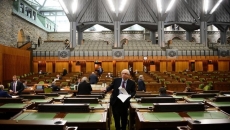
The finding is in one of several reports tabled in Parliament on Wednesday, which included a scathing assessment of the military's resupply system and concerns around how the Canadian Commercial Corporation considered human rights in deals with foreign countries.
That Crown corporation was responsible for inking the $14-billion deal in 2014 to sell Canadian-made armoured vehicles to Saudi Arabia, which has since become a lightning rod of controversy due to Saudi Arabia's poor human-rights record.
The auditor's review of the federal government's student-loan programs cited a number of problems with measures intended to help those unable to repay what they borrowed, starting with a failure to assess whether those asking for loan relief actually qualified.
There were also concerns that students were not being properly informed of their financial obligations when it came to repaying their loans, and that recent changes had made it easier for those receiving in the government's loan-relief program to qualify for non-payment.
Eighty-seven per cent of recent borrowers who were participating in the government's repayment assistance plan were not making repayments on $2.9 billion in loans, according to the auditor's report.
"In our view, this is a lot of money at risk of non-repayment," says the report.
The auditor also found shortfalls in the government's approach to recovering outstanding loans, with the Canada Revenue Agency, which is responsible for such efforts, not having the same powers to go after default student loans as it does for unpaid income tax.
The result is that the CRA has been able to recover only about $200 million in default loans per year, which means most of the $2.4 billion that was in default at the end of July 2018 is likely gone.
"There's a good chance that a big chunk of that will be lost forever," said Philippe Le Goff, principal at the Office of the Auditor General, adding: "It's a big persuasion business, the collection of money. It's a difficult business."
The auditor nonetheless urged the government to take a tougher stance by better assessing whether borrowers should be given relief and using other measures such as notifying credit bureaus of loans in default to encourage more repayment.
Employment Minister Carla Qualtrough, who is responsible for managing the loan-relief programs, said in a statement that the government is working to implement the auditor's recommendations while also working to make sure Canadians can access post-secondary education.
Among the other findings released by the auditor general on Wednesday:
— Rampant delays were found in the provision of spare parts, uniforms, rations and other materiel to military units that needed them, due to problems with the Department of National Defence's resupply system. Requested items were often out of stock and had to be found elsewhere, meaning they were often delivered weeks or months later than needed and at greater cost. It also found National Defence did not properly stock items where they were needed.
— The Canadian Commercial Corporation was criticized for not considering human rights enough when working on deals with foreign countries. That appears to contradict the Crown corporation's repeated assertions that human rights figure prominently in its operations, which focus on selling Canadian-made military goods and other items abroad. The CCC has been criticized in the past for the deal to sell light-armoured vehicles to Saudi Arabia and a now-cancelled contract to sell military helicopters to the Philippines, both of which raised human-rights concerns.
— The National Gallery of Canada was found to have a "significant deficiency" in the conservation of its art collection. There was no plan for conserving what the auditor called "technology-dependent art objects," and shortfalls in how the gallery tracked and approved the treatment and preservation of its collection.