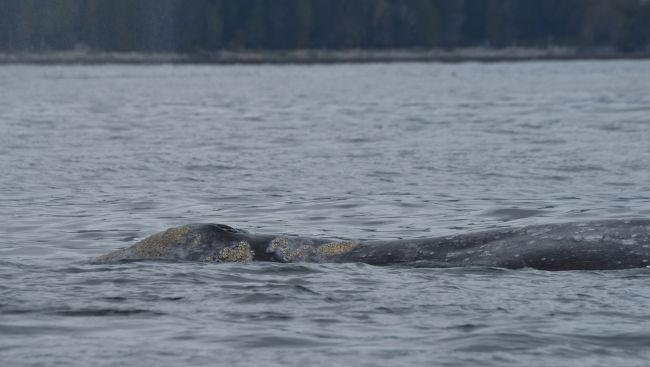
Four dead grey whales have been found off B.C.'s coast over 10 days this month, and officials with the Fisheries Department say there are signs of more deaths to come.
Paul Cottrell, the marine mammal co-ordinator with the department, said five dead grey whales have been found already this year, while the record is 11 deaths over all of 2019.
"We're hoping it's just a blip, but the indications are that we're likely going to see more mortalities, and of course, the great work that's going on with the sampling and necropsies will inform body condition and cause of death, ultimately," he said in an interview.
"But the underlying consistent thing we're seeing is very skinny animals with certain animals that are just really a bag of bones."
The latest animals to be found dead — three males and one female — were found around Barkley Sound, near Kyuquot and near Sidney, all areas off Vancouver Island.
“Two of those four dead grey whales were extremely emaciated. (I've) never seen such poor body condition,” Cottrell said.
Grey whales spend winters in Mexican waters, where they breed and calve, and don't typically eat. It's only when they return to northern waters that they begin to feed again.
"What we're seeing this year is these animals that are travelling north are not in very good body condition, and unfortunately it looks like the last feeding in the summer was not a great year," Cottrell said.
Wendy Szaniszlo, a marine mammal technician, said science suggests a reduction in the amount of food available in the Arctic and sub-Arctic feeding grounds for the whales last summer is contributing to malnutrition, lowered breeding rates and the deaths.
"The Arctic and sub-Arctic feeding grounds, it was found that the changing water temperatures has affected the prey availability, and there hasn't been as much prey, or the quality has been down," she said.
They are baleen whales, which means they sieve their food by scooping it up through their mouths, consuming small crustaceans and other "critters," Cottrell said.
But the ice cover melted a month or two earlier in their northern feed grounds, Cottrell said, which also appears to be impacting prey quality and abundance.
Last breeding season in the Mexican Baja lagoons, there were only 84 calves born, which was the lowest number on record to date, Szaniszlo said.
"When the whales are nutritionally stressed, it does affect their ability to hold a fetus to term and have the ability for the mother to care for their young," she said.
Cottrell says the deaths in B.C. are similar to what is happening along Washington state, where 15 whales have been found dead in the last couple weeks, and there have been similar deaths along the coasts of Oregon and California.
Szaniszlo said more research is needed into the whales' feeding grounds, not just in the Arctic and sub-Arctic, but also in parts of B.C. where about 250 of the animals — known as the Pacific Coast feeding group — feed.
Picture Courtesy: THE CANADIAN PRESS/Handout — Fisheries and Oceans Canada