Wednesday, March 18, 2026
ADVT 
National

Bank of Canada cuts key interest rate to 2.5% as U.S. tariff risks shift

Darpan News Desk The Canadian Press, 17 Sep, 2025 09:14 AM
  • Bank of Canada cuts key interest rate to 2.5% as U.S. tariff risks shift

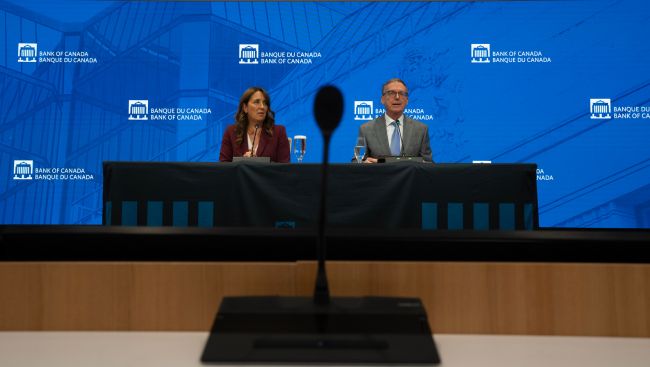
The Bank of Canada cut its benchmark interest rate by a quarter point on Wednesday as the central bank worries less about inflation risks and more about a slowing economy.

The Bank of Canada’s policy rate now stands at 2.5 per cent, breaking a streak of three consecutive holds since March.

Governor Tiff Macklem said the risks have shifted since the Bank of Canada’s last interest rate decision in July.

Cracks in the labour market and a sharp drop in exports are threatening growth, he said, while earlier signs of underlying inflation pressure are fading.

“With a weaker economy and less upside risk to inflation, governing council judged that a reduction in the policy rate was appropriate to better balance the risks,” he said in prepared remarks.

Annual inflation stood at 1.9 per cent in August, Statistics Canada reported Tuesday, with core inflation figures holding around three per cent year-over-year.

But the Bank of Canada, looking at a broader range of indicators, still sees underlying inflation holding at around 2.5 per cent.

Macklem also said the federal government’s decision to drop most retaliatory tariffs against the United States at the start of this month will take some fuel out of inflation.

The national unemployment rate meanwhile rose to 7.1 per cent after Canada’s economy shed more than 100,000 jobs across July and August. Real gross domestic product fell 1.6 per cent annualized in the second quarter.

Economists expect employers were rushing to get ahead of U.S. tariffs in the first quarter, pulling forward activity and driving the second-quarter contraction.

Macklem said that while there are still a lot of unknowns tied to U.S. tariffs and the global trade disruption, “near-term uncertainty may have come down a little.”

He said there was a “clear consensus” among governing council to cut the policy rate Wednesday. Economists widely expected the move heading into the announcement.

CIBC senior economist Katherine Judge said in a note to clients Wednesday that the economy is "losing resilience" and inflation should remain well contained moving forward.

She argued that will set the central bank up for another cut at its next decision on Oct. 29.

The Bank of Canada signalled it will keep looking on a shorter horizon than usual as it tries to set monetary policy in a constantly shifting environment.

Stephen Brown, deputy chief North America economist at Capital Economics, highlighted in a note that the central bank dropped from its statement a reference to the possible need for future rate reductions.

Monetary policymakers will be looking at how export activity evolves and whether costs from the trade disruption are passed on to consumers as it gauges where to take the policy rate next.

Brown said the Bank of Canada's focus on inflation expectations and the ways the trade dispute could spillover into household activity are telling.

"That leaves the door to another interest rate cut this year if, as we expect, economic growth remains weak while core inflation pressures remain under control," he said.

Picture Courtesy: THE CANADIAN PRESS/Adrian Wyld

MORE National ARTICLES

Consumers could find 'meaningful savings' as carbon price ends: Desjardins

Consumers could find 'meaningful savings' as carbon price ends: Desjardins
Canadians can expect to feel the absence of the consumer carbon price at the pumps immediately but it may take longer to notice a difference in the price of other goods, a new report released Wednesday suggests. The analysis by Desjardins Economics comes less than a week after Prime Minister Mark Carney and his new Liberal cabinet ordered that the consumer levy be set to zero on April 1.

Consumers could find 'meaningful savings' as carbon price ends: Desjardins

End of consumer carbon tax leaves $1.5-billion hole in B.C. budget

End of consumer carbon tax leaves $1.5-billion hole in B.C. budget
The budget released earlier this month shows the province was forecasting revenue of just over $2.5 billion from the tax in the 2024-25 fiscal year, while the estimated cost of the climate action tax credit was $995 million.

End of consumer carbon tax leaves $1.5-billion hole in B.C. budget

Ottawa caps non-sufficient funds fees at $10 starting March 2026

Ottawa caps non-sufficient funds fees at $10 starting March 2026
Ottawa has put in place new rules limiting the fees banks can levy on customers who don't have enough in their accounts to cover a cheque or other pre-authorized charges. The updates, included in an order-in-council last week, cap non-sufficient funds fees at $10 for personal deposit accounts, prohibit charging more than one NSF fee in a period of two business days, and prohibit charging an NSF fee when an account shortfall is under $10.

Ottawa caps non-sufficient funds fees at $10 starting March 2026

Federal government promises $2.55B in low-cost loans to build Toronto rental homes

Federal government promises $2.55B in low-cost loans to build Toronto rental homes
The federal government is promising billions in low-cost financing to help build thousands of rental homes in Toronto, including more than a thousand affordable units. Ottawa says it will provide $2.55 billion in financing through its Apartment Construction Loan Program, to be administered by the Canada Mortgage and Housing Corporation.

Federal government promises $2.55B in low-cost loans to build Toronto rental homes

Statistics Canada says population rose to 41,528,680 at Jan. 1 as growth slowed

Statistics Canada says population rose to 41,528,680 at Jan. 1 as growth slowed
Statistics Canada says the population grew to 41,528,680 people as of Jan. 1 as the pace of growth continued to slow after peaking in the third quarter of 2023. The total number of people was up 63,382 compared with Oct. 1, 2024, for a quarterly growth rate of 0.2 per cent.

Statistics Canada says population rose to 41,528,680 at Jan. 1 as growth slowed

Poilievre says Trump is right to say a Liberal PM would be easier to deal with

Poilievre says Trump is right to say a Liberal PM would be easier to deal with
Conservative Leader Pierre Poilievre says U.S. President Donald Trump is right to think he would have an easier time dealing with a Liberal prime minister in Canada. On Fox News on Tuesday evening, Trump was asked about the upcoming election and the fact that polls now suggest the Liberals are in the lead.

Poilievre says Trump is right to say a Liberal PM would be easier to deal with