
Monday, March 23, 2026
ADVT 
National

Bank of Canada cuts key interest rate to 2.5% as U.S. tariff risks shift

Darpan News Desk The Canadian Press, 17 Sep, 2025 09:14 AM
  • Bank of Canada cuts key interest rate to 2.5% as U.S. tariff risks shift

The Bank of Canada cut its benchmark interest rate by a quarter point on Wednesday as the central bank worries less about inflation risks and more about a slowing economy.

The Bank of Canada’s policy rate now stands at 2.5 per cent, breaking a streak of three consecutive holds since March.

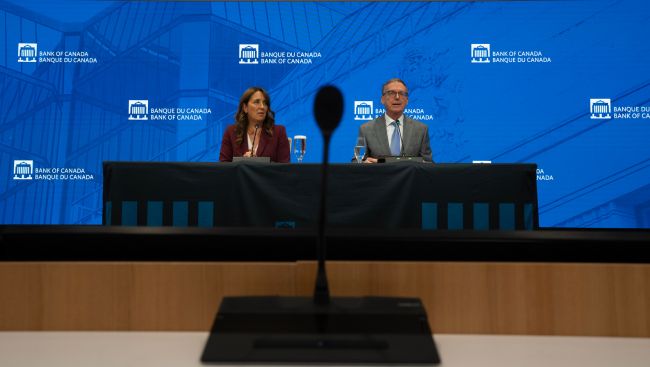
Governor Tiff Macklem said the risks have shifted since the Bank of Canada’s last interest rate decision in July.

Cracks in the labour market and a sharp drop in exports are threatening growth, he said, while earlier signs of underlying inflation pressure are fading.

“With a weaker economy and less upside risk to inflation, governing council judged that a reduction in the policy rate was appropriate to better balance the risks,” he said in prepared remarks.

Annual inflation stood at 1.9 per cent in August, Statistics Canada reported Tuesday, with core inflation figures holding around three per cent year-over-year.

But the Bank of Canada, looking at a broader range of indicators, still sees underlying inflation holding at around 2.5 per cent.

Macklem also said the federal government’s decision to drop most retaliatory tariffs against the United States at the start of this month will take some fuel out of inflation.

The national unemployment rate meanwhile rose to 7.1 per cent after Canada’s economy shed more than 100,000 jobs across July and August. Real gross domestic product fell 1.6 per cent annualized in the second quarter.

Economists expect employers were rushing to get ahead of U.S. tariffs in the first quarter, pulling forward activity and driving the second-quarter contraction.

Macklem said that while there are still a lot of unknowns tied to U.S. tariffs and the global trade disruption, “near-term uncertainty may have come down a little.”

He said there was a “clear consensus” among governing council to cut the policy rate Wednesday. Economists widely expected the move heading into the announcement.

CIBC senior economist Katherine Judge said in a note to clients Wednesday that the economy is "losing resilience" and inflation should remain well contained moving forward.

She argued that will set the central bank up for another cut at its next decision on Oct. 29.

The Bank of Canada signalled it will keep looking on a shorter horizon than usual as it tries to set monetary policy in a constantly shifting environment.

Stephen Brown, deputy chief North America economist at Capital Economics, highlighted in a note that the central bank dropped from its statement a reference to the possible need for future rate reductions.

Monetary policymakers will be looking at how export activity evolves and whether costs from the trade disruption are passed on to consumers as it gauges where to take the policy rate next.

Brown said the Bank of Canada's focus on inflation expectations and the ways the trade dispute could spillover into household activity are telling.

"That leaves the door to another interest rate cut this year if, as we expect, economic growth remains weak while core inflation pressures remain under control," he said.

Picture Courtesy: THE CANADIAN PRESS/Adrian Wyld

MORE National ARTICLES

Rain and possible snow melt set off high-water warnings for parts of B.C.

Rain and possible snow melt set off high-water warnings for parts of B.C.
A series of wet weather systems bringing rain and a warming trend has prompted high streamflow advisories for waterways on B.C.'s south coast and the lower half of Vancouver Island.  Environment Canada has issued rainfall warnings for Howe Sound and communities in north and eastern Metro Vancouver, saying as much as 100 millimetres of rain could fall by the end of the weekend. 

Rain and possible snow melt set off high-water warnings for parts of B.C.

Liberal party kicks Ruby Dhalla out of leadership race

Liberal party kicks Ruby Dhalla out of leadership race
The Liberal party has kicked Ruby Dhalla out of the leadership race just days before the contestants were to face off in two debates in Montreal. Party national director Azam Ishmael says in a statement published late Friday that the decision was made unanimously by the Liberal Leadership Vote Committee.

Liberal party kicks Ruby Dhalla out of leadership race

Earthquake shakes Vancouver and other B.C. cities

Earthquake shakes Vancouver and other B.C. cities
An earthquake with a preliminary magnitude of 5.1 has shaken Vancouver, Victoria and other B.C. cities. Natural Resources Canada says the quake was centred 24 kilometres north-northeast of Sechelt on the Sunshine Coast.

Earthquake shakes Vancouver and other B.C. cities

Heiltsuk Nation written constitution passes with 67 per cent of votes

Heiltsuk Nation written constitution passes with 67 per cent of votes
The Heiltsuk Nation has approved the adoption of a written constitution for the First Nation on British Columbia's central coast. The nation says 67 per cent of the 725 people who voted on the referendum were in favour of the constitution.

Heiltsuk Nation written constitution passes with 67 per cent of votes

Poilievre's proposed incentives for First Nations water, resource projects draw fire

Poilievre's proposed incentives for First Nations water, resource projects draw fire
Conservative Leader Pierre Poilievre says he would incentivize First Nations to support natural-resource projects through industry taxes and revisiting how much sway Indigenous Peoples and environmental considerations have over approving projects.  The proposals drew swift criticism from some experts and researchers.

Poilievre's proposed incentives for First Nations water, resource projects draw fire

Indigenous kids in care more likely to experience poor health later in life: report

Indigenous kids in care more likely to experience poor health later in life: report
Indigenous people who were in government care as children experience poorer health and socioeconomic outcomes later in life than those who were never in care, a new Statistics Canada report says. They suffer higher rates of disability, lower self-rated health levels and more homelessness, and are more likely to struggle to meet basic household needs, the report says.

Indigenous kids in care more likely to experience poor health later in life: report