
Thursday, March 26, 2026
ADVT 
National

Bank of Canada cuts key interest rate to 2.5% as U.S. tariff risks shift

Darpan News Desk The Canadian Press, 17 Sep, 2025 09:14 AM
  • Bank of Canada cuts key interest rate to 2.5% as U.S. tariff risks shift

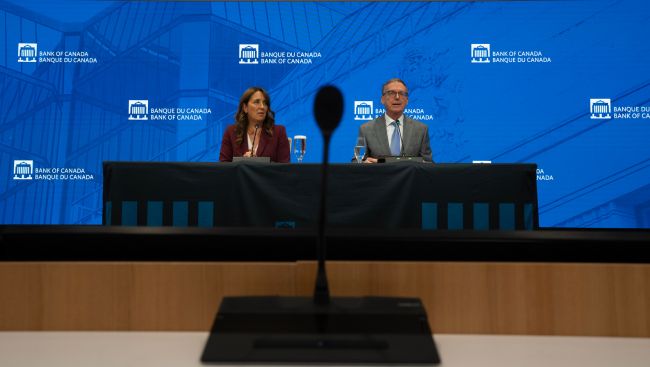
The Bank of Canada cut its benchmark interest rate by a quarter point on Wednesday as the central bank worries less about inflation risks and more about a slowing economy.

The Bank of Canada’s policy rate now stands at 2.5 per cent, breaking a streak of three consecutive holds since March.

Governor Tiff Macklem said the risks have shifted since the Bank of Canada’s last interest rate decision in July.

Cracks in the labour market and a sharp drop in exports are threatening growth, he said, while earlier signs of underlying inflation pressure are fading.

“With a weaker economy and less upside risk to inflation, governing council judged that a reduction in the policy rate was appropriate to better balance the risks,” he said in prepared remarks.

Annual inflation stood at 1.9 per cent in August, Statistics Canada reported Tuesday, with core inflation figures holding around three per cent year-over-year.

But the Bank of Canada, looking at a broader range of indicators, still sees underlying inflation holding at around 2.5 per cent.

Macklem also said the federal government’s decision to drop most retaliatory tariffs against the United States at the start of this month will take some fuel out of inflation.

The national unemployment rate meanwhile rose to 7.1 per cent after Canada’s economy shed more than 100,000 jobs across July and August. Real gross domestic product fell 1.6 per cent annualized in the second quarter.

Economists expect employers were rushing to get ahead of U.S. tariffs in the first quarter, pulling forward activity and driving the second-quarter contraction.

Macklem said that while there are still a lot of unknowns tied to U.S. tariffs and the global trade disruption, “near-term uncertainty may have come down a little.”

He said there was a “clear consensus” among governing council to cut the policy rate Wednesday. Economists widely expected the move heading into the announcement.

CIBC senior economist Katherine Judge said in a note to clients Wednesday that the economy is "losing resilience" and inflation should remain well contained moving forward.

She argued that will set the central bank up for another cut at its next decision on Oct. 29.

The Bank of Canada signalled it will keep looking on a shorter horizon than usual as it tries to set monetary policy in a constantly shifting environment.

Stephen Brown, deputy chief North America economist at Capital Economics, highlighted in a note that the central bank dropped from its statement a reference to the possible need for future rate reductions.

Monetary policymakers will be looking at how export activity evolves and whether costs from the trade disruption are passed on to consumers as it gauges where to take the policy rate next.

Brown said the Bank of Canada's focus on inflation expectations and the ways the trade dispute could spillover into household activity are telling.

"That leaves the door to another interest rate cut this year if, as we expect, economic growth remains weak while core inflation pressures remain under control," he said.

Picture Courtesy: THE CANADIAN PRESS/Adrian Wyld

MORE National ARTICLES

As birth tourism rises again, will Trump's citizenship moves send more Canada's way?

As birth tourism rises again, will Trump's citizenship moves send more Canada's way?
Vancouver-based birth tourism operator Liga Lin says her phone has been buzzing with inquiries from expectant mothers since U.S. President Donald Trump moved to end American birthright citizenship. Lin's business, New Joy Postpartum Care, arranges accommodation and services for non-resident women — mostly from mainland China, Taiwan and Hong Kong — who want to give birth in Canada, granting their children automatic citizenship rights.

As birth tourism rises again, will Trump's citizenship moves send more Canada's way?

A short list of some of the U.S. goods to be hit with Canadian tariffs on Tuesday

A short list of some of the U.S. goods to be hit with Canadian tariffs on Tuesday
Effective Tuesday, Canada is imposing 25 per cent tariffs on $30 billion in goods originating in the United States — part of Canada's response to sweeping tariffs on Canadian goods ordered by U.S. President Donald Trump. Here are some of the major categories of imported items being hit with Canadian tariffs, along with their approximate annual dollar values:

A short list of some of the U.S. goods to be hit with Canadian tariffs on Tuesday

Ontario, Quebec and B.C. among provinces pulling U.S. booze from provincial retailers

Ontario, Quebec and B.C. among provinces pulling U.S. booze from provincial retailers
Canadian alcohol producers are cheering decisions from several provinces to yank U.S. booze from provincial liquor stores. They say the move will deliver a boost to homegrown business while adding ammunition to a federal plan aimed at getting the U.S. to back down from tariffs.

Ontario, Quebec and B.C. among provinces pulling U.S. booze from provincial retailers

Canada slaps retaliatory tariffs on hundreds of U.S. goods, outlines response plan

Canada slaps retaliatory tariffs on hundreds of U.S. goods, outlines response plan
Ottawa is imposing 25 per cent tariffs on hundreds of goods originating in the United States — from meat and milk to carpets and curtains — in response to steep new American levies against Canada. A federal official also signalled that Canada will pursue available legal remedies in response to the U.S. breaching its international trade commitments.

Canada slaps retaliatory tariffs on hundreds of U.S. goods, outlines response plan

Employment Outlook 2025: Opportunities and Challenges in BC and Canada

Employment Outlook 2025: Opportunities and Challenges in BC and Canada
The employment landscape in British Columbia (BC) and Canada is undergoing dynamic transformations shaped by economic shifts, evolving labor market demands, and demographic changes. As we move into 2025, a comprehensive outlook reveals both opportunities and challenges for job seekers, particularly for immigrants, underrepresented groups, and youth entering the workforce.  

Employment Outlook 2025: Opportunities and Challenges in BC and Canada

Ottawa defers effective date of capital gains changes to 2026, promises exemptions

Ottawa defers effective date of capital gains changes to 2026, promises exemptions
The federal government says it is deferring the implementation of a hike to the capital gains inclusion rate to next year and plans to introduce new exemptions to ensure most middle-class Canadians do not pay more tax if the rate becomes official. The deferral announced by Finance Minister Dominic LeBlanc on Friday delays the implementation of the change from June 25, 2024 to Jan. 1, 2026.

Ottawa defers effective date of capital gains changes to 2026, promises exemptions