
Thursday, March 26, 2026
ADVT 
National

Bank of Canada cuts key interest rate to 2.5% as U.S. tariff risks shift

Darpan News Desk The Canadian Press, 17 Sep, 2025 09:14 AM
  • Bank of Canada cuts key interest rate to 2.5% as U.S. tariff risks shift

The Bank of Canada cut its benchmark interest rate by a quarter point on Wednesday as the central bank worries less about inflation risks and more about a slowing economy.

The Bank of Canada’s policy rate now stands at 2.5 per cent, breaking a streak of three consecutive holds since March.

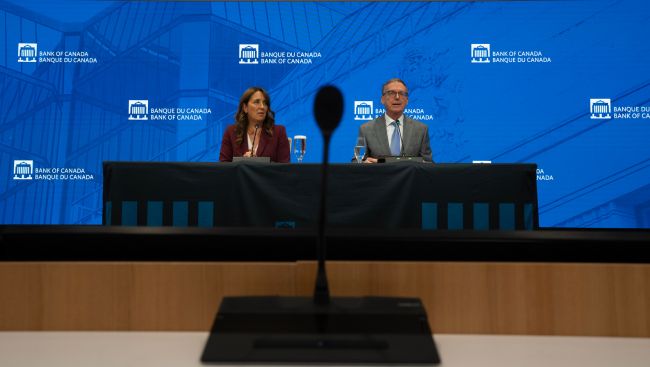
Governor Tiff Macklem said the risks have shifted since the Bank of Canada’s last interest rate decision in July.

Cracks in the labour market and a sharp drop in exports are threatening growth, he said, while earlier signs of underlying inflation pressure are fading.

“With a weaker economy and less upside risk to inflation, governing council judged that a reduction in the policy rate was appropriate to better balance the risks,” he said in prepared remarks.

Annual inflation stood at 1.9 per cent in August, Statistics Canada reported Tuesday, with core inflation figures holding around three per cent year-over-year.

But the Bank of Canada, looking at a broader range of indicators, still sees underlying inflation holding at around 2.5 per cent.

Macklem also said the federal government’s decision to drop most retaliatory tariffs against the United States at the start of this month will take some fuel out of inflation.

The national unemployment rate meanwhile rose to 7.1 per cent after Canada’s economy shed more than 100,000 jobs across July and August. Real gross domestic product fell 1.6 per cent annualized in the second quarter.

Economists expect employers were rushing to get ahead of U.S. tariffs in the first quarter, pulling forward activity and driving the second-quarter contraction.

Macklem said that while there are still a lot of unknowns tied to U.S. tariffs and the global trade disruption, “near-term uncertainty may have come down a little.”

He said there was a “clear consensus” among governing council to cut the policy rate Wednesday. Economists widely expected the move heading into the announcement.

CIBC senior economist Katherine Judge said in a note to clients Wednesday that the economy is "losing resilience" and inflation should remain well contained moving forward.

She argued that will set the central bank up for another cut at its next decision on Oct. 29.

The Bank of Canada signalled it will keep looking on a shorter horizon than usual as it tries to set monetary policy in a constantly shifting environment.

Stephen Brown, deputy chief North America economist at Capital Economics, highlighted in a note that the central bank dropped from its statement a reference to the possible need for future rate reductions.

Monetary policymakers will be looking at how export activity evolves and whether costs from the trade disruption are passed on to consumers as it gauges where to take the policy rate next.

Brown said the Bank of Canada's focus on inflation expectations and the ways the trade dispute could spillover into household activity are telling.

"That leaves the door to another interest rate cut this year if, as we expect, economic growth remains weak while core inflation pressures remain under control," he said.

Picture Courtesy: THE CANADIAN PRESS/Adrian Wyld

MORE National ARTICLES

Canadian doctor says WHO headquarters 'stressed, devastated' as Trump orders U.S. exit

Canadian doctor says WHO headquarters 'stressed, devastated' as Trump orders U.S. exit
Staff at the World Health Organization are "devastated" by President Donald Trump's executive order to pull the U.S. out of the agency, a Canadian global health specialist says. Dr. Madhukar Pai, the Canada Research Chair in Epidemiology and Global Health, is at the WHO headquarters in Geneva this week for meetings about tuberculosis and was there at the time Trump signed the order Monday.  

Canadian doctor says WHO headquarters 'stressed, devastated' as Trump orders U.S. exit

Immigration minister says U.S. is still safe for refugees despite Trump's rhetoric

Immigration minister says U.S. is still safe for refugees despite Trump's rhetoric
Refugee advocacy groups are pushing back as the federal immigration minister says Ottawa still regards the U.S. as a safe country for transgender refugees under President Donald Trump. Trump signed executive orders on the first day of his new term to make recognizing gender based on biological characteristics U.S. government policy, and to pause the refugee program.

Immigration minister says U.S. is still safe for refugees despite Trump's rhetoric

Nearly 500 B.C. residents received an organ transplant in 2024

Nearly 500 B.C. residents received an organ transplant in 2024
Health authorities in British Columbia say nearly 500 people in the province received a life-saving organ transplant last year. The Provincial Health Services Authority, BC Transplant and the Ministry of Health say in a joint news release that 481 transplants in 2024 came from more than 200 donors.

Nearly 500 B.C. residents received an organ transplant in 2024

Premiers, prime minister meet to talk Trump tariffs after cabinet retreat

Premiers, prime minister meet to talk Trump tariffs after cabinet retreat
Canada's premiers are meeting virtually with the prime minister today to talk about Donald Trump's early moves as president and the looming threat of tariffs. The first ministers have committed to weekly meetings now that Trump has been installed in the White House.

Premiers, prime minister meet to talk Trump tariffs after cabinet retreat

B.C. Premier David Eby asks Canadians to think carefully about spending money in U.S.

B.C. Premier David Eby asks Canadians to think carefully about spending money in U.S.
Trump's proposed 25 per cent tariffs on Canadian exports would be a "deliberate economic attack" on B.C. families and people should think carefully about spending money in a country that wants to do them economic harm, Eby said during a news conference in Vancouver on Tuesday.

B.C. Premier David Eby asks Canadians to think carefully about spending money in U.S.

Poilievre says he wants to cut the federal public service, doesn't mind remote work

Poilievre says he wants to cut the federal public service, doesn't mind remote work
Conservative Leader Pierre Poilievre says a government led by him would cut the number of federal public servants — but he doesn't mind if they work from home. When asked by Radio-Canada on Tuesday if U.S. President Donald Trump’s executive order sending federal workers back to the office five days a week is a good idea, Poilievre said that what matters is whether public servants do the work.

Poilievre says he wants to cut the federal public service, doesn't mind remote work