Bank of Canada governor Tiff Macklem says he's "encouraged" by the federal government's efforts to diversify the economy and protect it against increasingly common shocks to global trade.
He also says Ottawa's fiscal update, tabled earlier this week, will likely have little impact on the central bank's forecasts for inflation.
Macklem made the comments in an interview with The Canadian Press on Wednesday after the Bank of Canada held its benchmark interest rate steady at 2.25 per cent in a fourth consecutive decision.
The central bank updated its outlook for the economy that same day, and Macklem flagged a pair of outstanding risks to the forecast: the energy price spike from the war in Iran; and the looming review of the Canada-U.S.-Mexico trade agreement.
Depending on how those risks play out — whether they push inflation or economic growth in one direction or another — he said the Bank of Canada is in the unusual stance where its policy rate might have to go higher, lower or just hold steady for the foreseeable future.
Macklem maintains that the bank will support the economy where it can, but its mandate remains keeping inflation anchored at two per cent.
"We are in a more shock-prone world," he said in the interview.
"Our commitment is, we will be a source of stability. We will bring inflation back to target. It is essential that Canadians remain confident in price stability."
The Bank of Canada governor has acknowledged that the bank is limited in what it can do to guide the economy through structural transitions, such as protectionist U.S. trade policy or disruption from artificial intelligence.
That's more a job for fiscal policy from governments, Macklem has argued, not the blunt tool of the Bank of Canada's benchmark interest rate.
The central bank operates independently from the federal government to avoid perceptions of political pressure when setting monetary policy.
But Macklem and his colleagues at the bank are not shy about identifying what they see as long-standing vulnerabilities in the economy, and regularly sharing those perspectives in speeches, press conferences and appearances at government committees.
He said he sees "renewed momentum" to tackle some of these issues, which have been blamed in part for holding back business investment and productivity growth in the country for more than a decade.
Overreliance on the United States is one area where Macklem sees room to diversify Canada's exports. Boosting interprovincial trade by removing barriers and harmonizing regulations between provinces also strikes him as a top priority to stimulate growth.
"It's been so much easier to send stuff north-south to the U.S. than to send it across the country. So, as a result, we don't have as well developed an east-west transportation corridor as we could," Macklem said.
Macklem also travels regularly in his role as the head of Canada's central bank, and he said he hears from international investors that there's plenty of interest in Canada. What gets in the way of those capital flows, they tell him, are the often long timelines for getting projects approved in the country.
"These regulatory approvals, they are in place for well-intended reasons, but they're having unintended consequences. If we can streamline those, provide more predictability, I think you will see more foreign investment into Canada, which will also boost our economy," Macklem said.
Many of the hang-ups that are top of mind for the Bank of Canada governor echo those raised on Parliament Hill lately.
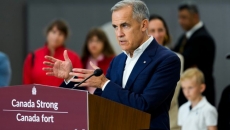
Since becoming prime minister a little over a year ago, Mark Carney — who held Macklem's position for five years starting in 2008 — has tried to diversify Canadian exports, knock down interprovincial trade barriers and court international investment during his travels abroad.
Macklem reiterated during the interview that he does not comment on specific fiscal policy proposals or actions taken by the government.
But when asked whether he felt the federal government was putting the economy on a track to be more resilient to global shocks, the central bank governor said he is "encouraged by the direction."
"These things are not going to get fixed overnight," Macklem said.
"It's going to take a determined plan … and a willingness to keep the momentum. But yes, I think the direction is encouraging and now a lot of it is about execution."
Carney's critics have argued the Liberal government continues to lag behind on approving new major projects despite plenty of talk about an urgent pace of building. Conservative Leader Pierre Poilievre has chastised Carney over declaring a "rupture" in the Canada-U.S. relationship and for running deeper deficits, which he says are fuelling inflation domestically.
Inflation stood at 2.4 per cent in March as the global oil price shock hit gas pumps across the country and still-stubborn food inflation kept costs up at the grocery store.
The Bank of Canada's baseline forecasts released Wednesday call for inflation to peak around three per cent in April before cooling back to the bank's two per cent target in early 2027. That outlook assumes global oil prices ease from their current levels in the months to come.
But a scenario that sees the cost of a barrel of oil remain at around US$100 through the rest of the year would likely result in a broader inflationary bout that pushes the Bank of Canada to hike its key rate multiple times, central bank officials warned.
The Bank of Canada's latest forecasts were released a day after the release of the government's spring economic update and didn't incorporate all of Ottawa's new spending plans.
Macklem said the full spring economic statement will be incorporated in the central bank's July forecasts. But he also noted that some major spending items, such as waiving the federal fuel excise tax and boosting a tax benefit for lower-income households, were already announced heading into this week and were baked into the Bank of Canada's outlook.
Asked whether the spring economic update would have implications for Canada's inflation outlook, Macklem said the changes "are not macro-economically significant" and he doesn't expect there to be a "big impact on the projection."
Picture Courtesy: THE CANADIAN PRESS/Sean Kilpatrick