Signs of resilience in the Canadian economy were enough for the Bank of Canada to leave its benchmark interest rate unchanged Wednesday, but the spectre of U.S. trade uncertainty continues to cast a shadow over the central bank’s decisions.
The central bank’s policy rate remains at 2.75 per cent after a third consecutive hold.
Governor Tiff Macklem said in prepared remarks that the governing council’s decision came from a “clear consensus.”
With a backdrop of considerable trade uncertainty, Canada’s economy has yet to deteriorate sharply in the face of U.S. tariffs and underlying inflation is showing some stubbornness.
The Bank of Canada lowers its policy rate when it wants to stimulate the economy but keeps borrowing costs elevated when it’s worried inflation will rise.
Macklem said the economy is showing “some resilience” so far, but he also opened the door to lowering rates if growth slows more sharply.
“If a weakening economy puts further downward pressure on inflation and the upward price pressures from the trade disruptions are contained, there may be a need for a reduction in the policy interest rate,” he said.
CIBC senior economist Andrew Grantham said in a note to clients Wednesday morning that the Bank of Canada "appears to be getting a little more comfortable" with the idea that future rate cuts could be needed to support the economy.
He said Macklem's language gave a hint that rate cuts could be on the table for September, but cautioned that upcoming economic data will have more sway.
Though headline inflation rose two ticks to 1.9 per cent in June, the Bank of Canada sees underlying inflation levels around 2.5 per cent when stripping out volatility and tax changes that are skewing the data.
Canada’s labour market is showing some weakness in tariff-exposed sectors such as manufacturing, but other industries continue to broadly add jobs.
Macklem said the Bank of Canada will be watching how much tariffs affect business activity and demand for Canadian exports, and whether higher costs from those import duties are passed on to customers.
U.S. effective tariff rates are “less than were threatened,” Macklem noted, but are still higher than recent historical experience. The odds of a “severe and escalating” global trade war have diminished in recent months, he said.
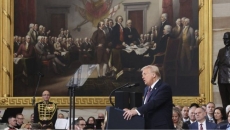
While U.S. President Donald Trump has recently struck trade deals with the likes of Japan and the European Union, those agreements still come with some level of tariffs.
Macklem said the nature of those deals suggest “the United States is not returning to open trade.”
The Bank of Canada published a monetary policy report alongside its rate decision Wednesday, but that report once again did not include a single, central forecast for the economy as the central bank’s outlook remains clouded by uncertainty.
Instead, the bank offered a scenario based on the current tariff level persisting, and two others that outline both a de-escalation and a further ramp up of tariffs. Each of those case studies sees at least some level of tariffs persisting.
While it’s tricky to get a firm number on what tariff levels look like given a variety of exemptions and overlapping duties, the central bank sees the effective U.S. tariff rate on Canada at roughly seven or eight per cent today, up five percentage points from the start of the year.
The bank’s monetary policymakers also assume a vast majority of Canadian goods will be exempt from tariffs over the coming years thanks to their compliance with the Canada-U.S.-Mexico Agreement as companies rush to get certified.
In the status quo scenario, the Bank of Canada sees the economy rebounding through the rest of this year after an estimated decline of 1.5 per cent in annualized real gross domestic product last quarter.
The current tariff scenario has real GDP growth coming in 0.5 percentage points lower in 2025 and 2026 compared to the Bank of Canada’s pre-trade war projections in January.
Inflation would also hold around two per cent through the end of 2027 in this outcome as the forces pushing prices higher are roughly offset by the forces dampening them.
A de-escalation scenario would cut U.S. tariffs on Canada in half, putting less upward pressure on inflation and seeing growth rebound faster. Canada’s counter-tariffs are also waived in this example.
But an escalation outcome would see the United States place a sweeping 10 per cent tariff on all goods from Canada and Mexico — ignoring the current exemptions for CUSMA compliance — in addition to a threatened 50 per cent tariff on copper imports. Canada would then respond with a 25 per cent tariff on $120 billion of U.S. goods, up from the current tariff scenario of $60 billion.
This escalated scenario would see inflation rise and the economy fall into a recession for the rest of 2025.
Trump has threatened to impose a 35 per cent duty on Canadian imports starting Friday if a trade deal isn’t struck between the countries before then. The Bank of Canada’s forecasts don’t specifically address the impact of that possible outcome.
Picture Courtesy: THE CANADIAN PRESS/Justin Tang