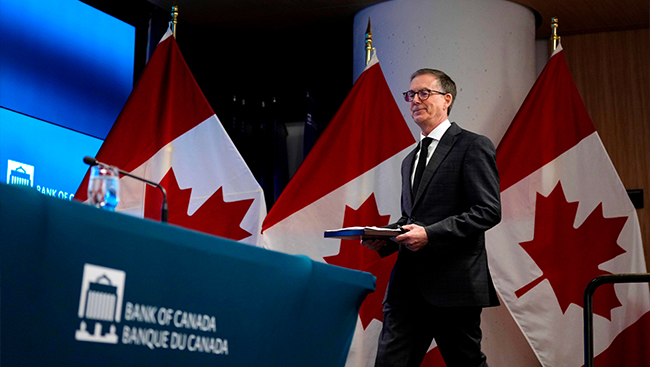
The Bank of Canada left its benchmark interest rateunchanged Wednesday as it waits to get a clearer picture ofhow global trade uncertainty is going to impact the Canadian economy.
The central bank held its policy rate steady at 2.75 per cent, the first time it has left the key rate unchanged following seven consecutive cuts since June.
That decision arrived in the midst of the United States' ever-shifting global trade war, and Bank of Canada governor Tiff Macklem made clear that the disruption from south of the border was the clear focus of Wednesday’s decision.
“The dramatic protectionist shift in U.S. trade policy and the chaotic delivery have increased uncertainty, roiled financial markets, diminished global growth prospects and raised inflation expectations,” he said at a press conference.
Macklem said the central bank weighed a hold or a cut in its latest decision, as it did ahead of its March meeting. Though tariffs have been imposed and since adjusted in between decisions, he said the bank still does not have clarity on how the dispute will unfold.
“The future is no clearer. We still do not know what tariffs will be imposed, whether they’ll be reduced or escalated, or how long all of this will last," he said.
The Bank of Canada raises the policy rate when central bankers fear inflation could accelerate and lower it when they want to stimulate economic growth.
But both scenarios are in play right now amid what Macklem called “considerable uncertainty” tied to the United States’ global tariff campaign.
“We decided to hold our policy rate unchanged as we gain more information about both the path forward for U.S. tariffs and their impacts,” Macklem said.
The Bank of Canada's decisionmakers are not focused on one likely path forward and are instead preparing for a range ofpossible outcomes, Macklem said, in the same way many Canadians are likely gathering around their kitchen tables trying to plan their own finances in an uncertain time.
"I think giving Canadians a false sense of precision would not be doing Canadians a good service," he said.
The central bank outlined a pair of economic scenarios alongside the rate decision that officials stressed should not be viewed as forecasts.
One sees the tariffs and threats negotiated away quickly and the economy stall, but escape with limited damage. Inflation would ease to 1.5 per cent for most of the year – largely thanks to the elimination of the consumer carbon tax – before rising back to the central bank’s two per cent target.
The other example envisions a more protracted global tradewar that sends Canada into a year-long recession, an outcome that Macklem said would be an "unprecedented shock" to the Canadian economy.
This scenario assumes the United States imposes tariffs of 12 per cent on all Canadian goods with a higher 25 per cent on motor vehicles and parts and another 25 per cent import tax applied globally; Canada also responds here with similar tariffs on a selection of U.S. goods.
Canadian real gross domestic product contracts in this projection for four consecutive quarters, averaging declines of1.2 per cent, and the U.S. tariffs “permanently reduce Canada’s potential output and its standard of living,” the report reads.
That outcome also sees inflation rise, topping three per cent in 2026, making the Bank of Canada’s job that much harder.
The central bank noted these two scenarios represent only a slice of the possible outcomes. But the governing council used this double-barreled framework to make its latest interest rate decision, attempting to set monetary policy that would best suit either outcome – in this case, a rate hold.
Avery Shenfeld of CIBC Economics noted the central bank's emphasis on the wide range of potential outcomes ahead and Macklem's opening remarks at the press conference suggest the bank is "choosing to wait and see, in order to gain more information about where things are headed."
He said it was clear the two scenarios are "only illustrative of a broader range of outcomes, and it's likely that this uncertaintyover its forecast was key in its decision to stand pat."
Despite the decision to leave rates unchanged, TD economist James Orlando said the tone of the announcement and Monetary Policy Report seemed almost consistent with a cut.
"It highlighted the downside risks to the economy, with both scenarios showing a level of weakness that is deserving offurther rate cuts," he wrote in a report on the decision.
The early tariffs and threats have already hurt business and consumer confidence in Canada, with some manufacturers laying off workers.
Inflation meanwhile cooled to 2.3 per cent in March, in part thanks to falling gas prices and weaker travel demand to the U.S. amid the trade war.
"And it's not just hypotheticals and sentiment surveys showing fragility. The real estate market has rolled over as Canadians grow more hesitant," Orlando said.
"This is also coming through in retail sales, while the March jobs report showed that firms are already trimming their workforce."
Orlando said the central bank is expected to further cut rates.
The Bank of Canada signaled it would “proceed carefully” in setting future rates and will be watching to see how much the tariffs reduce demand for Canadian exports, dampen spending from businesses and consumers, how quickly new costs are passed on to customers and how inflation expectations evolve.