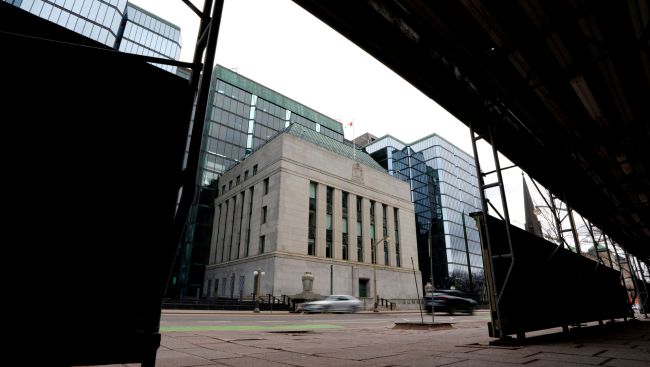
The Bank of Canada cut its benchmark interest rate by a quarter point Wednesday and signalled it may be satisfied with where the policy rate sits amid ongoing U.S. trade uncertainty.
The central bank’s key rate now stands at 2.25 per cent after a second consecutive cut.
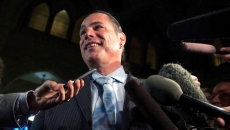
Bank of Canada governor Tiff Macklem told reporters after the announcement that monetary policy-makers feel the policy rate is at “about the right level” to keep inflation close to the bank's two per cent target while supporting the economy through tariff disruptions — provided the economy evolves in line with its expectations.
Economists widely expected Wednesday’s cut as Canada’s economy shows cracks from U.S. tariffs but inflation appears largely under control.
Macklem said the central bank is expecting the pressures pushing inflation higher — costs related to tariffs, for example — will be largely offset by a weaker economy going forward.
He also said there isn't much more the Bank of Canada can do at this point to help the country through the turmoil tied to tariffs — something he considers a structural shock to the economy, not a cyclical or temporary one.
"Monetary policy can't target specific sectors … it can't help companies find new markets, it can't help companies reconfigure their supply chains," he said.
"What it can do is it can try to mitigate the spillovers from the hard-hit sectors to the rest of the economy."
The Bank of Canada returned to publishing a central forecast for the economy and inflation Wednesday, a practice it had foregone since January as tariffs clouded its outlook.
“It has now been six months since we have been living with U.S. tariffs. And while U.S. trade policy remains unpredictable, its impacts are becoming clearer,” Macklem said.
After the economy contracted in response to a sharp drop in exports in the second quarter, the bank now sees modest annualized GDP growth of 0.5 per cent this quarter and one per cent in the fourth quarter.
The forecasts show growth will likely be restrained in the next two years, averaging 1.4 per cent, as population growth slows and Canadian exporters attempt to diversify beyond the U.S. market.
The central bank expects trade disruptions will structurally reduce the size of Canada’s economy and forecasts GDP will be 1.5 per cent lower by the end of 2026 than its projections before U.S. tariffs were imposed earlier this year.
Macklem warned that Canada must work to boost its productivity in the face of this weaker growth or face harsh economic consequences.
"Unless we change some other things, our standard of living as a country, Canadians, is going to be lower than it otherwise would have been," he said.
U.S. tariff policy remains “unpredictable,” Macklem noted. He made a brief reference to U.S. President Donald Trump’s decision over the past week to abruptly halt trade talks with Canada over an Ontario ad campaign and threatened to impose an extra 10 per cent tariff on Canadian goods.
This environment means the Bank of Canada can’t put as much stake in its forecasts as usual.
“The range of possible outcomes is wider than usual — we need to be humble about our forecast. If the outlook changes, we are prepared to respond,” Macklem said.
What constitutes a material change to the bank is not one month of readings or a single data point, Macklem said, but an "accumulation of evidence" that the economy is shifting according to the central bank's baseline.
The Bank of Canada will get another significant input for its modelling next week when the federal government tables its long-awaited fall budget.
Macklem has long said that while monetary policy is limited in how much it can support the economy through the trade disruption, fiscal policy-makers can provide targeted supports to respond to tariffs.
The governor was typically tight-lipped when asked how the federal government should respond to current economic challenges in next week's budget — the Bank of Canada operates independently from the federal government — but said the central bank would weigh the spending plan based on how it added to both supply and demand forces in the economy.
CIBC senior economist Andrew Grantham said in a note to clients Wednesday morning that the Bank of Canada "appears to be moving back onto the sidelines" to gauge incoming data.
Grantham said he expects this will be the central bank's final cut of the cycle if the economy starts to recover from here and Canada secures a trade deal to reduce ongoing sectoral tariffs from the U.S.
"However, further cuts would certainly be justified if the economy continues to weaken and/or if the outlook for trade doesn't improve," he said.
Stephen Brown, deputy chief North America economist with Capital Economics, said in a note he expects the bank will continue to reduce its policy rate to as low as 1.75 per cent in 2026.
He said he is expecting GDP will come in a touch lower than the Bank of Canada is now projecting in the years ahead, pushing inflation even lower and warranting more rate-cut relief for the economy.
Picture Courtesy: THE CANADIAN PRESS/Justin Tang