A senior official at the Bank of Canada says the central bank is reconsidering how it thinks and talks about inflation as it prepares to review its mandate later this year.
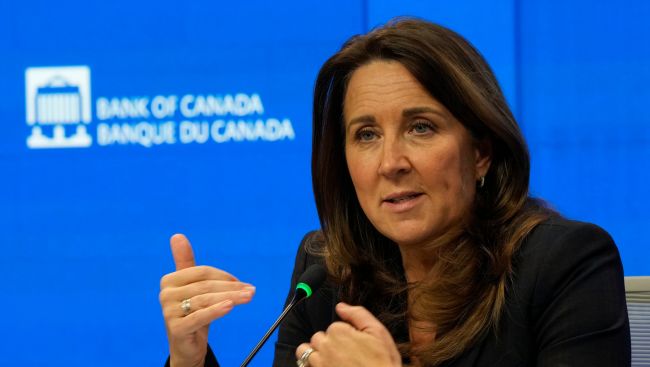
Bank of Canada senior deputy governor Carolyn Rogers was in Brandon, Man., on Thursday speaking to the city’s chamber of commerce about how the bank is grappling with a series of economic shocks.
“Canadians have faced a lot of economic upheaval over the past five years, and the next five may not be much calmer,” Rogers said in prepared remarks.
She said the oil price shock from the Iran war is squeezing consumers and businesses, but it’s still too soon to say what the conflict will mean for growth and inflation in the coming months.
The Bank of Canada held its benchmark interest rate steady at 2.25 per cent for a third consecutive time last week. Officials signalled at the time that they’d look through a near-term inflation spike from higher energy costs but would act if necessary to make sure price pressures from the conflict around Iran don’t become entrenched.
Financial markets shifted late last week to favour interest rate hikes from the Bank of Canada and other central banks later this year amid uncertainty in the Middle East, though many economists argue the slow recovery in the Canadian economy doesn’t merit higher rates right now.
Rogers acknowledged in her speech that the Bank of Canada underestimated how persistent inflation would be after the COVID-19 pandemic. The central bank had become accustomed to decades of low, stable inflation and its models underestimated the extent of the supply shock on prices, she said.
The senior deputy governor reaffirmed the bank’s confidence in its inflation target of two per cent, arguing that anchor proved its value by helping to rein in consumer expectations in the post-pandemic run-up in prices.
Rogers said that, in addition to the recent shock from the Iran war, the economy is now grappling with structural changes related to U.S. protectionism, stalled population growth and the rise of artificial intelligence.
She said the central bank is expecting a “more variable inflation environment” in the years ahead, given these structural shifts.
As the Bank of Canada prepares for the renewal of its five-year mandate from the federal government later this year, Rogers said the bank has been consulting with Canadians and have heard that the rapid changes in the policy rate in recent years were jarring.
“They’ve told us that they value stability in both inflation and interest rates. This is not a surprise, of course, but hearing it directly from Canadians is a good reminder,” she said.
Rogers said the Bank of Canada wants to be sure it is working to get a better grasp on where price pressures are heading.
The annual rate of inflation cooled to 1.8 per cent in February, though the Bank of Canada and many other economists expect that headline figure to rise in the months ahead amid higher gas prices.
Rogers said the Bank of Canada is working harder to detect supply shocks and using more real-time data to guide its decisions, rather than waiting on when those impacts show up in traditional economic reports.
The inflation picture has been clouded in recent months, in part by tax changes from the federal government that distort the annual comparisons.
Rogers said that, to cut through that noise, the bank has broadened the metrics it’s using to gauge underlying inflation, but she acknowledged that has sometimes “led to confusion or even a sense that we were moving the goal posts.”
“So, we are reflecting on what we learned and on how we can improve our communications to guide expectations,” she said.
Rogers also spent some time in her speech addressing the Bank of Canada’s role in housing affordability.
While a period of low borrowing costs can coincide with a rapid run-up in housing prices, and rate hikes can conversely push mortgage costs higher, she said the Bank of Canada does not target home prices specifically and is limited in what it can do to meaningfully improve the affordability of homes for Canadians.
The central bank is reviewing how it measures shelter inflation and is also working on how it can better explain the interaction between monetary policy and housing imbalances, Rogers said.
Picture Courtesy: THE CANADIAN PRESS/Adrian Wyld