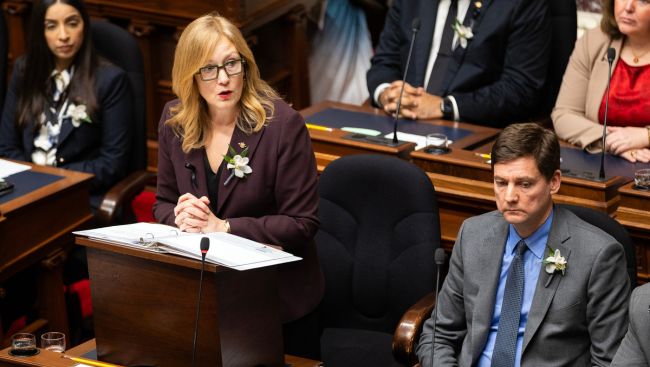
British Columbia's finance minister started to sell her "tough" budget Wednesday to business leaders who describe her deficit numbers as "scary," while other groups are tabulating the losses.
Brenda Bailey told about 200 people at a Greater Victoria Chamber of Commerce that the budget "lands in the middle" of those who say government should be making "big cuts" to health care, education and public safety and those who don't want government to stop building.
But the chamber's chief executive John Wilson said after Bailey's appearance that the business community would have liked to have seen deeper cuts because the deficit, which is predicted to soar to a record $13.3 billion next fiscal year, needs to be "reined in very quickly."
Bailey told the chamber that her budget will reduce the deficit "responsibly," while "safeguarding" the core public services of health care and education.
The finance minister said the government cannot cut its way out of the deficit, but is instead making structural changes to the public sector and by slowing the construction of capital projects.
Bailey said government has made some small tax changes, and plans to raise additional revenue by "maximizing" B.C.'s natural resources through LNG projects, while "doubling down on mining," especially in the area of critical minerals.
Bailey said the budget is “serious work for serious times."
It raises the base income tax rate by 0.54 per cent — the first increase in 26 years.
The government also plans to cut 15,000 full-time public sector jobs over the next three years.
But the budget released Tuesday has drawn critics from all sides with its soaring debt and deficit, public sector cuts, and construction delays for care homes, student housing and a cancer centre.
BC Federation of Labour secretary-treasurer Hermender Singh Kailley is calling for transparency to ensure the cuts won't affect front-line service delivery.
BC General Employees' Union president Paul Finch said they wanted to see "strategic investment" in services that keep costs down but instead saw more cuts to the public workforce.
Finch said the province has broken a promise that keeping costs down could be achieved by "rightsizing" the ratio of management to front-line service workers, and it will be challenging to build an economy on a "weakened public foundation."
The BCGEU also issued a news release Wednesday noting that the Office of the Merit Commissioner had been abolished and its responsibilities would be transferred to B.C.'s Public Service Agency, the same body that is responsible for administering hiring processes across the public service.
“You cannot effectively oversee yourself,” Finch said. “Independent review exists for a reason: to ensure accountability, maintain public confidence, and protect from political or internal interference."
Other groups are also noticing the cuts, including the Lower Fraser Floodplains Coalition. It said in a statement that it "deeply frustrated" that the provincial budget once again fails to reduce long-term flood risk in the Lower Mainland, one of British Columbia and Canada's most important regions from an economic perspective as a major trade corridor.
"Despite admitting that escalating threats from the disasters like flooding, wildfires and landslides pose serious risks to B.C.'s economic outlook, the province has decided to roll the dice and ignore the problems," it said.
The BC Real Estate Association said in a release that the budget was an "inflection point" for issues such as housing.
"Unfortunately, the budget failed to address either the growing tax burden or the province's housing issues," it said.
BCREA said it is not surprising that government is "running a sizable deficit" as the provincial economy faces external headwinds and uncertainty.
"However, the lack of a clear plan to return the provincial debt-to-GDP ratio to a sustainable path raises concerns about the province’s fiscal health," it said. "Mounting debt and rising debt-service costs will constrain the ability to provide tax relief for B.C. households or fund worthwhile programs."
Government is also faces ongoing criticism from the Opposition, in debate on the budget in the legislature.
On Wednesday, B.C. Conservative finance critic Peter Milobar focused on the government's decision to indefinitely delay Phase 2 of the Burnaby Hospital and Cancer Centre, with an estimated price tag of $1.8 billion.
"Last I checked, Burnaby has been represented by the NDP for a long time," he said. "Talking about taking an area of this province for granted. If you live in Burnaby, you should feel you have been taken advantage of and taken for granted."
Bailey acknowledged the critics during her chamber appearance on Wednesday.
"I know this is a tough budget," she says. "I firmly believe, though, that British Columbia is the place to be. We have everything to make sure that we can become self-reliant, that we can sell to the world."
She rejected the suggestion that government could have raised additional revenues by taxing the very wealthy, including large corporations.
Government opted against that, because it would not have worked, she says.
"Jurisdictions that have attempted that have, unfortunately, seen flight of capital," she said. "That's not something that we are interested in seeing."
Bailey said later during question period in the legislature that the budget defends core public service and there are affordability increases for families.
She also defended the decision to eliminate the Office of the Merit Commissioner, saying that merit has become part of the Public Service Agency's culture.
Picture Courtesy: THE CANADIAN PRESS/Chad Hipolito