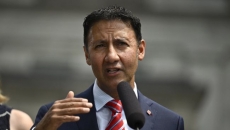
The British Columbia government is cancelling a promised $1,000 grocery rebate and will freeze hiring of some public service positions to "find dollars" in its budget as it prepares for "four years of unpredictability" from the United States, Finance Minister Brenda Bailey says.
Bailey said Thursday that the impacts of the "reckless" and "destabilizing" tariffs threatened by U.S. President Donald Trump are impossible to predict.
The moves come as B.C.'s budget is set to be tabled on March 4, the same day a month-long pause on Trump's tariffs on Canadian goods is set to expire and just over a week before tariffs on all foreign aluminum and steel could also begin.
The province is already seeing economic effects, even though tariffs aren't in place yet, and it would be "wrong to underestimate" their potential impact, Bailey said in a news briefing.
In the campaign for the October election, the governing NDP had promised the $1,000 grocery rebate to be delivered to all households this fiscal year ending March 31.
Premier David Eby had touted the pledge as offering immediate relief, in contrast to Opposition BC Conservative tax-relief pledges that he said would not deliver until 2026.
Bailey said she's disappointed the government can't keep its election promise on the rebate, but it would be a $2-billion expense when economic circumstances are incredibly difficult.
"This was a commitment that we very much wanted to make. We made it with the intention of doing it, but the world has changed," she said.
"It is our responsibility to make sure that we protect the core services for people in British Columbia, that we protect health care, that we protect education, that we protect social services, that we protect safety in our streets."
Bailey said the hiring freeze affects the province's public service, which includes people who work within the government ministries and directly for the ministries.
Jobs like health-care workers, which are part of the broader public sector, as well as specific "core" public service jobs like correctional and social workers, would not be affected, she said.
"It's our objective to find dollars that haven't perhaps landed exactly as we hoped they would. That's our first approach and most hopeful piece," she said.
"We'll also be looking at things like travel and consultancy costs and places where we might be able to find efficiencies across government."
Paul Finch, president of the BC General Employees' Union, said in an interview that the union was not told about the freeze ahead of time and has not seen the list of "core" jobs that will be protected.
"The civil service plays an incredibly important economic function, not only with public safety, but also with seemingly mundane tasks, such as the policy analysts that work on natural resource permitting and other key economic projects that we need to ensure keep going, especially now in the face of a trade dispute," he said.
Finch said front line positions are not overstaffed.
He said the government needs to take "a measured and careful approach" undertaking these types of moves and should be looking at the ratio of non-union managers to front line workers, which he said is now 1:3 after being 1:4 15 years ago.
Trump has said he plans a 25 per cent tariff on most Canadian goods, and 10 per cent for energy. The United States also announced a 25 per cent tariff on all foreign aluminum and steel earlier this week that Trump said would be stacked on the Canada-specific tariffs starting in mid-March.
Bailey said economic modelling for the tariffs, and Canada's retaliation, shows B.C. could lose $69 billion in GDP over four years and tens of thousands of jobs.
"We could never imagine a situation where our closest neighbour has essentially declared economic warfare on Canada. It's unimaginable, and the implications could be enormous," she said.
Bryan Yu, chief economist for Central 1 Credit Union, said the government is in a "very challenging position" with the budget, and it still would be a challenge if B.C. waited until after March 4 to release it.
"I think regardless of when the budget would come out, it would be within that overall cloud of uncertainty that's going to surround the budget, and I think that is the big challenge at this point, that uncertainty," he said.
Yu said the government's choice to be cautious and make sure it has funds available to deal with the impact of potential tariffs is "probably necessary at this point."
Bailey said the government considered doing two budgets because of the looming tariffs but decided against it, opting instead to develop a budget that is focused on protecting services.
She said the budget took into account the "best estimates" of 13 senior economists from across the country, who make up the B.C. Economic Forecast Council.
"All of those economists were given the opportunity to update us, including what they perceive to be the tariff impacts, and about half of them did provide updates to us," she said.
"That's the economic modelling that we've included for the decisions that we've made in the budget."