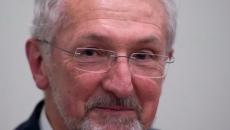
James Wolfe, who lives in B.C.'s Fraser Valley, spent the last year and a half looking for a long-term care bed for his 68-year-old brother Brian, who has Down syndrome and non-verbal dementia.
Mostly, it involved a back-and-forth with local health administrators. "They are great people," he said. "They are very compassionate doing their job."
But there was simply a lack of appropriate facilities, and Wolfe said his brother was in and out of hospital as his health declined.
"At Christmas, he was really sick in the hospital," Wolfe said, and while his brother was eventually discharged, he was back in hospital with pneumonia and sepsis in January.
Wolfe's advocacy has now finally landed his brother in a group home for adults living with disabilities.
Looking back, Wolfe said he wondered where his brother would be without family support, and he criticized a recent B.C. government decision to delay construction of seven long-term care projects.
The decision, announced in the February budget, comes amid a shortfall of long-term care beds that is projected to soar over the next decade as the population ages.
"I think it's horrendous," Wolfe said of the delays. "You are essentially putting people in danger, if you do not have a place to put them."
The facilities being put on hold are in Squamish, Abbotsford, Campbell River, Chilliwack, Delta, Kelowna and Fort St. John. They involve 1,223 beds, although some of those would replace current beds in existing facilities.
The Squamish project is a planned 152-bed facility that was originally set for construction in 2027. The government hasn't offered a new timeline.
The Sea to Sky Hospice Society had been planning to move into the new facility and the open-ended delay has stressed board chair Marya Hackett.
"We have a population of seniors that is aging, and is going to need long-term care. What are you going to do with them?" she asked.
Hackett said that even if it proceeds, the new project would not be keeping up with the need in the region. Eight of its beds have been slated for hospice care, although only four of them are new, with the others being transferred from an existing facility in Squamish.
The same could be said for the rest of the province.
Figures released by the Office of the Seniors Advocate in January pegged the shortfall of long-term care beds at 2,000.
Government numbers released last year, meanwhile, show B.C. will need 16,000 new long-term care beds over the next decade to make up the gap between the projected supply of publicly subsidized beds and projected demand.
B.C.'s senior population, aged 65 and older, is projected to increase by 26 per cent in the next 10 years, and wait-lists for long-term care have "ballooned," according to a report released by the seniors advocate in July 2025.
It shows that the number of people on the wait-list for long-term care tripled from 2,381 to 7,212 between 2016 and 2025. Wait times doubled from 146 days in 2018, the first year of data collection, to 290 days in 2025.
"Without significant additional investment in building more new long-term care beds, wait-lists and wait times will continue to rise to unsustainable levels," it reads.
When Finance Minister Brenda Bailey announced the delays in last month's budget, she said they would allow the facilities to be built at a lower cost in the future, by better distributing demand for building materials and other costs.
Speaking to local business leaders one day after tabling her budget, Bailey said she was asked to sign off on a project that would have cost $1.8 million per bed.
"That's crazy," Bailey said. "That is so expensive, you could buy a condo in (Victoria's) James Bay for $1.8 million."
Government, she said, had to do better. "How are we going to serve seniors? If we are spending that kind (of money), we're going to be able to build very few."
The finance minister said the government was looking into ways to standardize design of long-term care facilities without compromising quality of care, and she has insisted the delays are not cancellations.
Hackett agreed with Bailey's rationale to save money — but only to a point.
Government, she said, needed to make sure that it got the best value for money. "But any time you delay a project, your costs are going to increase, because the costs of everything are increasing," Hackett said.
The Opposition is not buying Bailey's arguments.
Peter Milobar, the Conservative finance critic, called the delays a "mean-spirited attack" on seniors during budget debate last month.
His colleague Brennan Day, critic for rural health and seniors health, said in the legislature that he did not believe Bailey's promise to build the delayed projects at lower costs, saying the government had "completely abandoned seniors."
He later tabled legislation to require government to become more transparent around the state of long-term care.
"You cannot fix what you do not measure," he said last month. "This bill forces the government to publish and update annually a clear plan to address long-term care beds, hospice capacity, wait-lists and care at home in full public view," he added.
Dan Levitt, B.C.'s seniors advocate, told reporters after Bailey presented her budget that the delays would deepen the gap between projected needs and construction of long-term care beds.
While he acknowledged the financial realities facing the province, he said delays would put more pressure on hospitals as seniors spent more time in emergency rooms and acute care.
"It's going to put pressure on doctor's offices, because that is where the seniors are going to go to get medical care," he said.
"It's going to put pressure on the family caregivers. People who should be in workforce are now caring for that senior. It's also going to create a situation where seniors are not getting the kind of care they should be."
The process of finding a long-term care solution for Brian Wolfe wasn't easy for James Wolfe, but he said it was worth it.
Wolfe said his brother is "doing really well," after having regained up to 13 pounds in weight in five weeks. Wolfe said his brother weighed only about 96 pounds when he went to hospital in January.
"I had to take time off work to go deal with where he is, and stuff like that," he said.
"It's quite an emotional roller-coaster, and it doesn't seem like anybody truly has any answers to anything."
Picture Courtesy: THE CANADIAN PRESS/Handout - James Wolfe