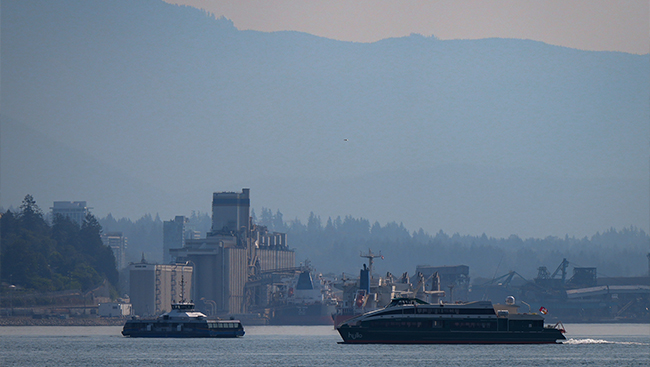
British Columbia's energy minister is backing plans to dredge and deepen Vancouver's Burrard Inlet to accommodate fully loaded oil tankers, despite concerns from environmentalists, experts and First Nations.
The plan, floated recently by Prime Minister Mark Carney, could result in fewer tankers carrying more oil from the Trans Mountain pipeline to markets abroad.
The expanded TMX pipeline has been operating since May 2024 and there have been calls to expand it again to help diversify energy exports away from the United States.
"We certainly have said we are supportive, given that it would meet the environmental requirements and consultation requirements (with First Nations) that you have," Energy Minister Adrian Dix said in a recent interview.
Dix added that it would be a federal project that "would allow for less traffic at the port and better utilization" because ships could fully load.
"To do that (now), to fully load up would risk you hitting the bottom," he said. "You don't want to do that."
The comments are a reversal by the NDP government from 2017 when then-premier John Horgan vowed to use "every tool in the tool box" to try to stop the expansion of the pipeline.
The Supreme Court of Canada shut down the B.C. government's opposition three years later, ruling that the province lacked the constitutional authority to interfere with projects crossing provincial borders, but still First Nations, environmentalists and experts say such an expansion raises concerns.
Dredging Burrard Inlet would allow fully loaded Aframax-class tankers to pass under Vancouver's Second Narrows Bridge after filling up at the Westridge Marine Terminal at the water's edge in Burnaby, the end of the 1,180 kilometre-long pipeline that begins near Edmonton.
Aframax tankers measure up to 250 metres long and have a draft of up to 16 metres deep, but Trans Mountain says on its website that such tankers generally load to about 80 per cent of capacity to provide clearance in Port Metro Vancouver.
Juan José Alava, principal investigator with the Ocean Pollution Research Unit at the Institute for the Oceans and Fisheries at the University of B.C., said any proposal to dredge the area requires careful scrutiny because of its impacts on the ecology of one of the "most beautiful areas, water bodies" in B.C.
Alava, who lives near the inlet, said it's very shallow with an average depth of 21 metres and a maximum depth of 66 metres. Dredging could have short-term and long-term impacts on the inlet's ecology, he said.
Dredging suspends more solids in the water, increasing its turbidity, he said. Higher turbidity in turn hampers the production of phytoplankton, the base of the food pyramid. This would impact larger animals, fish and mammals like seals and killer whales, he added.
"So you can create a real cascade effect in the ecosystem," Alava said.
Dredging can also impact the ability of salmon to spawn and would release pollutants trapped on the ocean floor, he said.
Enda Murphy, assistant professor in the department of civil engineering at the University of B.C., said it is not clear how much material would have to be removed at what cost, without all of the information in front of him.
It may not be a huge project compared with the millions of cubic meters per year taken from the nearby Fraser River, he said.
He agreed with Alava on several points, including the dangers of digging up pollutants that have accumulated over the decades of industrial use.
"(That) can pose risks to adjacent shorelines, particularly communities that have been trying to restore parts of Burrard Inlet like Tslei-Waututh (First) Nation."
Any future dredging of Burrard Inlet to accommodate heavier tankers would also have to consider potential impacts on shore lines through their wakes and on other marine traffic, Murphy said.
Any future dredging project would require fairly rigorous studies, but the technology and tools are available, he said.
That would be outweighed by the need to engage with the First Nations and other communities around the inlet, which would be "highly political," Murphy said.
No one from the Tsleil-Waututh First Nation was available for an interview, but Chief Jen Thomas said in a written statement that it has "not received any formal engagement regarding a proposed dredging of Burrard Inlet to facilitate further oil shipments past our community."
Thomas said Burrard Inlet and the Second Narrows are important cultural, spiritual, historical, economical and ecological sites for the nation.
"A proposal to dig up the seabed, which is culturally a part of us, is a very serious concern," Thomas said, adding that Tsleil-Waututh First Nation will "certainly have more to say on this matter" once it receives and has time to review such a proposal.
She notes that the Tsleil-Waututh hold inherent and constitutionally protected title and rights to the area.
"The Crown must remember that TWN is an order of government with jurisdiction over these matters as well, and Tsleil-Waututh cautions those who speak as though this project has been pre-approved."
Lucero Gonzalez, conservation and policy campaigner with the Wilderness Committee, said Burrard Inlet and the Salish Sea can't sustain megaprojects like the TMX, if B.C. wants to preserve those ecosystems and endangered species like the Southern Resident orcas that depend on them.
"Doubling down on ecological destruction for a project that was never ecologically or economically viable is a complete political failure," Gonzales said.
Dix stressed that the dredging would be a federal, not a provincial project.
"We just made it clear that we'd have no objection other than it obviously meets all the proper standards."
Carney had first raised the possibility of deepening Burrard Inlet on March 21 as one of several potential projects to develop Canada's natural resources and infrastructure.
Dix had signalled his government's support on previous occasions, including on April 17 during question period, when Opposition Conservative Gavin Dew asked if he was working with authorities to speed up a second expansion of the Trans Mountain pipeline and the dredging of the Burrard Inlet.
"It’s my view that given that public investment, that private investment and the importance of energy issues, we should use what we’ve built (the pipeline) to the fullest possible extent," Dix said. "We built it. We paid for it. We should use it."
Dew said in an interview he supports dredging up Burrard Inlet, adding that it "obviously needs to be done in a responsible and compliant" way.
"But it's just common commercial sense that we shouldn't be underutilizing tankers," he said. "Then, the pipeline was common sense when the NDP were dead set against it for years."
The B.C. Greens interim leader Jeremy Valeriote expressed surprise that the issue has surfaced in "the absence of an actual proposal or further details" from government.
Valeriote said in a statement that he expects to see a full environmental assessment, meaningful engagement with the Tsleil-Waututh First Nation and a "transparent explanation of the rationale and potential impacts” if dredging up Burrard Inlet.
“It’s not the kind of decision that should be floated casually or pursued without thorough public scrutiny," he said.
Dix agreed that the project needed a full review from the federal government, adding that the provincial government has already spoken with to Tsleil-Waututh First Nation.
"Obviously, it is not a project yet," Dix said. "It's not our project, but we did (speak with the nation) before we expressed our views on this."
Picture Courtesy: THE CANADIAN PRESS/Darryl Dyck