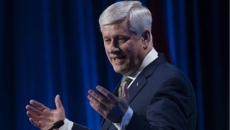
One day before delivering her first budget, British Columbia's finance minister said she knows that everyone is wondering how it can be done in the face of unprecedented tariffs from the United States.
It is not time to make "deep cuts," Brenda Bailey told reporters on Monday, but a time to plan for uncertainty and ensure programs and services are protected.
Experts and economists say the impact from U.S. tariffs on Canadian goods will make Bailey's budget on Tuesday one of most consequential for the province in recent memory.
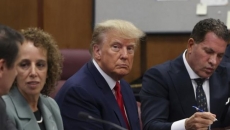
U.S. President Donald Trump confirmed Monday that 25 per cent tariffs would be announced Tuesday for imports from Canada and Mexico, with a lower 10 per cent levy on Canadian energy.
It follows the U.S. Department of Commerce's announcement that it intends to almost triple anti-dumping duties on softwood lumber imports from Canada to 20.07 per cent.
Premier David Eby has called the U.S. tariff threat a "declaration of economic war," and on Monday he said he strongly denounced the duties.
"B.C. has long maintained that any and all duties on softwood lumber are unjustified, and these anti-dumping duties are based on a biased calculation — one that has been criticized by many of the United States' trading partners," Eby said in a statement.
Bailey spoke just before Trump confirmed the tariffs will be slapped on Canada on Tuesday, and said the uncertainty has already impacted B.C.'s economy.
"I expect that uncertainty and disorder will be with us and our friends in America for the next four years," she said.
"I just want to assure people that this budget does plan for that level of uncertainty. It's a budget that has room for us to respond."
The province has already cancelled a promised $1,000 grocery rebate and frozen some public-sector hiring as it braces for a trade war against what Eby called an "outsized and significantly more powerful foe."
"We fully intended to deliver it. But I can tell you that on Nov. 25 when then president-elect Trump posted that there would be 25 per cent tariffs across the board on Canadian goods and services, completely out of nowhere and unjustified, it changed our financial circumstances," Bailey said.
The province is already going into the budget carrying a record deficit, forecast to be $9.4 billion this fiscal year. On Monday, Bailey did not rule out a possible $10 billion deficit in Tuesday's budget.
While the province is dedicated to getting to a balanced budget, this will take "successive budgets," Bailey said.
In December, Bailey had said that the ballooning deficit would not change the government's intention to make "smart, targeted investments" to grow the economy, rather than cutting services.
But that was before Trump took office.
"What people in British Columbia need doesn't change based on American trade policy," Bailey said.
"People need health care, education, social services and safety, and businesses need to know that they can succeed in British Columbia. You will see these values reflected tomorrow when we deliver budget 2025."
Peter Milobar, the B.C. Conservative critic for finance, told reporters Monday that the official opposition wants to make sure the government doesn't try to get a "free pass" by blaming the financial situation on the United States "for what has really been their own lack of fiscal management over the last several years."
"I think we're in for a world of hurt," Milobar said.
"Without the tariffs alone, we were probably pushing closer to a $10 (billion) or an $11 billion deficit."
Jairo Yunis, director of policy with the Business Council of British Columbia, said members are anxious about the tariff uncertainties, and many are looking to the budget to "walk the talk" of strengthening B.C. as a value proposition for investors.
Stewart Prest, a political science lecturer at the University of British Columbia, said the recent throne speech — evoking wartime imagery with references to Winston Churchill, D-Day and the fight against Nazism — clearly indicates this year's budget will be anything but business as usual.
"While the form and nature of the fight will be quite different here, we're not talking about a shooting war, thankfully. We are talking about fundamental defence of sovereignty of the country and B.C.'s role in that," Prest said. "So, I think that that's an appropriate frame, unfortunately.
"There are still things that need to be done that are the same as needed to be done yesterday and last year … but all this is going to have to be recast within the frame of defending British Columbia (and) Canada's sovereignty at the same time."
Speaking on Friday, Eby said the uncertainty from the United States made it hard on businesses planning their future in a nebulous economic environment.
The Opposition Conservatives' jobs and economic development critic accused the NDP government last week of trying to "wrap themselves in the flag," while the provincial economy deteriorated.
"We came into this fight weak. Under the NDP, B.C. has become less competitive and less prepared for economic shocks," Gavin Dew said earlier this month.
Jock Finlayson, chief economist for the Independent Contractors and Businesses Association, said Bailey's task with the budget is an unenviable one, given the deficit.
Her options to mitigate the effects of possible tariffs are "quite limited," he said.
"I think B.C. is hamstrung because of the fiscal mismanagement over the previous two years," Finlayson said. "If they were running a budget balanced, or surplus, then they would have more scope to maybe spend another five or 10 billion dollars on discretionary, short-term programs to help industries or communities."
"So now we face a crisis, and the cupboard is essentially bare," Finlayson said.
He said the province should be pursuing everything possible to facilitate new projects and private-sector investment "anywhere and everywhere where it can be brought to fruition."
Yunis, from the Business Council of British Columbia, agrees.
"It's a huge risk if we don't get this right," he says. "The Trumpadministration is basically making the case for Canadian businesses to go to the U.S., and we've seen it within the forestry sector."