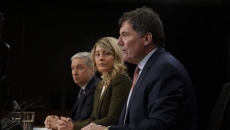
Members of the Tsilhqot'in Nation were at the United Nations headquarters in New York City on Thursday calling for the British Columbia and Canadian governments to help expand support services in the battle against the toxic drug crisis.
Chief Francis Laceese said the crisis is a "continuation" of threats Indigenous Peoples have faced in the form of residential schools and the smallpox epidemic that devastated Indigenous communities in B.C. in the early 1860s.
"We weren't supposed to be here anymore. The drug crisis is a continuation of this threat to our survival," Laceese said of Canada's residential schools, which separated more than 150,000 Indigenous children from their families.
"I think the government has to intervene, especially the Canadian government and British Columbia, to help us with this crisis," he said.
There had been a meeting recently with B.C. officials to discuss the crisis and impending closure of a four-bed detox centre in Williams Lake, he noted.
Thursday's news conference, which the U.N. says was sponsored by Canada's permanent mission to the world body, came one year after the Tsilhqot'in National Governmentdeclared a local state of emergency following a spike in deaths from toxic drug poisoning in its six member nations in central B.C.
"I think the statistics will show how many people have passed just in our community or at the nation level, B.C. level," said Laceese, the chief of Tl'esqox First Nation and vice chief of the Tsilhqot'in National Government.
Asked about harm-reduction measures such as overdose prevention sites and B.C.’s program that provides prescription alternatives to toxic illicit drugs, the executive director of the Tsilhqot'in National Government said access is a challenge because of the remote nature of many communities.
“We don’t have a lot of those,” Jenny Philbrick said of harm-reduction services. “We’re looking for total wraparound services moving forward for our people.”
The First Nations Health Authority released data this month showing 427 members of First Nations in B.C. died of a toxicdrug overdose last year.
It marked a 6.8 per cent decrease from 2023, but the death rate was still an average of 6.7 times higher than other residents of the province.
The health authority's chief medical officer, Dr. Nel Wieman, said that represents "the largest gap" between First Nations members and others since B.C. declared a public health emergency over toxic drugs in 2016.
The Tsilhqot'in Nation said last April when it declared the local state of emergency that toxic drugs, combined with the historical and ongoing harms of colonialism, were contributing to higher rates of overdose deaths among Indigenous Peoples.
The statement called on "all ministries and agencies to work together to end this loss of lives" and pointed to a lack of treatment facilities.
Chief Roger William with the Tsilhqot'in National Governmenttold Thursday's press conference that they need help to address the crisis "in our own way," in part through culturally centred programming
"On-the land treatment processes. Supportive recovery through equine therapy. Funding to support our culture and language," he said.
He said Tsilhqot'in members often face racism and discrimination in health-care settings, such as hospital emergency rooms, and they need provincial and federal helpto improve access to treatment and recovery services.
William said expanding supportive housing is also a key part of the fight against the toxic drug crisis. The basic needs of Tsilhqot'in members must be met in order to stop their "people from falling into using drugs," he said.
He said there had been some progress working with government.
"We're saying that it's not enough" to address the crisis, he said.
William noted his nation is not the only First Nation in B.C. grappling with the crisis, and others have also declared states of local emergency.
"(We) want to find space for all First Nations to come together and talk about solutions," he said.
Sierra William, a member of the Xeni Gwet'in community where Roger William serves as chief, also took part inThursday's press conference.
She said smallpox, residential schools and the Sixties Scoop — during which children were taken from their homes and adopted by predominantly non-Indigenous families — had all led to trauma in Indigenous communities.
Canada's Truth and Reconciliation Commission outlined a decade ago what must happen to improve the well-being of Indigenous Peoples, she said.
"If the calls to action were to be realized, some of our people wouldn't have a reason to turn to drugs," she said.
William said for her, self care doesn't mean taking a bubble bath.
"Self care for us is doing things to connect us to our culture, to our ways of life. The exact things (that) were taken away from us through colonization."
The Truth and Reconciliation Commission had called forsustainable funding for existing and new healing centres to address the physical, mental, emotional, and spiritual harms caused by residential schools, William noted.
The commission, which was tasked with researching Canada's residential school system, found the institutions were rife with abuse.
The commission estimated 6,000 children died in the schools, the last of which closed in 1996, though experts have said the actual death toll could be much higher.
Picture Courtesy: THE CANADIAN PRESS/Sean Kilpatrick