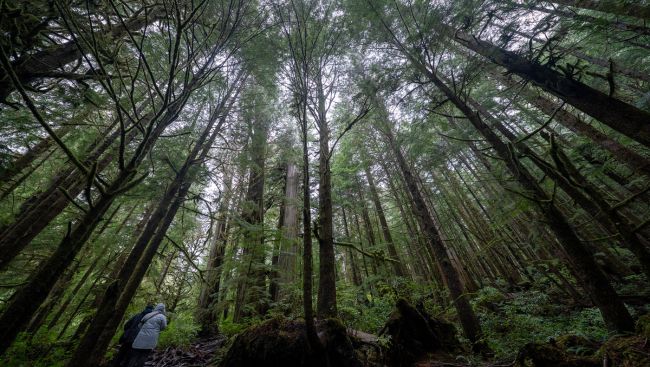
A government-commissioned review of forestry in British Columbia is calling for the system to be razed and rebuilt with a focus on trust and transparency about the state of the province's forests, shifting away "from managing harvest volumes to managing lands."
The final report from the Provincial Forestry Advisory Council released Monday says trust has been eroded by inconsistent forest data controlled largely by industry and government.
It calls for the creation of a transparent forest inventory based on laser measurements with a new independent body to manage the information.
"We're here because we have a system that is built on an era that no longer exists," said Shannon Janzen a co-chair of the advisory council.
"There has been too much change, there has been too much disruption around us that we need to step ahead, accept our reality, and be able to adapt so that the communities themselves have power over their future."
The 80-page report says there also needs to be an arm's-length assessment of high-value old growth trees to reduce conflict and ensure everyone is working from the same reliable data.
The authors of the report, including industry representatives and academics, pitch a model that would change who makes decisions about lumber allotment, taking that power away from the provincial government and shifting it to regional bodies that manage defined areas.
Co-chair Garry Merkel described it as being "a little bit like school boards," with decision-makers who are connected to the communities.
He said under the current model decisions are largely driven by people outside of the communities "trying to think about what they need and what they want," while also dealing with changing rules that come with each provincial government that is elected.
Janzen, a former chief forester, said the use of area-based land management is not a new idea and is already in use in places like Ontario and Alberta.
"It is not about government as much as it is about the people on the ground who actually have to step up and figure out how they can sort of form their own destiny here," she said.
"And it's about letting go of centralized control, Victoria-based decisions, into people in regions where the land is and the impacts of that land is actually felt."
Forest Minister Ravi Parmar would not commit to implementing the report's recommendations, telling reporters on Monday that he has to consult with other ministries.
"Government will be looking at those recommendations in detail and as part of the broader work that we're doing to restore confidence in British Columbia's forest sector," he said.
Thousands of forestry workers have lost their jobs as mills close across the province with timber supplies drying up and the U.S. government increasing tariffs and fees on Canadian softwood.
The report calls for publicly accessible, reliable data to form the foundation for land management decisions. It says a "robust" inventory must be created based on the use of LiDAR technology, which uses lasers to analyze forests, including tree heights, canopy density, and terrain.
"Trust is eroded by inconsistent data currently controlled largely by industry and government. To support evidence-based decisions, the province must transition to external, expert driven, transparent and service-oriented data management and delivery," it says.
Advocates wanting to protect B.C.'s ancient forests have previously warned that outdated and inaccurate government data puts the trees at risk of being logged.
Green Party MLA Rob Botterell, who was at the news conference with Parmar on Monday, said in a statement that the report "offers a monumental reset for British Columbia’s forests."
“B.C.’s forest-management system will face worse ecological degradation, instability, heightened conflict, declining public trust, and the loss of communities from permanent mill closures. The real risk is pretending a system that has failed workers, communities, and forests for decades will suddenly start working,” he said.
The opposition B.C. Conservatives said the report, which estimates implementation of the recommendations could take five years, "ignores industry realities and doubles down on governance restructuring."
Forests critic Ward Stamer said in a statement that the report’s core recommendations emphasize new structures, additional oversight bodies, and long-term frameworks, while largely ignoring the immediate barriers preventing wood from getting to market.
“Instead of streamlining permits or cutting red tape, this report actually recommends creating yet another oversight body,” he said. “It barely addresses regulation or permitting in any meaningful way. That tells forestry workers exactly where they stand.”
A statement from the BC Council of Forest Industries, which represents most of the lumber, pulp and paper and manufactured wood producers in the province, said it would be reviewing the recommendations with its members.
"We appreciate the goals of long-term stability and predictability, as well as the need for regional decision making. It is clear the status quo is not working, and strengthening B.C.’s forest sector is a shared priority," its statement said.
A joint statement from the Ancient Forest Alliance and the Endangered Ecosystems Alliance criticized the report, saying it fails to focus on clear policy incentives to protect old growth.
Endangered Ecosystems Alliance executive director Ken Wu said there were useful recommendations around improved mapping and data, but it didn't address the need to quickly transition to a value-added, second-growth industry.
The statement said the recommendation for regionalized forest management, with diminished provincial authority, risked jeopardizing the protection of ecosystems.
"This approach opens up the possibility of the timber industry, which deeply pervades much of rural B.C., to undermine conservation objectives and widen logging loopholes within conservation reserves, like Old-Growth Management Areas and Wildlife Habitat Areas, under the guise of regional ‘community decision-making’ and ‘wildfire risk management,'" Ancient Forest Alliance campaigner Issy Turnill said in the statement.
"This could be a Trojan horse to open up protected areas to commercial logging."
Brian Menzies, the executive director of the Independent Wood Processors Association of B.C., said there’s little detail in the report about how its members would access more fibre.
“I don't believe the authors of this report understand how the value-added manufacturing sector works, and it would have been nice to be included in their thinking,” he said in a statement.
He said it appeared this report “was developed in a vacuum without the assistance of those companies in B.C. that are struggling to create a new innovative value-added wood manufacturing sector."
Picture Courtesy: THE CANADIAN PRESS/Jonathan Hayward