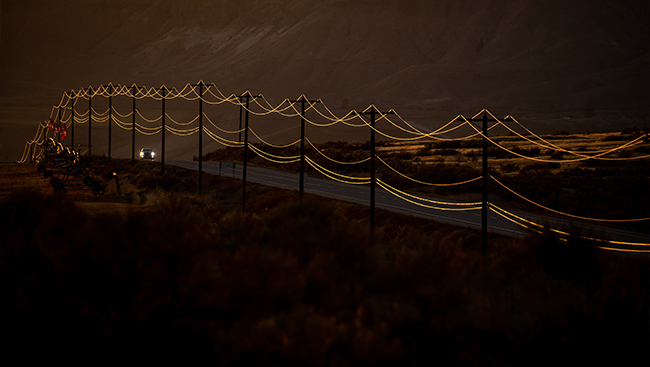
British Columbia's power utility is facing transformational challenges of drought, rising costs and a trade war with the United States as it works to meet electricity demand that's surging after two decades of relative stability.
An expected demand increase of 15 per cent by 2030 is sparking questions about whether BC Hydro is ready, with one former B.C. environment minister saying the provincefaces a power gap.
The Crown utility says it imported a net 13,600 gigawatt hours of power in the 2024 fiscal year, a figure representing about 22 per cent of all supply sources according to a service plan forecast issued last February.
But the utility says it has been a net exporter for eight of the past 15 years, and its outgoing CEO is unequivocal: "We have enough power."
Customers "should feel confident that (BC Hydro) will be able to meet their needs in a range of circumstances over time," Chris O'Reily said in an interview after addressing the Greater Vancouver Board of Trade on Thursday.
O'Reily told the board tariffs on Canadian goods launched by U.S. President Donald Trump have been "weighing on everyone's minds."
But Canada's trade challenges are also an opportunity to strengthen energy security, expand clean power and drive long-term prosperity, he said.
"By fostering homegrown solutions, by reinforcing regional collaboration, we can reduce our reliance on foreign markets and boost B.C.'s economy and create well-paying jobs in the renewable power sector," said O'Reily, who retires this year.
He pointed to additional capacity coming online with the Site C dam in northern B.C. as well as 10 renewable energy projects selected through BC Hydro's call for power in 2024 and another call set to launch this year.
O'Reily also highlighted BC Hydro's capital plan released in January. It allocates $36 billion over 10 years to replace aging infrastructure, expand distribution capacity and connect new electricity sources to the grid, he said.
Barry Penner, who served as B.C.'s environment minister between 2005 and 2010, is skeptical about the utility's readiness.
He said the province isn't generating enough electricity on its own, particularly given threats from south of the border.
"We're importing electricity on a net basis, meaning, yes, there are still brief periods where we're selling electricity, but we're importing a lot more than we're selling."
B.C. is on track to be a net importer again this year, buying most from the United States, said Penner, who chairs the Energy Futures Institute.
"Is there a guarantee we'll be able to buy that electricity tomorrow, or next year? Can you promise that President Trump won't curtail electricity sales?" Penner said.
"I hope he won't. But he's been demonstrated to be rather unpredictable and not necessarily a reliable ally to Canada."
Penner said drought has been the driver behind imports, forcing BC Hydro to hold back water in reservoirs to ensure supply during peak demand.
In an application to the B.C. Utilities Commission in March, the utility said "persistent drought conditions and low snowpack since the fall of 2022" had required higher-than-planned electricity import costs amounting to $1.5 billion.
O'Reily said that's partly why customers saw a rate increase of 3.75 per cent on April 1, with the same bump set to kick in next year. Each increase amounts to about $3.75 per month for the average residential customer, he said.
In addition to drought, BC Hydro's submission to the B.C. Utilities Commission said it faced "extraordinary inflation andmarket escalation," through it had benefited from higher-than-expected energy trading income.
O'Reily said the latest rate increases also reflect an "offset" provided by profits from Powerex, BC Hydro's electricity trading business. Over the last five years, he said the average annual profit from Powerex has been about $550 million.
"All of that gets put back to our customers and it reduces rates. So it reduces rates by about nine per cent," he said, andB.C. maintains some of the lowest rates in North America.
A report from Clean Energy Canada in February said B.C. imported 16 per cent more power than it exported between January 2019 and November 2024, but the value of exports was 35 per cent higher than the cost of the imports.
Still, Penner said it's the recent trend that's concerning.
He said drought was the subject of a December 2023 letter sent by the CEO of Powerex to the governing body of the Western Energy Imbalance Market that facilitates cross-border and interstate energy transfers between utilities.
The letter from Tom Bechard, who has since retired, said B.C. had been experiencing a "prolonged, widespread and severe drought" requiring "large volumes of ongoing net imports" from Powerex.
In 2023, Powerex had been a net importer for about 10,000 gigawatt hours, "greatly exceeding the previous annual net import record," the letter said.
Another former member of the province's Environment Ministry, however, said B.C. appears to be in "reasonably good shape" to meet growing demand for power.
Mark Zacharias, who served as deputy minister between 2017 and 2020, said the Site C dam and the 10 renewable energy projects selected through the call for power last year are expected to boost B.C.'s capacity by 16 per cent.
The province has announced BC Hydro is planning another call for power this year with the goal of adding another eight per cent capacity, he said.
At the same time, B.C. is becoming more efficient in using electricity, said Zacharias, now a special adviser with Clean Energy Canada.
"There are a lot of technological improvements happening very rapidly around us … that are also going to contribute to future grid stability and basically help offset whatever might be happening with climate change and reservoir levels," he said.
BC Hydro has projected its energy efficiency plan could result in up to 2,000 gigawatt hours of savings by 2030, equivalent to powering 200,000 homes.
Penner, meanwhile, said electricity from the 10 projects selected in the last call for power — nine wind and one solar — may take five years or more to hit the grid, and BC Hydro itself has acknowledged a risk.
"This risk may materialize as projects failing to reach commercial operation, delivering less energy than anticipated, or delivering the expected energy at a later date," it told the utilities commission in February.
The earliest guaranteed commercial operation date among the projects is 2031, though the submission said the provinceis working to accelerate timelines.
Where O'Reily, Penner and Zacharias agree, though, is on the need to reduce reliance on the United States, in part by strengthening ties with the rest of Canada.
B.C. and Canada should be "energy and electricity sovereign," Zacharias said.
"We need to look east-west across Canada, particularly when the (United States) is no longer a stable trading partner."
O'Reily, too, said BC Hydro is interested in strengthening ties with Alberta and the rest of Canada, moving away from the traditional north-south linkages.
"More independence from the United States, I think, is a pretty reasonable thing to do given events," he said.
"But we are going to remain connected. We generate significant revenue from that interconnection … It's part of how we keep rates down here."
Picture Courtesy: THE CANADIAN PRESS/Darryl Dyck