British Columbia has launched a $400 million fund to directly invest in private-sector projects or provide them with loans.
Premier David Eby said the B.C. Strategic Investment Fund that was flagged in last week's provincial budget will allow government to share in the future success of businesses that receive its funding, provided they turn a profit.
"This fund will be a key tool to attract major national investments to British Columbia, including opportunities tied to the Defence Bank proposal that we are advancing right now … as well as Canada's national defence strategy," he said on Tuesday. "This puts us in a position to compete for and win these major investments."
The government said the fund is part of its Look West strategy that aims to secure $200 billion in new private sector investments over 10 years in various sectors, including defence, life sciences and maritime industries among others.
Eby said the fund will allow government to help private companies get projects off the ground, then it would benefit through profit-sharing agreements and equity stakes.
The government says the fund will be similar to others, including in Ontario and Quebec.
Speaking at a news conference in Victoria outside a Canadian Coast Guard station, Eby said the fund would put B.C. in a position to win major contracts.
"Today, we are talking about a $400 million fund that is going to anchor major investment in British Columbia and help us participate in the federal government's commitment to spend five per cent of GDP on defence," he said.
Jen Riley, the president of the BC Chamber of Commerce said in a statement shared by Eby's office that the group welcomed the province's "commitment to advancing major infrastructure, and strengthening B.C.'s trade and economic capacity."
But the fund also received criticism from the Conservative Party of B.C.
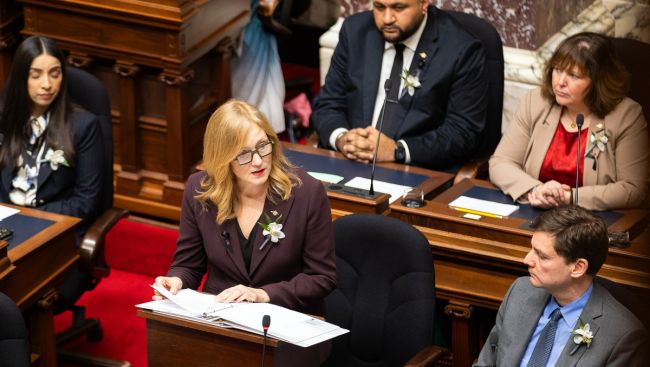
Gavin Dew, the critic for jobs, economic development and innovation, said during question period on Tuesday that the fund distracts from "nine years of NDP economic mismanagement" as he responded to comments made by Finance Minister Brenda Bailey.
"Her solution, instead of addressing investment fundamentals, is a $400 million slush fund for the premier to pick winners and losers instead of making sure that every company can build and grow and invest in this province," Dew said.
The announcement of the fund comes amid lingering criticism of last week's budget.
A coalition of business leaders said on Tuesday that the government must scrap a planned expansion of provincial sales tax to a range of professional services, saying it would depress economic growth and send business to other provinces.
Bridgitte Anderson, CEO of the Greater Vancouver Board of Trade, said the business community was "vehemently opposed" to the PST expansion on services like engineering and geoscience because it would raise costs and discourage investment as B.C. faces tariffs and other economic challenges.
Anderson, whose organization gave last week's budget a D grade, said the government never discussed the expansion during pre-budget consultations.
She said the government doesn't have a revenue problem, but a spending problem, in the face of a "skyrocketing deficit" forecast to reach more than $13 billion next fiscal year.
The proposed expansion of the PST is scheduled to take effect on Oct. 1 and the government has said it will align B.C. with other jurisdictions.
At the later news conference, Eby rejected the demand to scrap the tax expansion.
"We made, frankly, a difficult decision," he said. "We don't want to put additional taxes on anyone. It doesn't matter whether it's businesses, individuals or families."
Michael Goehring, CEO of the Mining Association of British Columbia, also criticized the tax increase.
"Government has made progress on permitting, but the new PST hike will hinder efforts to grow B.C.'s mining industry," he said.
When asked about Goehring's criticism, Eby said his government has "put in huge supports in place" for the mining sector and will continue to do so.
Eby said that in the last year, four new major mining projects have been brought forward and government has "dramatically" reduced permitting times and additional funds have been allocated for faster permitting and skills training.
"We will work with them to make sure that we are doing the best to support them during this process."
Picture Courtesy: THE CANADIAN PRESS/Chad Hipolito