British Columbia's public post-secondary institutions have seen a 70 per cent decline in international students, requiring the province to launch a review in a bid to stabilize the sector, the minister of post-secondary education said.
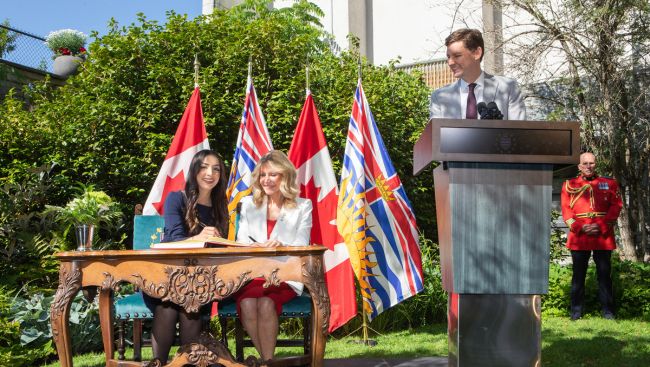
Jessie Sunner announced the review on Tuesday, saying Ottawa's decision to cut international student permits was a "unilateral" move that's contributing to the financial stress the province's educational institutions are facing.
"We were left out of those conversations," Sunner said of the move, adding provincial officials must be at the table in such discussions.
"We need to determine what the needs of B.C. are together. It's hard to do that (with) a federal lens of sweeping changes across the country when the needs here in B.C. are different than other parts," she told the news conference.
A statement from Sunner's ministry said B.C. was launching the independent review into its post-secondary education system as enrolment drops and inflation rises.
It will be conducted by former B.C. deputy minister and Emily Carr University board chair Don Avison, with recommendations expected by March 15.
"The review presents an opportunity to look at both near- and longer-term sustainability issues in post-secondary education and training," Avison said in a statement. "I welcome the opportunity to consider how best to address the challenges that lie ahead."
The review will consider what the province is calling a "holistic approach" to post-secondary education, covering governance, operations, program delivery and financial sustainability, the ministry statement said.
A focus, Sunner said, is to make sure programs are delivered more effectively "within current budgets" and reduce duplication while improving efficiency overall.
"Where we are right now with our economic situation not just (in) B.C. but across the country, we are not in a position to provide any kind of additional funding to the sector," she said.
"I think that's why it's even more important that what we do have, the supports that we have provided, we are making sure that they are being utilized in the best way possible."
The latest projection of B.C.'s provincial deficit puts the figure at about $11.6 billion.
Sunner said the post-secondary review is related to B.C.'s Look West economic plan, and training must be in pace to provide the skilled labour required for growth.
Earlier this month, the province announced an investment of $241 million over the next three years to expand trades training in an effort to boost the availability of skilled labour that will be necessary for several major proposed projects.
"A strong and resilient public post-secondary system is fundamental to building that workforce and driving B.C.'s economic growth," Sunner said in a statement.
"Public post-secondary institutions must be prepared to respond to these evolving needs."
Sunner pointed to the trades training investment as evidence of the New Democrat government's support for young people looking for well-paying jobs in B.C.
But she said the province needs to look at the post-secondary sector overall.
"There are schools that are doing a bit better than others, but across the entire sector, there are projected deficits for at least one year within the next few years, almost across all (institutions)," she said. "So this just shows that this not an issue with one institution or two."
The statement from Sunner's ministry said schools have suffered from declining domestic enrolment, combining with inflation to land them in a "critical position, with widening gaps between revenues and expenses."
The review aims to shore up short-term stability while building a "foundation for long-term financial sustainability and operational resilience" for B.C.'s post-secondary sector, Sunner said.
Picture Courtesy: THE CANADIAN PRESS/Chad Hipolito