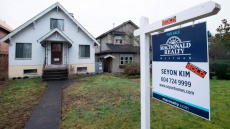
VANCOUVER — Public outcry over British Columbia's sizzling real estate market pushed the province's Liberal government to introduce a foreign-buyers' tax last month, but uncertainty around the policy leaves little room for political manoeuvring before next year's election, once the impact of the tax is better understood, experts say.
Max Cameron, a political scientist at the University of British Columbia, said the prospect of housing affordability turning into an election issue is "undoubtedly" what motivated the Liberals to step in with the tax.
"Their gamble is that it's better to look like you're doing something than to appear indifferent or tone deaf to the issue," Cameron said.
"This is a government that is very single-minded about its electoral calculations. That's what drives its policy making."
On Aug. 2, the provincial government began levying a 15-per-cent tax on all non-Canadians purchasing property in Metro Vancouver. It justified the surprise move as a bid to boost affordability for citizens looking to enter the housing market.
Cameron said the B.C. Liberals' strategy appears aimed at depriving the Opposition New Democrats of fodder to accuse them on the campaign trail of inaction on housing.

"The big fear on the part of the Liberals, to be blunt, is (NDP housing critic) David Eby filling town halls with angry residents saying, 'I can't afford to live in this place anymore and I'm moving out,' and the NDP capitalizing on that and carrying it forward as a central part of their campaign," he said.
At the same time, the B.C. Liberals and its free-enterprise coalition cannot be seen as anti-market, thereby alienating its pro-business, anti-tax base, said Jamie Lawson, a political scientist at the University of Victoria.
"It's actually quite a delicate thing they have to do and there aren't too many directions that a government with their commitments can go to provide really aggressive solutions."
The government's goal is to give Canadians "access to workable real estate purchases," said Advanced Education Minister Andrew Wilkinson on behalf of Finance Minister Mike de Jong, who was unavailable to comment.

"It's hard to find anyone who would say the market wasn't overheated in the Lower Mainland in the first half of 2016," Wilkinson said. He added that it would be premature to comment on the policy's long-term impact or whether the government might consider eventually tweaking the tax.
Hamish Telford, a political scientist at the University of the Fraser Valley, said the Liberals' brand as the party of laissez-faire made it difficult for them to intervene in the marketplace.
The conundrum the Liberals face now is that the tax will either be too effective or not effective enough, he said.
"The risk here is that they cool off the housing market too much and they get trapped in a situation where, on the one hand, Liberal voters are losing equity, but (on the other hand) housing doesn't become affordable enough for those who already can't get into the market," said Telford.
"One hopes that the 15-per-cent tax was calculated carefully enough that it would cool but not crash the market."

The Real Estate Board of Greater Vancouver released data Friday showing that home sales tumbled by 26 per cent in August compared to the same period last year. Despite the drop in sales, the board reported the composite benchmark price for all residential properties in Metro Vancouver had jumped more than 30 per cent since August 2015, to about $933,000.