When Elizabeth Osinde arrived in Canada about two years ago as a refugee from Kenya, pregnant with her son, she remembers being able to buy a bunch of kale for $2 or $3 dollars.
That same bunch is now closer to $5.
Osinde said she has a deep sense of gratitude for everything that Canada and the refugee program provides for her and her son, but she still has to rely on emergency hampers from Vancouver's Union Gospel Mission to make ends meet.
"I get half of my groceries from them because sometimes it's a challenge," she said of the hampers that are available to her one every three months, that also come with non-perishable items such as diapers and a $25 gift card for a local grocery store.
Without the help she could not afford milk for her growing son, she said.
"I depend on UGM, I depend the government. I really thank God for you guys because your government is good. Whatever they are giving we are not complaining" she said.
Union Gospel Mission said Tuesday that use of its emergency food hamper program increased 114 per cent in 2025, to 9,019 hampers from 4,209 the year before.
The increase has prompted an appeal for more funding for programs to address food insecurity, while it adds its name to calls for governments to consider getting into the grocery business to help bring down costs.
"Right now we live in a system where food is treated as a means for profit, rather than as a human right," Union Gospel Mission spokesman Nick Wells said.
"Food access needs to be improved and so city or provincially owned grocery stores are one potential thing (to help)."
Governments as grocers isn't a new idea, but has received more attention with New York's new mayor promising a pilot program and it appearing on the platform of a federal NDP leadership candidate.
Those who have looked at the prospect for Canada say the federal government would likely have to create a large enough network for the buying power to make a difference, while an industry representative called the idea "nonsensical" with the potential to harm independent grocers.
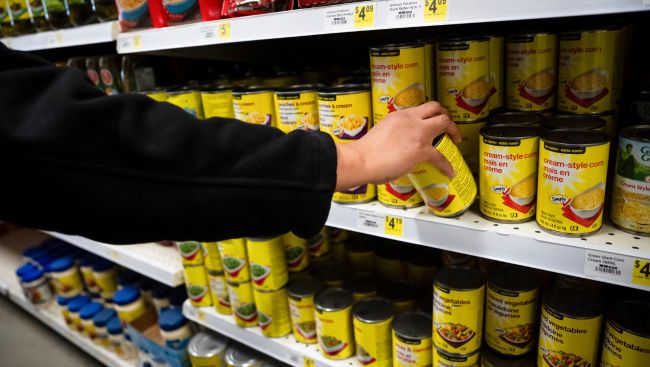
The Bank of Canada said this month that grocery prices have risen by about 22 per cent since 2022, while other consumer prices rose an average of 13 per cent.
"Elevated food prices continue to strain budgets for many households. Lower-income households in particular are feeling this burden because they allocate much more of their budget to groceries than higher-income households do," the analysis said.
In New York, Mayor Zohran Mamdani campaigned on a promise to open five public grocery stores, one in each of the city's boroughs, as part of a pilot program.
Avi Lewis is running for leader of Canada's New Democrats on a platform that includes a promise of a "public option for groceries."
Lewis said public grocery stores could cut costs by 30 to 40 per cent by using a subsidized warehouse model that his campaign materials compare to Costco.
A similar idea appears in an article published last month by the think-tank Canadian Centre for Policy Alternatives, which suggests a “Costco-plus-local” model could reduce grocery prices by 25 to 45 per cent, depending on where people live.
Errol Schweizer, a former U.S. executive with Whole Foods, and one of the co-authors of the article, said the federal government would cover costs like labour, rent, and utilities as well as some logistic funding for more remote locations. This would allow the grocery stores to sell food at cost.
He said standard grocery stores need high-gross margins to have enough to keep them running, even if their final profit is only one-to-three per cent.
"If you want to lower prices to 2019 levels, you have to subsidize that gross margin, period. And you can either do that through a subsidized grocery store or by giving people more money," he said.
In the United States, a publicly run grocery chain exists for members of the military and their families, Schweizer said. The Pentagon covers the costs to run the military commissary system and the stores are mandated to save shoppers at least 23.7 per cent.
One of the keys, he said, is scale. Ottawa would need enough buying power to get wholesale deals.
The article estimates it would cost the federal government approximately $350 million for initial infrastructure to open 50 stores and six distribution hubs.
Annual operating costs, with government covering labour and overhead like rent, would be another $290 million.
"It's not a lot of money. It's less than a fighter jet. It's a fraction of a fraction, it's a rounding error when you consider the Canadian government budget," Schweizer said.
Canada's plan to buy 88 U.S.-built F-35 fighter jets was given a price tag of $27.7 billion by the auditor general last year.
Gary Sands, senior vice president of the Canadian Federation of Independent Grocers, called the idea "just nonsensical," pointing out that stores run on profit margins of about two per cent.
He said factors like wildfires, disruptions to the supply chain caused by tariffs, energy costs and inflation are just some of what's driving up food costs.
"It's like the four horsemen of the apocalypse have taken up careers in the food industry. And for someone to suggest that, poof, all of those issues go away because now it's a government-run grocery store, to me, it's just a head scratcher," he said.
He notes that even if a government steps in to cover some costs, the money will still come from taxpayers.
Instead, Sands said the government should invest in distribution and transportation to create an east-to-west supply chain with regional supply terminals across the country.
"How can we support the Canadian independent retail grocers that are existing now? Support Main Street grocers. We don't need government grocers," he said.
Osinde said anything that could be done to make food cheaper would be a blessing, and could end her reliance of the hampers.
"We could give other people who cannot get the support from the government (a chance) to get those food hampers," she said.
Picture Courtesy: THE CANADIAN PRESS/Christopher Katsarov