British Columbia is pushing back against Alberta Premier Danielle Smith's proposal for a bitumen pipeline to B.C.'s northern coast.
It's expected to be a focus of Prime Minister Mark Carney's meeting Monday with premiers in Saskatoon, where the assembled leaders are discussing a draft list of "national interest" projects to be fast-tracked through the approval process.
Smith said any project list that doesn't include new pipelines would send a bad message to Alberta as separatist sentiment flares up in that province.
Smith said she wants to see a bitumen pipeline built to ship oil to the Port of Prince Rupert on B.C.'s northern coast.
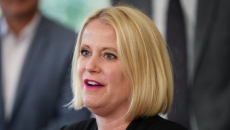
B.C. deputy premier Niki Sharma pointed out Monday that Smith's pipeline proposal has "no proponent at this stage" and said her province is pursuing "shovel-ready" projects.
"Although we have differences of opinion with respect to that, we're focused on where we can find alignment," Sharma said on her way into Monday's meeting.
"We're going to be focused on shovel-ready projects in B.C. that we can bring forward and we know will have a really solid impact on the economy."
B.C. Premier David Eby is not at the meeting. He is in Asia for a preplanned trade mission.
Smith said that nine federal policies, including the oil and gas emissions cap and the tanker ban on B.C.'s northern coast, discourage companies from proposing pipeline projects in Canada. She wants the Carney government to eliminate those polices.
"The problem is unless we address the nine terrible policies that have damaged investor confidence, we're not going to get the proponents coming forward with major investments," she said.
Carney vowed during the election campaign to slash federal approval times on major infrastructure projects in the "national interest" to help make the country an "energy superpower" as the country adjusts to ever-changing tariffs imposed by the U.S.
Legislation to make that infrastructure push a reality is expected to be introduced in the House of Commons as early as this week.
"We're in the process of redefining our relationship with the United States," Carney said at the beginning of Monday's meeting.
"That's what this meeting is about, building a stronger Canadian economy, a one Canadian economy."
The prime minister and the premiers are keeping the full list of projects under discussion a secret because they don't want to send negative signals about anything that doesn't make the short list.
On his way into the meeting Monday, Ontario Premier Doug Ford said the idea of a pipeline to B.C.'s northern coast would be discussed.
"Hopefully we can get it out west, so we can get to the Asian market, but we have to get it north and we have to get it east as well," Ford said.
Ford said it's "absolutely critical" that Canada expand its export markets.
The Ring of Fire mining project in northern Ontario is among Ford's main priorities heading into the meeting.
Saskatchewan Premier Scott Moe said he hopes that Carney's push to make Canada an "energy superpower" can help stem rising western alienation. Moe said that in order for this to happen, the regulatory environment will need to change.
"Policies do matter, and I think that's proved out in Saskatchewan over the last decade or decade-and-a-half with the mining investments that we've been able to attract. But policies do matter. And so we are going to need a shift in policies in order for that to happen," Moe said.
New Brunswick Premier Susan Holt said Smith’s pitch to fast-track a pipeline aligns with Carney's agenda.
“I think that that's exactly what the prime minister is talking about - nation-building projects to make us an energy superpower, build the kind of trade infrastructure that lets Canada really thrive,” she said.
“Out in the East and in New Brunswick, we know a lot about this because we're looking to connect our electricity infrastructure to build the connections that we need … to Nova Scotia and P.E.I. and Quebec and the U.S., so that the kind of energy that we're developing can reach the rest of the country."
Quebec has opposed pipelines in the past and Premier François Legault said that any new pipeline projects that would run through the province need to be examined closely.
"So we need to see what's the economic impact for Quebec, what is the impact on the environment. So what I say is that if there is a project going through Quebec, we'll study it," Legault said.
When asked about Smith's demands, Legault said he was invited to the meeting by Carney, not Smith, and he hadn't seen any concrete proposal for a new pipeline.
With differing demands from the 13 premiers, there will have to be compromises if Carney's vision of building a "one Canada economy" is going to work out.
Northwest Territories Premier R.J. Simpson said that, with so many competing agendas around the table, not all premiers are going to get "everything they want."
"But there's opportunity, there's a lot to do in Canada," he said. "A lot of these projects, they might not start on day one, maybe they're going to start down the road."
The first ministers are also expected to discuss breaking down interprovincial trade barriers, which would make it easier to purchase Canadian-made goods from other provinces and territories.
Many provinces, including Quebec and Ontario, are coming to the table with legislation that would eliminate some of these longstanding obstacles to internal trade.
Reporters and TV cameras were allowed into the meeting room to watch opening remarks Monday.
Ford walked into the room chatting with Smith and then told reporters that “love is in the air” just before the premiers gathered for the roundtable.
Internal Trade Minister Chrystia Freeland and Carney’s outgoing chief of staff Marco Mendicino shook hands with Moe on the margins of the room just before the meeting’s start.
Intergovernmental Affairs Minister Dominic LeBlanc took a seat at the table with the premiers next to Holt, while Natural Resources Minister Tim Hodgson sat at another table at the very back of the room near Mendicino and Freeland.
Picture Courtesy: THE CANADIAN PRESS/Liam Richards