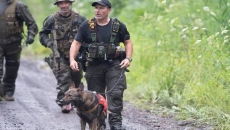
A regional politician in British Columbia's Interior is calling for more support amid a "dire" wildfire situation that he said has filled every available hotel with fleeing evacuees and stretched local security resources beyond their capacity.
Ken Gillis, who chairs the Thompson-Nicola Regional District, signed an evacuation order Monday for 28 properties near the community of Westwold, the latest in a string of such orders he has signed in recent days. He had to direct the latest evacuees to Kelowna, more than 100 kilometres away, because of the lack of accommodations closer to home, he said.
The district also put in a request with the provincial government for an additional 100 to 150 security and policing personnel to secure evacuated areas.
"It's a nightmare," Gillis said in an interview Monday. "We have absolutely nothing left (for accommodations) in Kamloops, we have nothing left in Merritt, we have nothing left in Salmon Arm. They're absolutely full."
Gillis said he considered directing evacuees to Cache Creek, but decided against it because the community is under an evacuation alert. An alert means residents must be prepared to leave their homes at a moment's notice.
"Some of the places are just places we can't send people to because two hours from then we might need to uproot them and send them somewhere else."
Later Monday evening, Gillis ordered the evacuation of another seven properties near Heffley Lake due to a wildfire in the Whitecroft area.
The fires affecting the regional district were among some 300 burning across the province on Monday.
Late in the evening, the province said on social media the Osoyoos Indian Band had ordered the evacuation of more than 100 properties. The BC Wildfire Service said earlier that it was responding to the Inkaneep Creek wildfire on the band's land, approximately six kilometres north of Osoyoos.
The wildfire service tweeted that it estimated the fire was about 300 hectares in size and personnel on site were reporting "aggressive fire behaviour."
Several new evacuation orders and alerts were also posted over the weekend by regional governments across B.C.'s southern Interior.
They came as the provincial organization that co-ordinates emergency support warned that available accommodation for thousands of wildfire evacuees was strained to the limit in the Thompson and Cariboo regions, and some evacuees were being sheltered as far south as Chilliwack.
Late Monday night, the Regional District of Okanagan-Similkameen issued an evacuation alert for parts of the town of Oliver.
Emergency Management B.C. has encouraged anyone who decided to leave their homes for larger communities due to smoky conditions to consider returning to make space for those facing a direct threat. Smoky conditions shift and move, so those who left their homes don't necessarily reduce their exposure, it said in a statement Sunday.
Environment Canada had air quality statements in effect across Western Canada on Monday due to smoke from wildfires between British Columbia and Ontario.
Ingrid Jarrett, president and CEO of the B.C. Hotel Association, said it has been working with Emergency Management B.C. for several weeks identifying and designating hotels with space for evacuees.
Overall, she said there were more rooms available than were needed, including in the Thompson and Cariboo regions, but the availability was concentrated in urban areas like the Lower Mainland.
Part of the problem is a staffing shortage caused by the COVID-19 pandemic, which means some hotels don't have enough staff to operate all of the rooms. While Jarrett did not have figures on overall room capacity, she said about 30,000 tourism and hospitality jobs are unfilled.
"We have some that have many rooms that are blocked off or wings that ... they simply cannot sell them for whatever reason because they just don't have anybody to clean the rooms," she said.
International students, visitors on working holiday visas and others who often work in hotels haven't yet returned to B.C., she said.
She also noted that motels, lodges and other accommodations qualify as emergency shelters in addition to hotels.
Beyond his concerns about accommodation, Gillis said the regional district hopes that additional security and policing resources would keep people out of evacuated areas, prevent looting and give peace of mind to anyone who is hesitant to leave their homes that the area will be secured.
Ultimately, he said he hopes the provincial government shares the request with their federal counterparts in case the Canadian Armed Forces can be called in.
"We're looking for an organization of some sort that can bring on a full force that has its own accommodation, meals transport," effectively setting up camps, Gillis said.
Emergency Management B.C. said in a statement the RCMP are working with the regional district on the request.
Dawn Roberts, director in charge of communications for the RCMP in B.C., said the Mounties have assigned a liaison officer to review it.
Typically, the Mounties will work with local governments to set up checkpoints as well as deploy roving officers. The RCMP identifies and deploys resources on a daily basis and has the benefit of drawing staff from other jurisdictions, she said.
The RCMP is already readying additional resources for populated areas — like 100 Mile House, Ashcroft and Clinton — where evacuation alerts recently went into effect.
"We're starting to ready those potential resources to either pre-deploy them into the communities and have them ready as necessary or to respond as necessary," Roberts said.

.jpg "No need for tariffs, Trudeau tells Trump")