A First Nations leader says the British Columbia government wants amendments that propose a "gutting" of its own reconciliation legislation.
Robert Phillips, a member of the political executive of the First Nations Summit says the First Nations Leadership Council has received and reviewed changes the province wants to make to the Declaration on the Rights of Indigenous Peoples Act, or DRIPA.
Phillips said the details of the proposed changes are confidential for now.
"But at this point, it's pretty much almost gutting DRIPA out," Phillips said of the proposed amendments.
The legislation is based on the United Nations Declaration on the Rights of Indigenous Peoples, but two recent court decisions citing DRIPA have sided with First Nations on mining and property rights, which the government has said isn't the intention of the law.
The B.C. government said in a statement Friday that it is asking the Supreme Court of Canada to hear an appeal of the landmark court ruling that found the province's mineral claims regime were “inconsistent" with the law, while it would also be proposing amendments to the DRPIA Legislation in the coming session of the legislature
Philips said First Nations leaders overwhelmingly disagree with the proposed amendments, and dislike the idea of changing the law at all.
"So, at this point, I can't say that we are going to get to work on amending DRIPA," Phillips said.
The court filing, which was sent to Canada's highest court on Tuesday, says "reconciliation and core democratic values" are at stake as a result of last year's ruling by the B.C. Court of Appeal in favour of the Gitxaala First Nation, which it says has caused "confusion."
The province says in its filing that the Supreme Court must clarify the legal status of UNDRIP in Canadian law and the role of courts when it comes to interpreting legislation such as DRIPA the Declaration on the Rights of Indigenous Peoples Act, which was intended to implement UNDRIP.
Eby said in December that while the government could appeal to the Supreme Court, it would more likely amend the legislation, but it is now doing both.
The premier's statement says DRIPA is a "road map" for First Nations and non-First Nations to stay out of court to resolve "shared concerns," and both sides have been "succeeding."
He pointed to the recent first-ever consent-based decision-making agreement between the Tahltan First Nation and the provincial government that helped to restart a gold and silver mine at the site of the former Eskay Creek mine.
"This was enabled by the Declaration Act," Eby said.
But the B.C. Court of Appeal ruling "upends that balance," Eby added.
The ruling in December says DRIPA should be "properly interpreted" to incorporate UNDRIP into the laws of B.C. with immediate legal effect after the court found UNDRIP and the province's mineral claims regime were "inconsistent."
The premier says in his statement that this decision has "created confusion and concern" about DRIPA's intent.
The other precedent sitting ruling came from the B.C. Supreme Court in August, confirming the Cowichan Tribes hold Aboriginal title over about 300 hectares of land in Richmond, B.C. The ruling said Crown and city titles within the area are defective and invalid, and that the Crown's granting of private titles on the land "unjustifiably" infringed on the Cowichan title.
Phillips said Eby's desire to amend DRIPA is frustrating, because it risks creating political and economic uncertainty.
"I'm the one who is trying to push all these major projects as well … and even myself, I just don't understand why he wants to amend."
He said the premier may just be "political manoeuvring" in the face of a potential election, or pressure from the provincial Conservatives, whose plan to abolish DRIPA, "is even more ridiculous."
Phillips said it is important that British Columbia continues down the line of aligning laws and policies with DRIPA.
"It's either shared decision-making or it is not," Phillips said. "It's either legislative alignment or it is not."
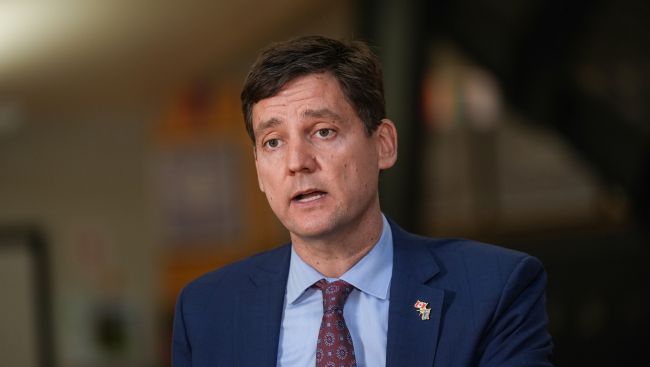
Picture Courtesy: THE CANADIAN PRESS/Darryl Dyck