

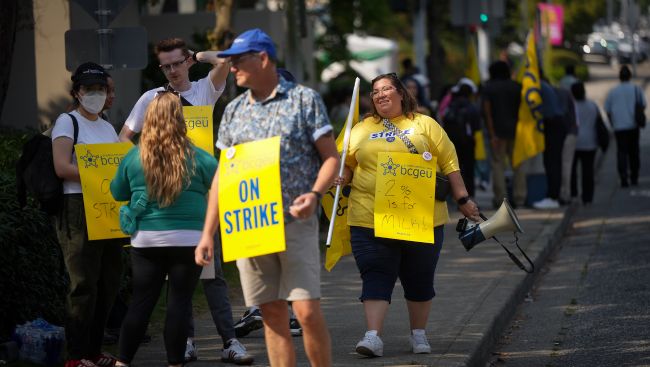
The president of the British Columbia General Employees' Union says an expansion of job action in the province's public service strike doesn't immediately include liquor or cannabis distribution sites.
But Paul Finch said that the union isn't ruling them out as targets of future picketing in the week-old strike.
"We will not be targeting the liquor distribution centres despite some creative reports over the weekend. That's not on the list of notice of sites that we've given at this time," Finch said at a picket site in Surrey, B.C., on Monday.
He said the union was "not going to broadcast our strike strategy going forward," but when asked if liquor sites might be hit in future he said "everything is on the table."
Finch laid out a new phase of the public service strike targeting "core government services" in 11 cities across the province on Tuesday and Wednesday to pressure the government back to the bargaining table.
He said the escalation targets government services but will "minimize the impact to the public."
"What I'll say is it's about a dozen new sites that are going to be under picket lines tomorrow. That's over a thousand members of the union that will be joining," Finch said.
His remarks came moments after the government released details of its offer to striking public service workers, in a rare move.
The Finance Ministry said in a statement that the government had proposed a 4.5 per cent compensation increase over two years, made up of both general wage increases and cost-of-living allowances.
It said the union wanted 15.75 per cent, adding that the BCGEU's previously stated request for an 8.25 per cent wage increase "only tells part of the story."
The statement estimated the cost of the union's "additional compensation increases." proposals at more than $200 million in
It puts the ongoing annual cost of the BCGEU's wage and other compensation proposals at $437 million.
The statement said the 2022 contract plus the BCGEU's current request would amount to a 30 per cent compensation increase over five years, while the government's proposed 18.75 per cent increase slightly exceeds projected inflation of 18.7 per cent in the same period.
It said the union's 2025 proposals for the next two years total 15.75 per cent, "or 3.25 times higher than the estimated 4.8 per cent inflation rate over the same two-year period."
"The ongoing cost of the BCGEU's 15.75 per cent compensation proposals is estimated at $437 million," it said.
"To put that in perspective, if the rest of the unionized public sector in B.C. received the same increases, it would represent an annual ongoing cost to provincial taxpayers of $6.6 billion."
Finch said that suggesting that the union request was three times inflation amounted to "creative math" by the government.
"What's happened is that what they've done is they've costed the menu, not the meal, for non-general wage increase items," he said, adding that details included in the government costings were part of the "menu of options."
The new picket sites include a range of regional government offices and service locations in cities including Kamloops, Kelowna, Nelson and Prince George.
Finch said the union and the province negotiated a "comprehensive" agreement on essential services, which wasn't the case in 2022.
"This round we've taken a very different approach," he said. "Last round we didn't have that in place and so the liquor distribution branch was one of the only places we could strike."
He said all job action was "designed to bring government back to the table."
"If they do not come back to the table with a fair wage offer, we will be expanding the strike and that expansion will start to impact the services that British Columbians rely on."
The union represents more than 34,000 members working for B.C.'s public service and has already held pickets in Vancouver, Victoria, Surrey, and Prince George, and the Royal BC Museum.
Some of its key asks include competitive wages and fair access to telework.
Premier David Eby has said the government's goal is to reach a deal that's both fair to unionized workers and fair to taxpayers.
Negotiations for a new contract broke off in July.
Monday's ministry statement was the first to outline the government's position.
The ministry said the government has shared "similar analysis" during the 2022 round of public sector bargaining, and in 2014.
"We believe it is in the public's interest for the parties to be transparent about the level of compensation increases that have been proposed," it said.
Picture Courtesy: THE CANADIAN PRESS/Darryl Dyck


