
Sunday, March 22, 2026
ADVT 
National

B.C. wolves use line to pull up crab traps in first possible tool use by species

Darpan News Desk The Canadian Press, 17 Nov, 2025 10:38 AM
  • B.C. wolves use line to pull up crab traps in first possible tool use by species

Researchers have captured video footage of wild wolves in British Columbia pulling crab traps out of the sea by their lines to eat the bait inside, in the first evidence of possible tool use by the animals.

A report released Monday in the scientific journal Ecology and Evolution by researchers Kyle Artelle and Paul Paquet says they placed cameras on the beach aimed at Heiltsuk First Nation crab traps to work out what was repeatedly damaging them.

The traps, set up near Bella Bella, on B.C.'s central coast, were being used to control the invasive European green crab, and some were in deeper water submerged at all times, leading researchers to believe the damage that started in 2023 was caused by marine mammals.

"We were going, 'Well, what the heck is doing this, right?'" said Artelle, a researcher with State University of New York's College of Environmental Science and Forestry, who was involved with the Heiltsuk Nation's efforts to respond to the green crabs.

"It can't be a bear, a wolf. They're not going to dive down to get to the trap. So, what is getting the traps?"

Their assumptions were wrong.

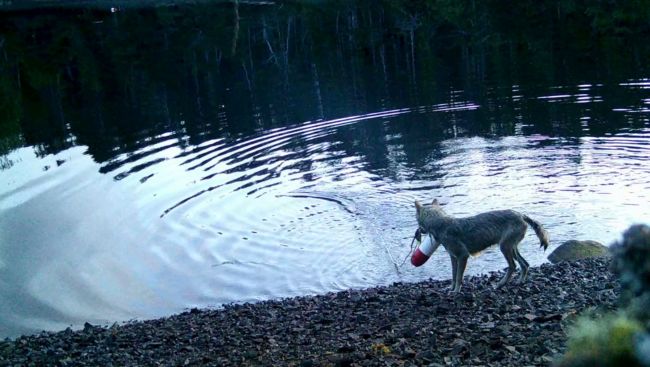
Within a day of the cameras being set up in May last year, researchers  captured footage of a sea wolf emerging from the water with a buoy hanging from its mouth.

The footage then showed the wolf dropping the buoy on the beach, picking up the exposed line, and pulling it until the crab trap emerged from the water.

The wolf then picked up the trap with its mouth, moved it to shallower waters and ate the bait inside.

"We had to pick our jaws off the floor," Artelle said.

"We know that they're really, really smart, but it hadn't crossed our mind that, oh, maybe a wolf is swimming out to the deeper traps and bringing the buoy to shore, pulling the line up just like a person would."

The cameras then picked up a second sea wolf also pulling up a crab trap in a similar way earlier this year, leading researchers to believe other wolves in the local pack may have learned from each other.

Sea wolves are a grey wolf subspecies known for their marine-based diet. 

As for how the behaviour started, Artelle said researchers can only speculate.

"We ultimately don't know, but the two most likely explanations in our minds, one would be that the wolves started doing this with traps that were exposed at a low tide because that's really easy," Artelle said.

"There might've been this incremental learning that started with the trap fully onshore to traps partly submerged, to then associating the line with the trap and then the buoy with the line … It would make a lot of sense, and that's often how we learn."

Researchers say a few cameras at the B.C. site are now dedicated 24-7 to the crab traps to track the behaviour of sea wolves in the area, while work is "in progress" to prevent too much damage to the traps that may inhibit the invasive crab study.

"Some really special things are happening here, and we want to understand more about that. What else is happening on the ground? What else do these wolves have to teach us? And so that's a focus for the next decades as we explore more about wolves here," Artelle said.

"This is really just the tip of the iceberg."

Picture Courtesy: THE CANADIAN PRESS/Handout - Kyle Artelle

MORE National ARTICLES

Public safety minister says Canada has answered U.S. demands on border security

Public safety minister says Canada has answered U.S. demands on border security
Canadian law enforcement and border officials joined McGuinty and Canada's newly appointed "fentanyl czar" Kevin Brosseau in the U.S. capital this week to make a final diplomatic push against the tariffs. Trump's executive order to implement 25 per cent tariffs on all Canadian imports, with a lower 10 per cent levy on energy, was delayed until March 4 after Canada agreed to introduce new security measures at the border.

Public safety minister says Canada has answered U.S. demands on border security

B.C.'s NDP government survives non-confidence vote brought forward by Conservatives

B.C.'s NDP government survives non-confidence vote brought forward by Conservatives
The British Columbia government has survived a non-confidence vote late Wednesday after the Opposition Conservative party wasted no time in trying to overthrow the NDP. In a vote that split along party lines, a motion brought forward by Opposition leader John Rustad was narrowly defeated, with every Conservative member voting for while both BC Green Party representatives voted against alongside NDP members.

B.C.'s NDP government survives non-confidence vote brought forward by Conservatives

Vancouver council approves pause on supporting housing projects

Vancouver council approves pause on supporting housing projects
Vancouver's council has approved Mayor Ken Sim's plan to temporarily halt net new supportive housing projects in the city. A news release from Sim's office says it will allow the city to focus to "renewing aging, deteriorating stock," and transition temporary modular housing into permanent homes, while pushing for more supply elsewhere in the region.

Vancouver council approves pause on supporting housing projects

Conservatives launch attacks on Mark Carney over his firm's relocation to the U.S.

Conservatives launch attacks on Mark Carney over his firm's relocation to the U.S.
Carney has become the primary target of Conservative attacks in recent weeks and the party is telling its supporters through fundraising emails that the race is a "sham" and just a "coronation."

Conservatives launch attacks on Mark Carney over his firm's relocation to the U.S.

B.C. looks at coalition of willing provinces to expand trade within Canada, Eby says

B.C. looks at coalition of willing provinces to expand trade within Canada, Eby says
The threat of U.S. tariffs on Canadian goods and services has pushed the need for improved interprovincial trade as provinces look for ways to diversify their markets to protect economies and jobs. Despite the establishment of the Canadian Free Trade Agreement in 2017, many products do not trade freely among provinces and territories.

B.C. looks at coalition of willing provinces to expand trade within Canada, Eby says

Immigrant-owned firms suffer from productivity gap for variety of factors: StatCan

Immigrant-owned firms suffer from productivity gap for variety of factors: StatCan
Companies owned by newcomers to Canada tend to struggle taking their businesses to the next level more than Canadian-born founders, new data suggests. The report released by Statistics Canada on Wednesday explores barriers immigrants to Canada can face when starting and scaling a business. One of the most significant findings was around labour productivity — how much an individual can produce in an hour of work.

Immigrant-owned firms suffer from productivity gap for variety of factors: StatCan