Wednesday, March 25, 2026
ADVT 
National

B.C. wolves use line to pull up crab traps in first possible tool use by species

Darpan News Desk The Canadian Press, 17 Nov, 2025 10:38 AM
  • B.C. wolves use line to pull up crab traps in first possible tool use by species

Researchers have captured video footage of wild wolves in British Columbia pulling crab traps out of the sea by their lines to eat the bait inside, in the first evidence of possible tool use by the animals.

A report released Monday in the scientific journal Ecology and Evolution by researchers Kyle Artelle and Paul Paquet says they placed cameras on the beach aimed at Heiltsuk First Nation crab traps to work out what was repeatedly damaging them.

The traps, set up near Bella Bella, on B.C.'s central coast, were being used to control the invasive European green crab, and some were in deeper water submerged at all times, leading researchers to believe the damage that started in 2023 was caused by marine mammals.

"We were going, 'Well, what the heck is doing this, right?'" said Artelle, a researcher with State University of New York's College of Environmental Science and Forestry, who was involved with the Heiltsuk Nation's efforts to respond to the green crabs.

"It can't be a bear, a wolf. They're not going to dive down to get to the trap. So, what is getting the traps?"

Their assumptions were wrong.

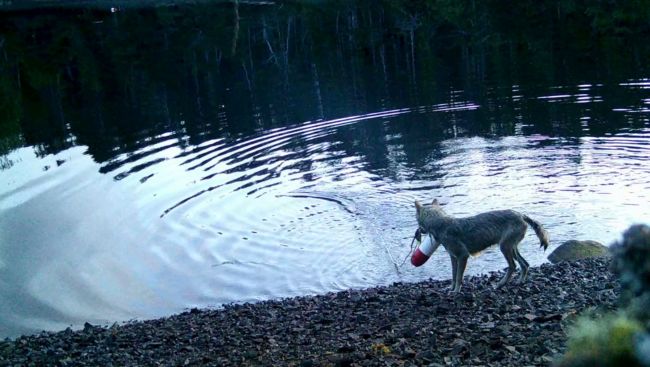
Within a day of the cameras being set up in May last year, researchers  captured footage of a sea wolf emerging from the water with a buoy hanging from its mouth.

The footage then showed the wolf dropping the buoy on the beach, picking up the exposed line, and pulling it until the crab trap emerged from the water.

The wolf then picked up the trap with its mouth, moved it to shallower waters and ate the bait inside.

"We had to pick our jaws off the floor," Artelle said.

"We know that they're really, really smart, but it hadn't crossed our mind that, oh, maybe a wolf is swimming out to the deeper traps and bringing the buoy to shore, pulling the line up just like a person would."

The cameras then picked up a second sea wolf also pulling up a crab trap in a similar way earlier this year, leading researchers to believe other wolves in the local pack may have learned from each other.

Sea wolves are a grey wolf subspecies known for their marine-based diet. 

As for how the behaviour started, Artelle said researchers can only speculate.

"We ultimately don't know, but the two most likely explanations in our minds, one would be that the wolves started doing this with traps that were exposed at a low tide because that's really easy," Artelle said.

"There might've been this incremental learning that started with the trap fully onshore to traps partly submerged, to then associating the line with the trap and then the buoy with the line … It would make a lot of sense, and that's often how we learn."

Researchers say a few cameras at the B.C. site are now dedicated 24-7 to the crab traps to track the behaviour of sea wolves in the area, while work is "in progress" to prevent too much damage to the traps that may inhibit the invasive crab study.

"Some really special things are happening here, and we want to understand more about that. What else is happening on the ground? What else do these wolves have to teach us? And so that's a focus for the next decades as we explore more about wolves here," Artelle said.

"This is really just the tip of the iceberg."

Picture Courtesy: THE CANADIAN PRESS/Handout - Kyle Artelle
MORE National ARTICLES

No Canadian soldiers assigned to border enforcement, minister says

No Canadian soldiers assigned to border enforcement, minister says
Public Safety Minister David McGuinty says there is no plan to send Canadian soldiers to the Canada-U.S. border. In a bid to head off crippling tariffs threatened by U.S. President Donald Trump, Canada has committed to tasking 10,000 frontline personnel with protecting the border.

No Canadian soldiers assigned to border enforcement, minister says

Gang leader and another man charged after shooting in Fort Nelson, B.C.

Gang leader and another man charged after shooting in Fort Nelson, B.C.
A man well known to police and identified in the courts as a gang leader faces charges in connection with a shooting in Fort Nelson, B.C.  Police say Jarrod Bacon has been charged with aggravated assault, while John Chasse faces an assault charge in connection with the shooting that sent one person to hospital last Wednesday.

Gang leader and another man charged after shooting in Fort Nelson, B.C.

B.C. human rights commissioner wants study of police in schools after board's firing

B.C. human rights commissioner wants study of police in schools after board's firing
British Columbia's human rights commissioner says the provincial government has effectively made police liaison programs mandatory in schools with its firing of the Greater Victoria school board, while failing to provide a factual basis for the decision. Kasari Govender says in a letter to Education Minister Lisa Beare and Public Safety Minister Gary Begg that failure to fund research into the matter is contrary to the government's human rights obligations "and undermines its stated values to combat racism."

B.C. human rights commissioner wants study of police in schools after board's firing

Man injured in avalanche on Vancouver Island, taken by rescue helicopter to hospital

Man injured in avalanche on Vancouver Island, taken by rescue helicopter to hospital
A man has been seriously injured in an avalanche on Vancouver Island and required the rescue helicopter to fly him directly to hospital for treatment. Metro Vancouver-based North Shore Rescue says in a social media post that the man was partially buried in a slide in the backcountry near the Mount Cain ski area on northern Vancouver Island on Sunday. 

Man injured in avalanche on Vancouver Island, taken by rescue helicopter to hospital

Drug deaths in B.C. drop 13 per cent, hitting four-year low of 2,253

Drug deaths in B.C. drop 13 per cent, hitting four-year low of 2,253
The BC Coroners Service says toxic drug deaths in British Columbia were down 13 per cent last year, with the toll now lower than any year since 2020. Chief Coroner Dr. Jatinder Baidwan says the decline is consistent with elsewhere in Canada and internationally, but doesn't mitigate the fact that 2,253 people died of overdoses in B.C. last year, or the grief felt by their loved ones.

Drug deaths in B.C. drop 13 per cent, hitting four-year low of 2,253

Metro Vancouver to stay cold for at least a week with wintry road conditions

Metro Vancouver to stay cold for at least a week with wintry road conditions
This week's wintry blast of snow in Metro Vancouver will likely remain on the ground, with below-average temperatures forecasted well into next week. Environment Canada meteorologist Alyssa Charbonneau says while temperatures may moderate slightly during the daytime over the weekend, whatever's melted will likely refreeze at night.

Metro Vancouver to stay cold for at least a week with wintry road conditions