

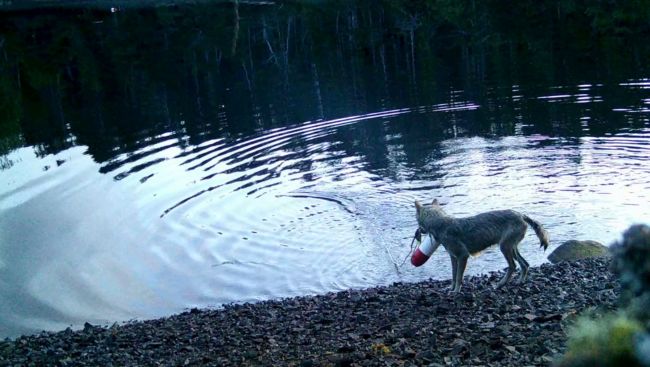
Researchers have captured video footage of wild wolves in British Columbia pulling crab traps out of the sea by their lines to eat the bait inside, in the first evidence of possible tool use by the animals.
A report released Monday in the scientific journal Ecology and Evolution by researchers Kyle Artelle and Paul Paquet says they placed cameras on the beach aimed at Heiltsuk First Nation crab traps to work out what was repeatedly damaging them.
The traps, set up near Bella Bella, on B.C.'s central coast, were being used to control the invasive European green crab, and some were in deeper water submerged at all times, leading researchers to believe the damage that started in 2023 was caused by marine mammals.
"We were going, 'Well, what the heck is doing this, right?'" said Artelle, a researcher with State University of New York's College of Environmental Science and Forestry, who was involved with the Heiltsuk Nation's efforts to respond to the green crabs.
"It can't be a bear, a wolf. They're not going to dive down to get to the trap. So, what is getting the traps?"
Their assumptions were wrong.
Within a day of the cameras being set up in May last year, researchers captured footage of a sea wolf emerging from the water with a buoy hanging from its mouth.
The footage then showed the wolf dropping the buoy on the beach, picking up the exposed line, and pulling it until the crab trap emerged from the water.
The wolf then picked up the trap with its mouth, moved it to shallower waters and ate the bait inside.
"We had to pick our jaws off the floor," Artelle said.
"We know that they're really, really smart, but it hadn't crossed our mind that, oh, maybe a wolf is swimming out to the deeper traps and bringing the buoy to shore, pulling the line up just like a person would."
The cameras then picked up a second sea wolf also pulling up a crab trap in a similar way earlier this year, leading researchers to believe other wolves in the local pack may have learned from each other.
Sea wolves are a grey wolf subspecies known for their marine-based diet.
As for how the behaviour started, Artelle said researchers can only speculate.
"We ultimately don't know, but the two most likely explanations in our minds, one would be that the wolves started doing this with traps that were exposed at a low tide because that's really easy," Artelle said.
"There might've been this incremental learning that started with the trap fully onshore to traps partly submerged, to then associating the line with the trap and then the buoy with the line … It would make a lot of sense, and that's often how we learn."
Researchers say a few cameras at the B.C. site are now dedicated 24-7 to the crab traps to track the behaviour of sea wolves in the area, while work is "in progress" to prevent too much damage to the traps that may inhibit the invasive crab study.
"Some really special things are happening here, and we want to understand more about that. What else is happening on the ground? What else do these wolves have to teach us? And so that's a focus for the next decades as we explore more about wolves here," Artelle said.
"This is really just the tip of the iceberg."
Picture Courtesy: THE CANADIAN PRESS/Handout - Kyle Artelle


