Saturday, July 4, 2026
ADVT 
National

B.C. wolves use line to pull up crab traps in first possible tool use by species

Darpan News Desk The Canadian Press, 17 Nov, 2025 10:38 AM
  • B.C. wolves use line to pull up crab traps in first possible tool use by species

Researchers have captured video footage of wild wolves in British Columbia pulling crab traps out of the sea by their lines to eat the bait inside, in the first evidence of possible tool use by the animals.

A report released Monday in the scientific journal Ecology and Evolution by researchers Kyle Artelle and Paul Paquet says they placed cameras on the beach aimed at Heiltsuk First Nation crab traps to work out what was repeatedly damaging them.

The traps, set up near Bella Bella, on B.C.'s central coast, were being used to control the invasive European green crab, and some were in deeper water submerged at all times, leading researchers to believe the damage that started in 2023 was caused by marine mammals.

"We were going, 'Well, what the heck is doing this, right?'" said Artelle, a researcher with State University of New York's College of Environmental Science and Forestry, who was involved with the Heiltsuk Nation's efforts to respond to the green crabs.

"It can't be a bear, a wolf. They're not going to dive down to get to the trap. So, what is getting the traps?"

Their assumptions were wrong.

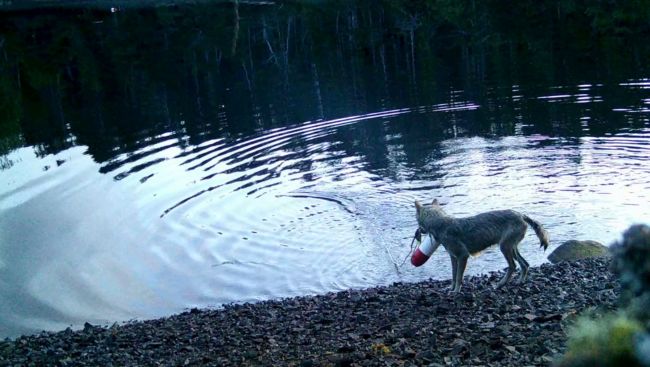
Within a day of the cameras being set up in May last year, researchers  captured footage of a sea wolf emerging from the water with a buoy hanging from its mouth.

The footage then showed the wolf dropping the buoy on the beach, picking up the exposed line, and pulling it until the crab trap emerged from the water.

The wolf then picked up the trap with its mouth, moved it to shallower waters and ate the bait inside.

"We had to pick our jaws off the floor," Artelle said.

"We know that they're really, really smart, but it hadn't crossed our mind that, oh, maybe a wolf is swimming out to the deeper traps and bringing the buoy to shore, pulling the line up just like a person would."

The cameras then picked up a second sea wolf also pulling up a crab trap in a similar way earlier this year, leading researchers to believe other wolves in the local pack may have learned from each other.

Sea wolves are a grey wolf subspecies known for their marine-based diet. 

As for how the behaviour started, Artelle said researchers can only speculate.

"We ultimately don't know, but the two most likely explanations in our minds, one would be that the wolves started doing this with traps that were exposed at a low tide because that's really easy," Artelle said.

"There might've been this incremental learning that started with the trap fully onshore to traps partly submerged, to then associating the line with the trap and then the buoy with the line … It would make a lot of sense, and that's often how we learn."

Researchers say a few cameras at the B.C. site are now dedicated 24-7 to the crab traps to track the behaviour of sea wolves in the area, while work is "in progress" to prevent too much damage to the traps that may inhibit the invasive crab study.

"Some really special things are happening here, and we want to understand more about that. What else is happening on the ground? What else do these wolves have to teach us? And so that's a focus for the next decades as we explore more about wolves here," Artelle said.

"This is really just the tip of the iceberg."

Picture Courtesy: THE CANADIAN PRESS/Handout - Kyle Artelle

MORE National ARTICLES

Seizure of illicit drugs on Vancouver Island

Seizure of illicit drugs on Vancouver Island
Police on Vancouver Island say they have seized illicit drugs and guns as part of an investigation targeting mid-level drug trafficking in the Cowichan Valley. R-C-M-P say searches at three homes in the Duncan area and one in Sooke turned up three kilograms of suspected fentanyl, 3.5 kilograms of methamphetamine and cocaine, as well as six handguns, including two that were made using a 3-D printer.

Seizure of illicit drugs on Vancouver Island

More shelter beds for people in Victoria street camp cited by police for 'hostility'

More shelter beds for people in Victoria street camp cited by police for 'hostility'
Dozens of new shelter beds are opening for people living on the streets in Victoria, including at an encampment where police escorts have been required for emergency responders. A statement from the Housing Ministry says that up to 72 new beds will be made available for people living on Pandora Avenue and elsewhere.

More shelter beds for people in Victoria street camp cited by police for 'hostility'

Japanese Canadian paper, pillar for community during war, saved from digital oblivion

Japanese Canadian paper, pillar for community during war, saved from digital oblivion
More than eighty years ago, Japanese Canadians came together to sustain The New Canadian, the only newspaper specifically for the community that was allowed to be published through the Second World War. Now the community has come together again — and may have saved the newspaper's archives from the digital scrap heap.

Japanese Canadian paper, pillar for community during war, saved from digital oblivion

SUV allegedly rams into police car

SUV allegedly rams into police car
Surrey Mounties say they got a call about a suspicious vehicle around 146 Street and 108 Avenue, and the driver of a Ford S-U-V allegedly hit a police vehicle as it fled from officers.  Surrey R-C-M-P says the S-U-V also hit another vehicle that was stopped and later drove into oncoming traffic as police were in pursuit. 

SUV allegedly rams into police car

One-third of Canadians report being personally impacted by severe weather: poll

One-third of Canadians report being personally impacted by severe weather: poll
A new poll suggests more Canadians are feeling the direct impacts of extreme weather, but that has not changed overall opinions about climate change. The results from a recent Leger poll suggest more than one in three Canadians have been touched directly by extreme weather such as forest fires, heat waves, floods or tornadoes. 

One-third of Canadians report being personally impacted by severe weather: poll

Former U.S. ambassador to Canada gives 'tsunami warning' about Trump

Former U.S. ambassador to Canada gives 'tsunami warning' about Trump
A former United States ambassador to Canada is sounding the alarm that a second Donald Trump presidency would cause chaos for Canadians as he urged Americans abroad that their votes could prove crucial in the presidential election. Bruce Heyman, who served as ambassador from 2014 to 2017, gave Canada a “tsunami warning,” saying if Trump takes the White House, Canada is at great risk.  

Former U.S. ambassador to Canada gives 'tsunami warning' about Trump