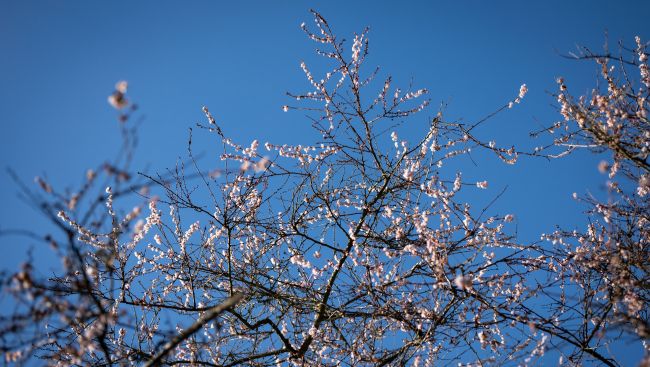
A couple weeks ago, North Vancouver resident Larry Sewell looked down a street in his neighbourhood and did a double take.
"I said, 'God — (that) looks like a cherry blossom,'" said Sewell.
"I just walked up there and went underneath and took some pictures. I mean, I've seen blossoms come out in February before and stay out. But then I don't think this early. I can't ever remember seeing them this early."
An unseasonably mild winter is coaxing blossoms to bloom early in some Metro Vancouver neighbourhoods, as it experiences one of the warmest Januaries on record.
While that may give British Columbians bragging rights over Eastern Canada, which was slammed by a severe winter storm last week, experts warn that if early blooming is followed by a cold spell, it could have a destructive impact on plants.
Climate scientist and former leader of the B.C. Green Party Andrew Weaver said that in Victoria, it's not just cherry blossoms that are showing up early. All kinds of flowers are popping up in the provincial capital, from crocuses to daffodils.
"I'm just driving to find some flowers, they're everywhere by the water here in Fairfield (a neighbourhood in Victoria), they're just everywhere," said Weaver, a professor at the University of Victoria’s School of Earth and Ocean Sciences.
Meteorologist Derek Lee with Environment and Climate Change Canada said temperatures so far this month had been about two degrees warmer than the historical average since 1896.
Agency data shows the average maximum temperature in Vancouver for the first 18 days of the year was 8.3 C, peaking at 13.8 C last week, while the average minimum has been 4 degrees.
Lee said Vancouver should be seeing highs of about six degrees and lows of one degree.
"Just looking at the ranking right now, I can see that maybe this January is maybe in the top 10 warmest Januaries on record," said Lee, adding that those numbers could change.
Overnight temperatures in Vancouver, measured at Vancouver International Airport, only dipped below zero once, on Sunday night, although this week's forecast is for more seasonal weather.
Lee said Pacific storms play a key role in the warm weather, and this year is a La Niña year, altering storm tracks to bring more warm air.
"So, it's more active over maybe parts of southern B.C., the south coast, that's why. Because we have a more active storm track, it's bringing more and more warm air from the Pacific to keep us warm," said Lee.
The unusual warm weather, rain and occasional sunshine had contributed to early plant growth, said Lee, adding that it had not been getting cold enough to freeze plants overnight.
University of Victoria biology professor Barbara Hawkins said she expected some plum, cherry, and apple blossoms to come out earlier than normal because "we have had such a warm winter with a much greater accumulated heat sum to date than is usual."
Hawkins said global warming could be a contributing factor to the current warm spell.
"Temperatures are variable from year to year, however, so it could be just an unusually warm year. If we keep seeing this pattern over time, we will be more and more certain that it is caused by global warming," said Hawkins.
Weaver, however, called the warm January a "direct consequence of global warming."
"Frankly, people just don't listen," said Weaver, "There's well-documented evidence that the last frost is much later than normal, and the thaw is much earlier than normal. It's changed. It's changing. So, spring is coming earlier all over the world."
That can be destructive to harvests — two winters ago, a warm spell that encouraged early budding was followed by a catastrophic cold snap that wiped out B.C.'s grape crop and the vast majority of its stone fruit harvest.
The prospect of a cold snap in the near future was "troubling," said Weaver.
"Because when the plants, trees, flowers, think it's spring, they start to bring out leaves, they start to grow. They start to put energy into producing leaves. If you get a freeze, a really strong freeze, after they've been triggered to start growing, that can actually damage the plants," said Weaver.
"That's a concern for this year. We really don't want a really big cold snap because that could be harmful."
Picture Courtesy: THE CANADIAN PRESS/Ethan Cairns