VANCOUVER - Hundreds of thousands of tiny bits of plastic waste have been found in the stomachs of belugas, proving that the pollution is making its way even to the most remote Arctic waters, a new study says.
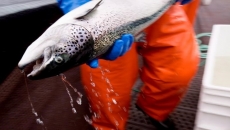
In the study, published in the journal Science of the Total Environment, researchers looked at five species of Arctic fish that are regular prey of belugas and found 21 per cent of them had microplastic particles in their gastrointestinal tracts.
The lead author of the study, Rhiannon Moore, said this finding confirmed that microplastics are moving up the food chain.
"It's a worry because plastic, as we know, is everywhere, and we don't really know the long-term effect of all the different types of plastic that are ending up in these species," she said in an interview.
Moore, who recently completed a master of science degree at Simon Fraser University and is a zero-waste outreach co-ordinator with the City of Victoria, said many northern animals are encountering environmental change.
"So, we have species that are experiencing the effects of climate change, increased marine traffic, migration patterns — all sorts of changes. And so this is just another ... human-made impact that that's occurring."
Microplastics are contaminants that are less than five millimetres in size.
Almost 80 per cent of the particles found in the stomachs of fish studied come from textiles and clothing that are washed into waterways in the laundry process, the report said.
There is evidence that tiny bacteria make these fibres their home, increasing their palatability for fish, it added.
The study documents microplastics in the stomachs of fish from the Eastern Beaufort Sea, north of Yukon, the Northwest Territories and Alaska.
The seven belugas used in the study were those that are seasonally hunted by members of the Inuvialuit community of Tuktoyaktuk in the western Canadian Arctic.
The study said the Arctic deep sea has been identified as a potential source of plastic accumulation.
Belugas are known to dive to depths greater than 1,000 metres and spend "significant" time at the sea floor bottom, it said.
"How climate change will influence beluga foraging behaviour and activity in the deep sea, and the associated exposure to plastic debris remains unclear," the report said.
Peter Ross, a senior scientist with the Raincoast Conservation Foundation and a co-author of the report, said evidence suggests that microplastics in the Arctic are largely making their way on currents from the Atlantic Ocean.
"The Arctic communities are not really big players in contaminating their backyard," he said.
"So, we have yet again another example of a pollutant from the more urbanized and industrialized south moving quickly and readily into the Arctic."
There is "near universal contamination" of the water in the Arctic, he said.
Moore said she was "not necessarily surprised" by the findings because of the large quantities of plastic that enter the oceans every year.
But she said she is hoping that the discovery spurs people into taking action.
"Everyone loves whales, and nobody really wants whales to be threatened in any way," Moore said.
"Whenever you talk about whales and pollution, it tugs on their heartstrings and so you would hope that this would cause people to act and look at daily life choices."