WASHINGTON - It's been less than three years since the U.S.-Mexico-Canada Agreement replaced NAFTA as the law of the land in continental trade, and there are already hints of the existential anxiety that preceded it.
That's because of the so-called "sunset provision," a clause that reflects the lingering working-class distrust of globalization in the U.S. that helped Donald Trump get elected president back in 2016.
Article 34.7 of the agreement, the "review and term extension" clause, establishes a 16-year life cycle that requires all three countries to sit down every six years to ensure everyone is still satisfied.
That clock began ticking in the summer of 2020. If it runs out in 2026, it triggers a self-destruct mechanism of sorts, ensuring the agreement — known in Canada as CUSMA — would expire 10 years later without a three-way consensus.
For Canada, the sunset provision "is a minefield," said Lawrence Herman, an international trade lawyer and public policy expert based in Toronto.
"It is certainly not a rubber-stamping exercise — far from it."
Of particular concern is the fact that the provision doesn't spell out in detail what happens if one of the parties indicates that it won't sign off on extending the deal without significant changes to the terms.
"The concern is that this could mean, in effect, that we'll be into a major renegotiation of CUSMA in 2026," by which time the political landscape in both the U.S. and Mexico could look very different, Herman said.
"What happens then? The government and business community need to be thinking about this and start preparing the groundwork and doing contingency planning now."
The deal as it stands is hardly perfect, if the number of disputes is any indication.
In the 33 months since USMCA went into effect in July 2020, 17 disputes have been launched among the three countries, compared with a total of 77 initiated over the course of NAFTA's 25-year lifespan.
The U.S. remains unhappy with how Canada has allocated the quotas that give American dairy producers access to markets north of the border. Canada and Mexico both took issue with how the U.S. defined foreign auto content. And Canada and the U.S. oppose Mexico favouring state-owned energy providers.
But those disputes are evidence not of a problematic agreement but of one that is working, said Kenneth Smith Ramos, the former head of the Trade and NAFTA office in Mexico's embassy in Washington.
Canada, Mexico and the private sector in the U.S. fought hard to ensure the new agreement included dispute resolution tools, which the U.S. considered extraterritorial, said Smith Ramos, who served as Mexico's chief negotiator.
"If one or two of the partners come out and say, 'We need radical changes, because this is not working,' they can very quickly get politicized," he told a panel discussion Tuesday hosted by the Wilson Center.
"That can make the 2026 review that much more difficult if we don't resolve all of these issues."
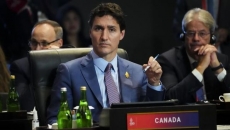
The Canada-U.S. disputes are likely to be on the agenda when Prime Minister Justin Trudeau sits down later this week in Ottawa with President Joe Biden, his first official visit to Canada since being sworn in two years ago.
"The president's really excited about doing this, about going up there and really going to Ottawa for no other purpose than the bilateral relationship," National Security Council spokesman John Kirby told the White House briefing Monday.
Prior meetings between the two have typically been on the margins of international summits or at trilateral gatherings with their Mexican counterpart, Andrés Manuel López Obrador.
Kirby cited climate change, trade, the economy, irregular migration and modernizing the continental defence system known as Norad as just some of "a bunch of things" the two leaders are expected to talk about.
"He has a terrific relationship with Prime Minister Trudeau — warm and friendly and productive."
Trade disputes notwithstanding, the overwhelming consensus — in Canada, at least — is that USMCA is vastly better than nothing.
"I don't want to be alarmist about this, but we cannot take renewal for granted," said Goldy Hyder, president and CEO of the Business Council of Canada, after several days of meetings last week with Capitol Hill lawmakers.
Constantly talking up the vital role bilateral trade plays in the continent's continued economic health is a cornerstone of Canada's diplomatic strategy. The message Hyder brought home from D.C.? Don't stop now.
"We met several senators, we met people from the administration, and their message was, 'Be down here. Make your case. Continue to remind Americans of the role that Canada has in their economy,'" he said.
"We've got to … be a little less humble in the United States and start reminding Americans just how much skin in the game that they have in Canada."
That can be a challenging domestic political truth in the U.S., where deep-seated resentment over free trade in general and NAFTA in particular metastasized in 2016 and persists to this day.
Biden likes to put a blue-collar, Buy American frame around policy decisions. His original plan to advance electric-vehicle sales saved the richest incentives for vehicles assembled in the U.S. with union labour.
Aggressive lobbying by Canada helped avert a serious crisis for Canada's auto sector; the Inflation Reduction Act that Biden ultimately signed included EV tax credits for vehicles assembled in North America.
For many, it was a cautionary tale about the importance of arguing Canada's interests in Washington.
A strong U.S. depends on a strong Canada, said Rob Wildeboer, executive chairman and co-founder of Ontario-based auto parts supplier Martinrea International Inc., who took part in last week's D.C. meetings.
"The USMCA and the ability to move goods across borders is extremely important to us, it's extremely important to our industry, it's extremely important to this country, and it's a template for the things we can do together with the United States," Wildeboer said.
"In order for the U.S. to be strong, it needs strong neighbours, and Canada's right at the top of the list."