EDMONTON - Canada's oil province may finally be shedding its image as an economic one-trick pony, the Alberta government says in its new budget.
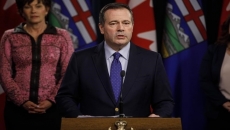
"We're doing all we can and seeing great results on economic diversification," United Conservative Finance Minister Travis Toews said at a Thursday news conference.
Budget documents trumpet billions of dollars flowing into provincial sectors that don't necessarily scream Alberta. Tech, aerospace, financial technology, film and television have all seen growth, as well as more traditional mainstays like petrochemicals.
Venture capital firms pumped $455 million into the province last year, double the 2019 figure. Non-energy exports, at nearly $38 billion, grew 21 per cent between 2020 and 2021.
Agriculture, Alberta's economic bedrock, saw nearly five per cent growth in value-added sales between 2019 and 2020.
Those figures are still dwarfed by oil and gas.
Upstream oil and gas investment grew by 25 per cent last year to reach $23 billion. And Alberta's energy exports were worth $100 billion last year — a whopping 65 per cent increase.
But Toews said diversification — a hopeful buzzword in the province since the late-1980s government of Premier Don Getty — is well and truly underway.
"We're seeing investment broadly throughout the economy," he said. "And that will ultimately provide more stability to the revenues of this province."
Kent Fellows of the University of Calgary's School of Public Policy said the government is focusing on some of the right areas, such as expanding the uses of the province's oil and gas.
"They are taking seriously the idea of looking at new markets that are non-combustion markets — what can we do with natural gas other than just burning it?"
But it's a trend that predates the current government, he said. The previous New Democrat government brought in programs the current one has more or less kept in place.
"There are a couple of themes that are consistent," Fellows said. "Diversification takes a long time."
He added it's hard to tease out the effects of government programs from what would have taken place anyway.
Trevor Tombe, also a University of Calgary economist, said he sees very little diversification in a budget heavily reliant on oil and gas. What progress has been made has little to do with policy, he said.
"That had almost nothing to do with the changes in the budget that we saw here. The Alberta government is not very sensitive to those broader economic changes."
Opposition New Democrat leader Rachel Notley said the UCP shouldn't get any credit.
"Diversification was something that this government abandoned and, in fact, rejected in the first two years of their tenure," she said. "You may recall the finance minister saying that diversification is a long-term luxury that no one can focus on right now."
Notley said the budget contains similar measures for the tech industry to those brought in during her tenure, only smaller. She said the fact the budget still relies on oil and gas revenues shows Alberta has a long way to go to get off the royalty thrill ride.
"They're not making investments in long-term, sustainable, mortgage-paying economic diversification and job creation going forward," she said. "They're still riding the roller-coaster."
Chris Severson-Baker of the Pembina Institute, a clean energy think tank, said the government's budget is missing diversification opportunities.
He said the TIER fund — a carbon levy collected from Alberta's heaviest industries — isn't being used to help existing industry decarbonize and build a low-carbon future. Nor does the budget direct as much of its windfall royalties as it should into cleaning up the tens of thousands of abandoned oil and gas wells across the province.
"We don't have a clear plan for how we're going to decarbonize the oil and gas sector or what the future economy's going to look like," he said.