Canada joined with its major allies Thursday in condemning China for imposing a new national security law on Hong Kong, one day after a contentious B.C. court ruling in the Meng Wanzhou affair.
The statement of "deep concern" with the United States, Australia and Britain comes as experts warn that two Canadians imprisoned in China could face retaliation because Wednesday's court ruling in the Meng case didn't go the way the People's Republic would have liked.
The Chinese Embassy in Ottawa angrily denounced the decision by B.C. Supreme Court Justice Heather Holmes in the extradition case of the Huawei executive, who is wanted on fraud charges in the U.S., as it once more called for her immediate release.
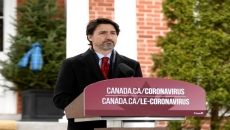
Prime Minister Justin Trudeau said Thursday, to reporters after an online UN conference, that Canada's independent judicial system "rendered a judgment without any political interference." He noted Meng would "undoubtedly avail herself of" further legal moves to fight the extradition request.
The Meng dispute — which has plunged Sino-Canadian relations to an all-time low — did not dissuade Canada from signing on to the statement that criticizes China for imposing a national-security law on Hong Kong.
The Chinese territory is supposed to have autonomy under a "one country-two systems" agreement. The statement said the law is "in direct conflict" with China's "international obligations under the principles of the legally binding" agreement that saw Britain hand over its administration of Hong Kong to China on July 1, 1997.
"Hong Kong has flourished as a bastion of freedom. The international community has a significant and longstanding stake in Hong Kong's prosperity and stability," the statement said.
"Direct imposition of national-security legislation on Hong Kong by the Beijing authorities ... would curtail the Hong Kong people's liberties, and in doing so, dramatically erode the autonomy and the system that made it so prosperous."
UN Secretary-General Antonio Guterres wouldn't say if the security law violated the agreement between China and Britain when asked about it during a virtual press conference with Trudeau on Thursday afternoon.
The sharp criticism comes as the Trudeau government has been dealing with its own China crisis since December 2018.
Michael Kovrig, an ex-diplomat working for the International Crisis Group, and Michael Spavor, an entrepreneur who did business in North Korea, have been in Chinese prisons with no access to lawyers or their families since they were detained nine days after Meng's arrest by the RCMP on Dec. 1, 2018.
They are accused of violating China's national security interests, and they have been denied regular monthly visits by Canadian diplomats since January because of COVID-19 restrictions on Chinese prisons.
"We will continue to advocate for the two Canadians arbitrarily detained in China and I take this opportunity to thank the international community for standing by so strongly with Canada in this situation," Trudeau said.
Some analysts say their treatment could get a lot worse, especially based on Chinese government statements leading up to the ruling.
"The PRC authorities' statement of consequences of 'continuous harm' to Canada if Ms. Meng is not returned to China forthwith suggests that there will be further retaliation," said Charles Burton, a China expert with the Macdonald-Laurier Institute, who has been a diplomat in Beijing.
"I am concerned that Kovrig and Spavor may be forced to make false confessions on Chinese TV followed by a sham secret trial and possible sentences of death, usually suspended for two years before commutation to life imprisonment."
David Mulroney, the Canadian ambassador to China between 2009 and 2012, said China is furious over the Meng case.
"Unfortunately, two innocent Canadians, Michael Spavor and Michael Kovrig, will bear the brunt of that anger. It is likely that the detentions will be extended until China has some clarity as to Ms. Meng's eventual fate. Unfortunately, that could take some time," said Mulroney.
"China will also seek to lash out at Canada."
Fen Hampson, a global security expert with the Norman Paterson School of International Affairs at Carleton University, said Canada should rethink whether it needs to intervene politically to end the case rather than let it play out in the courts for years.
"You've got two Canadians who are in jail under fairly perilous circumstance, given COVID-19, and broader considerations at play in terms of Canada's trade and investment relations with China," said Hampson.
"Whatever happens, it will end up on the desk of the justice minister — he's the one who has to decide whether she gets extradited or not. In some ways, you're delaying the inevitable. The government is still going to have to make that decision."
The roots of Canada's current problems with China predate the Meng-Kovrig-Spavor affairs, said Wendy Dobson, an author and China expert who is co-director of the Institute for International Business at the University of Toronto's Rotman School of Management.
The government's current preoccupation with "diversifying" its trade relations with other Asian countries reflects a long-standing inability to do just that, she said.
"We've been saying this to ourselves for years, but we haven't gotten very far," Dobson said.
"We have not done a very good job of educating Canadians and deepening their understanding of who this partner is, where this partner comes from, and how to contribute in a way that is useful to both of us in the long term."
The president of Canada Hong Kong Link said her group and others planned to launch a comprehensive lobbying and educational effort aimed at different parties, and especially members of key Commons and Senate committees to influence Canada's foreign policy towards China.
Gloria Fung said a minority Parliament gives her group and other greater leverage to affect change.
"It is very important for Canadian voters, civil society, to realize the kind of power we have towards our government," she said. "I think, so far, the Liberal government has been very weak, as far as the foreign policy towards China is concerned."