Wednesday, December 31, 2025
ADVT 
National

Canada, allies launch Arctic military exercise

Darpan News Desk The Canadian Press, 04 Aug, 2020 07:58 PM
  • Canada, allies launch Arctic military exercise

Canada and some of its closest allies have kicked off a three-week naval exercise in the Arctic that aims to send a message of unity against potential adversaries in the North without spreading COVID-19 to local communities.

The training exercise known as Operation Nanook has been a mainstay for the Canadian Armed Forces since 2007 but this is the first year that the U.S., France and Denmark will all be participating as well.

Canadian and U.S. naval officers told reporters during a briefing Tuesday that the involvement of those other nations reflected the importance of co-operation among allies when it comes to military operations in an increasingly important part of the world.

Western countries as well as potential adversaries such as Russia and China have been steadily expanding their military footprints and activities in the region as climate change makes it easier to reach and operate in, raising concerns about the threat of a conflict.

"The message is the Arctic is strategically important, it's becoming increasingly important and it's important for our collective national security," said Vice-Admiral Steven Poulin, commander of the U.S. Coast Guard's Atlantic area.

"And I think the participation is a reflection of a mutual commitment by the partners and allied nations to share goals to that end."

Yet this year's iteration of Operation Nanook is also smaller than past versions, which have included personnel and equipment from across the Canadian military, particularly the Canadian Rangers, as well as other federal departments.

Rear Admiral Brian Santarpia, commander of the Royal Canadian Navy's Maritime Forces Atlantic, said this year's exercise will not include any land-based forces and focus almost exclusively on naval operations because of concerns about spreading COVID-19.

"Much of Nanook we decided not to conduct this year because we didn't want to be a vector into our own remote populations, where they're quite protected from COVID now just by that very fact of being remote," Santarpia said.

The three Canadian navy ships and four foreign vessels participating will not make any stops in Canada's Far North. Their only port call will be to Nuuk, Greenland, to refuel. Sailors will not be allowed off their ships.

Canada's three territories have been largely spared from any COVID-19 outbreak, with only a handful of positive cases reported.

The Canadian and allied warships will focus most of their activities in the Davis Strait between Baffin Island and Greenland, which is considered part of the Northwest Passage.

Canada and the U.S. have been at odds for decades over whether the passage is Canadian or international waters, a question Santarpia, Poulin and Vice-Admiral Andrew Lewis, commander of the U.S. 2nd Fleet, studiously avoided.

"It's a complex issue that involves more lawyers than naval officers and it has a lot to do with interpretations of international law," Santarpia said.

"This exercise is really designed to let us work better together than we already do and we'll let the lawyers worry about the rest of it."
MORE National ARTICLES

Trudeau says wage-subsidy program to be extended as steep job losses continue

Trudeau says wage-subsidy program to be extended as steep job losses continue
Prime Minister Justin Trudeau says the federal government's emergency wage-subsidy program will be extended beyond its early-June endpoint. The program covers 75 per cent of worker pay up to $847 a week to try to help employers keep employees on the job in the face of steep declines in revenue due to the COVID-19 pandemic.

Trudeau says wage-subsidy program to be extended as steep job losses continue

Huge job losses in B.C. indicate a 'hard road ahead': finance minister

Huge job losses in B.C. indicate a 'hard road ahead': finance minister
British Columbia Finance Minister Carole James says she doesn't want to sugar coat what will be a hard road ahead as labour force figures show the province lost a quarter of a million jobs in April. Combined with jobless figures in March, almost 400,000 people were unemployed.

Huge job losses in B.C. indicate a 'hard road ahead': finance minister

Canadians trust doctors, scientists and government more since pandemic began

Canadians trust doctors, scientists and government more since pandemic began
A new survey suggests the COVID-19 pandemic has given Canadians almost absolute trust in doctors. The Proof Strategies annual trust index is usually completed in January but when Canada went into a nationwide lockdown to slow the spread of the novel coronavirus the public-relations firm decided to ask the same questions again in early May.    

Canadians trust doctors, scientists and government more since pandemic began

Greyhound Canada to shut down temporarily all bus routes as ridership plunges

Greyhound Canada to shut down temporarily all bus routes as ridership plunges
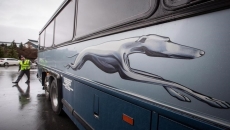
Greyhound Canada is temporarily slamming the brakes on all of its bus routes and services as ridership plummets amid the COVID-19 pandemic. The transportation company says starting May 13 it will halt all routes until passenger demand recovers. 

Greyhound Canada to shut down temporarily all bus routes as ridership plunges

Canadian Forces still unsure how to raise helicopter that crashed

Canadian Forces still unsure how to raise helicopter that crashed
The Canadian military is still determining how to raise the wreckage of a military helicopter that crashed into the Mediterranean Sea last week, Defence Minister Harjit Sajjan said Thursday. The crash killed six members of the Canadian Forces, though the remains of only one, Sub-Lt. Abbigail Cowbrough, have been recovered.

Canadian Forces still unsure how to raise helicopter that crashed

Feds to partly cover 'top ups' for front-line workers on minimum wage

Feds to partly cover 'top ups' for front-line workers on minimum wage
Prime Minister Justin Trudeau says the federal government, provinces and territories will spend $4 billion to increase the wages of essential workers in the COVID-19 pandemic. He says the details are still to be finalized with some provinces.  

Feds to partly cover 'top ups' for front-line workers on minimum wage