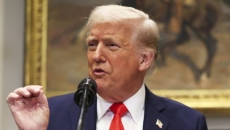
As U.S. President Donald Trump continues to cast doubt on the future of the NATO military alliance, Canada is looking to partner with the European Union on defence.
Here's a closer look at what's driving this major shift in transatlantic relations.
What problem is Europe trying to solve?
Trump has said that Washington won't necessarily defend NATO allies — a threat that undermines the entire point of the alliance, said defence policy analyst Federico Santopinto.
"Europeans feel very vulnerable without the United States," said Santopinto, a senior researcher at the Paris-based French Institute for International and Strategic Affairs.
He said Russia's invasion of Ukraine revealed just how much the continent had come to depend on American defence spending.
While European nations have spent roughly the same as the U.S. on military aid for Kyiv, Washington has provided Ukraine with indispensable intelligence and surveillance and reconnaissance equipment that Europe lacks.
When the U.S. and Germany — alarmed by the prospect of direct conflict with Moscow — prevented Ukraine from using American and German weapons to hit targets deep within Russia, many EU nations saw how their own hands might be tied if they needed to use donated gear in some future conflict.
"The war in Ukraine taught everybody that when you wage war, you need to be sovereign over the weapons you have," Santopinto said.
In addition, much of Europe's defence market is fragmented. Many EU nations own military equipment that isn't interoperable, leaving capacity gaps across the continent, particularly in air defence.
The EU does not have an army but it can help to structure the continent's military industries.
How is Canada involved?
Canadian officials have sought to reduce their reliance on American gear — particularly since Trump mused in March about selling allies "toned-down" versions of fighter planes with fewer capabilities than U.S. aircraft.
For more than a year, Canada and the EU have been in talks about a possible "security and defence partnership."
Brussels has signed such deals with Japan and South Korea, but they largely focused on joint naval exercises. The deal with Canada would involve defence procurement, according to officials on both sides of the Atlantic.
In a white paper released in March outlining the EU's approach to defence industries, the European Union said that "our co-operation with Canada has intensified and should be further enhanced … including on respective initiatives to boost defence industry production."
Christian Leuprecht, a political science professor at Queen's University and the Royal Military College, said both sides can build on the fact that "European companies already invest fairly heavily and extensively in Canada, including on defence."
What is the EU doing to boost defence?
In March, the European Commission unveiled ReArm Europe, a plan that would earmark up to the equivalent of C$1.25 trillion for defence over five years.
It's not a subsidy program but would provide loans and allow member states to take on more debt to spend on defence, without triggering the restrictions the EU imposes on members with excessive deficits.
Santopinto said EU countries determined to cut back spending due to the high cost of borrowing aren’t likely to take on more debt, ReArm notwithstanding.
Still, ReArm proposes a loan program worth about $235 billion to be called Security Action For Europe, or SAFE, which would allow countries to work with others outside the European Union to jointly buy or build arms.
The program is still being negotiated and might only allow such partnerships with countries that have signed security and defence agreements with the EU. Canada does not yet have such an agreement.
Prime Minister Mark Carney was elected on a platform that promised to advance "Canada's involvement in the ReArm Europe plan in support of transatlantic security."
Leuprecht said "even a fraction of that money" being spent on ReArm would be a lifeline for a Canadian economy struggling under the weight of American tariffs.
Foreign Affairs Minister Mélanie Joly said a month ago that she expects a defence deal with Europe "in the coming months." She said the deal could be very good for aerospace and artificial intelligence companies in Montreal and Davie Shipbuilding near Quebec City.
How do individual countries feel?
Reports have emerged in recent months of a split among EU members on how the SAFE loan program should function — and whether it could be used to make joint purchases with Canada and the U.K.
France has for years called for Europe to have "strategic autonomy" in defence. Santopinto said France — which has a large domestic weapons industry — has pushed for Europe to make most or all of its own military equipment.
France has tried to work around an American law that limits its exports of arms produced with certain U.S. parts.
Santopinto said Poland and nations like Estonia, Latvia and Lithuania — countries on Russia's doorstep — would prefer to see the U.S. continue to take an active role in Europe's defence.
Other EU nations, including Germany and the Netherlands, have indicated an openness to linking the EU's military supply chains with like-minded countries.
Separately, Germany and Norway have proposed partnering with Canada to procure new submarines — a project that would give Ottawa earlier access to the vessels and help it meet its NATO spending targets. Norway is not a member of the EU.
Why does Europe sign deals with other countries?
Santopinto said the EU wants to use the clout it enjoys due to the size of its market to set military procurement standards that would make it easier for European armies to work together.
"It’s a way for European Union to become a more strong actor in the field of armament" through "a new alternative of industrial defence policy to the domination of the United States," he said.
The EU has used its economic clout and population to set standards in other areas that have been adopted globally — such as the requirement that websites seek permission to gather personalized information.
Leuprecht said Canada can offer Europe a place to produce arms with much cheaper energy, and access to data centres required to run some military technology.
"It's an opportunity for Canada to contribute to deterrence, by strengthening those relationships with our European partners and (by) Russia knowing that Canada will be there for our European partners," he said.
Is Canada a good partner?
Ottawa's allies have for years pressed Canada to reach the NATO member defence spending guideline of two per cent of gross domestic product — a target Ottawa has not met since the alliance set it in 2006.
That pressure has been mounting since Russia launched its war on Ukraine — and particularly since Trump started suggesting the U.S. might not come to the defence of NATO allies that don't meet the target.
Fearing that territorial gains in Ukraine will embolden Moscow to invade countries like Latvia — where Canadian troops are serving as part of a deterrence mission — European countries are already debating increasing the NATO spending target to 2.5 or three per cent.
EU officials frequently say Canada is among their closest partners and has shared values. Ottawa is already party to EU programs like PESCO that allow for some defence-industry collaboration.
But Leuprecht pointed out that European leaders have stayed largely quiet about Trump's talk of annexing Canada.
"The stunning silence … tells you a whole lot about the view of Europeans with regards to Canada's reliability," he said.
Leuprecht blames that silence on what he considers Canada's insufficient defence spending and its failure to export energy like liquefied natural gas across the Atlantic. He said he suspects this is why one-third of EU states still haven't fully ratified the bloc's trade deal with Canada.
Canada's economy is about as large as Russia's, he said, but Moscow is much more effective at advancing its strategic goals.
"There is a widespread belief in Europe that Canada has not been a reliable and reputable partner when Europe has needed Canada," Leuprecht said, adding it would be harder for Canada to miss defence spending targets when they're set with another country.
"Here is an opportunity for Canada to demonstrate to Europe that we are prepared to be the reliable partner that we have been in the past."
Are Europeans looking to leave NATO?
Not according to the latest official joint report on EU-Canada relations, published last month.
"Canada and the EU recognize NATO as the primary collective defence organization for members of the alliance, and continue to encourage increased co-operation between the EU and NATO to further benefit from the experience and expertise of each organization," reads the government report.
Leuprecht said the EU's white paper is aimed at complementing NATO so that Europe meets U.S. demands to do more without losing Washington's security guarantee. That arrangement is in Canada's interest, he said.
"If the European Union goes it alone, Canada's value to Europe will decline precipitously," he said, arguing this would probably leave Ottawa almost entirely reliant on Washington.
Santopinto said Europe wants Canada to help preserve NATO. "They could show that there is a democratic western front that is still existing, despite this strange and erratic attitude of the United States," he said.
All of these matters are expected to be on the agenda at the NATO summit in June, which both Carney and Trump are expected to attend. "This might possibly be the single most important NATO summit ever," Leuprecht said.
Picture Courtesy: THE CANADIAN PRESS/Adrian Wyld