OTTAWA - Shock and horror turned to anger on Thursday as Canada and its allies responded to Russia’s invasion of Ukraine with a barrage of new sanctions targeting the Russian economy and its leaders that they hoped would avert an all-out war.
Yet after having already warned Russian President Vladimir Putin for weeks that such a punishment was coming if he attacked Ukraine, it remained even more uncertain what, if anything, short of an armed confrontation would force him to reverse course.
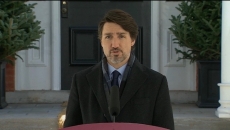
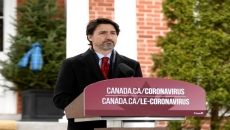
Prime Minister Justin Trudeau accused Putin of sparking the greatest threat to European stability since the Second World War. He said the invasion of Ukraine represented an attack on democracy, international law, human rights and freedom.
"Russia’s actions stand in direct opposition to the democratic principles that generations of Canadians have fought to protect," Trudeau said.
"Democracies and democratic leaders everywhere must come together to defend these principles and stand firmly against authoritarianism."
The invasion was preceded by a Russian military buildup around Ukraine followed by weeks of dialogue and warnings from Trudeau, U.S. President Joe Biden and European leaders about devastating sanctions if Putin ordered an attack.
As Russian paratroopers reportedly took control of an airport only kilometres from the Ukrainian capital Kyiv and more Russian troops poured into the country after a barrage of early-morning missiles hit sites across Ukraine, the sanctions were unveiled.
Fifty-eight people and entities connected to Russia, including key political leaders, oligarchs and their families, as well as the paramilitary organization known as the Wagner Group are being sanctioned by Canada, along with several major Russian banks.
Also on the list are members of the Russian Security Council, including key cabinet ministers close to Putin.
Canada is also cancelling existing export permits for Russia. Foreign Affairs Minister Mélanie Joly, who earlier summoned Russia's ambassador for a dressing down at Global Affairs Canada, estimated the permits amounted to $700 million in trade.
"They will impose severe costs on complicit Russian elites, and they will limit President Putin's ability to continue funding this unjustified invasion," said Trudeau, after meeting G7 leaders.
Trudeau joined Biden and European leaders who also moved to strangle Russia's financial ability to wage war while punishing Putin and his inner circle.
Trudeau's office said he spoke by phone with President Volodymyr Zelenskyy to offer Canada's support and said the Ukrainian leader welcomed the arrival of two shipments of lethal military aid.
But one Canadian international affairs expert said Canada and its allies failed Ukraine by not doing enough to prevent what has now unfolded.
"I don't think more sanctions will stop Putin. He's made his decision how far he will go," Michael Bociurkiw said in an interview from the western Ukrainian city of Lviv.
He is a Canadian who formerly served as the spokesman for the Organization for Security and Co-operation in Europe during the height of tensions following Russia's annexation of Ukraine's Crimean Peninsula in 2014.
"Zelenskyy and his team have been begging and begging and begging the West for crippling sanctions to happen before an invasion. The West did not listen to that. Their response was actually quite weak, especially the White House one. So now we have what we have."
The Ukrainian Canadian Congress, which represents 1.3 million Canadians of Ukrainian descent, called for Russia to be tossed from the banking system as part of "devastating" economic sanctions.
"Ukraine needs weapons with which to defend itself right now," UCC executive director Ihor Michalchyshyn added in a statement. "Most importantly they need anti-air systems like Stinger missiles and other air defence and naval defence systems."
Deputy Prime Minister Chrystia Freeland, who is of Ukrainian descent, spoke directly to Ukrainians and Russians in their own languages.
"Ukraine is not yet dead," Freeland said in Ukrainian before switching to Russian and saying: "Our quarrel is not with the Russian people — it is with President Putin and those around him who have made the choice to threaten a sovereign democracy."
Andrii Bukvych, the Ukrainian chargé d’affaires to Canada, urged the severing of diplomatic relations with Russia and for NATO to enforce a no-fly zone over his country to prevent Russian aerial bombardments.
"We do understand there is a high toll that the free world economy of Western economies will pay for deterring Russia, for supporting Ukraine," the Ukrainian envoy added.
"But I believe that this toll is still much more less than having World War Three, which will inevitably take place unless Putin will be stopped in Ukraine.”
Yet despite the stakes and unity, Canada and NATO have made clear they have no plan to send troops into Ukraine to fight Russia. They have instead reinforced the military alliance’s presence in eastern Europe in case the conflict expands beyond Ukraine.
In the most serious moment of his tenure in the White House thus far, Biden insisted Thursday that the world was united in its opposition to Putin and his "naked aggression" as he detailed further sanctions.
Biden said that while American forces have been deployed to backstop NATO forces in the area, the U.S. would not be sending troops to confront Putin's armies directly.
"I want to be clear: the United States is not doing this alone," he said, describing a broad coalition of international partners comprising well over half of the global economy, including Canada.
He also acknowledged the potential economic impact on the U.S., which is already reeling from inflationary pressures and supply chain disruptions brought on by the COVID-19 pandemic, but underscored the importance of everyone hardening their resolve.
"I know this is hard, and that Americans are already hurting. I will do everything in my power to limit the pain the American people are feeling at the gas pump," he said.
"But this aggression cannot go unanswered. If it did, the consequences for America would be much worse. America stands up to bullies. We stand up for freedom. This is who we are."
Defence Minister Anita Anand said 3,400 Canadian Armed Forces members are being put on standby in case they need to deploy in a hurry. Those forces are on top of the 460 additional troops promised to NATO operations in Europe earlier this week.
Meanwhile, Trudeau announced Canada has arranged for the safe passage of any Canadian citizens, permanent residents and their families still in Ukraine through land borders with Poland, Slovakia, Hungary, Romania and Moldova.
The federal government will be prioritizing immigration applications for Ukrainians who want to come to Canada and is launching a dedicated telephone line for anyone who has any urgent questions about emigrating from Ukraine, he added.
In a rare show of unity, political leaders across Canada set aside their differences to condemn Putin's actions and voice support for Ukraine, including interim Conservative leader Candice Bergen, NDP Leader Jagmeet Singh and Ontario Premier Doug Ford.
"Putin's contemptible aggression and invasion of Ukraine is unacceptable," Bergen said in a statement. "His attack on the Ukrainian people and their democratically elected government is despicable."
Singh called on the government to immediately impose severe economic sanctions "where it hurts Putin the most," including by targeting Russian oligarchs who support him and kicking Russia from the global banking system.